New York, NY – December 1, 2025 – U.S. Treasury yields have experienced a significant climb today, marking a pivotal moment for financial markets. This ascent, driven by a complex interplay of global monetary policy shifts, persistent inflation concerns, and the ever-growing specter of increased government borrowing, has sent immediate ripple effects across Wall Street. The benchmark 10-year Treasury note yield, a crucial indicator for borrowing costs worldwide, rose notably, signaling a repricing of risk and a re-evaluation of future economic expectations.
The immediate implications are clear: a broad sell-off in equities, particularly impacting growth-oriented sectors and smaller capitalization companies, as higher yields make fixed-income investments more attractive. This shift underscores a broader market recalibration, prompting investors to scrutinize company valuations and the sustainability of corporate debt in an environment where the cost of money is no longer historically cheap.
The Forces Behind the Yield Climb: A Confluence of Global and Domestic Pressures
The recent surge in Treasury yields on December 1, 2025, is not an isolated event but rather the culmination of several powerful economic forces. A primary catalyst was a notable sell-off in global bond markets, particularly in Japan, where hints from the Bank of Japan regarding a potential interest rate hike spurred Japanese investors to retain capital in local bonds, reducing their appetite for U.S. Treasuries and creating a ripple effect internationally. Simultaneously, a substantial wave of new corporate bond offerings, including a significant issuance from pharmaceutical giant Merck & Co (NYSE: MRK), absorbed market liquidity, contributing to the upward pressure on yields.
Domestically, lingering inflation concerns continue to fuel the "higher for longer" interest rate narrative. Despite a high probability of a Federal Reserve rate cut in December, underlying inflationary pressures, partly exacerbated by tariffs contributing to rising input costs, remain a key driver for long-term yields. Furthermore, the burgeoning U.S. national debt and the government's consistent need to issue more debt to finance expenditures, potentially including future tax rate cuts, consistently exert upward pressure on long-term yields. A significant portion of the recent increase, particularly at the longer end of the curve, is attributed to a rise in the term premium – the additional compensation investors demand for holding long-term government bonds due to uncertainty surrounding future interest rate policy and increased Treasury supply.
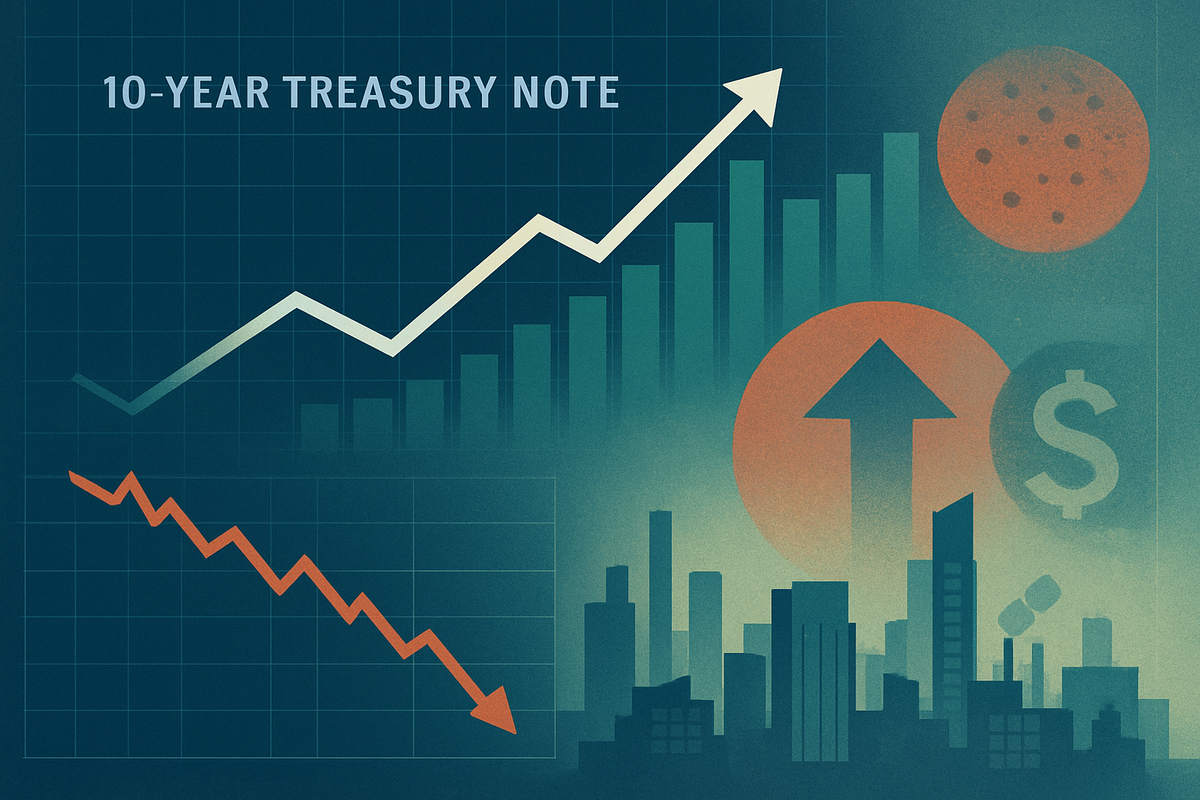
On December 1, 2025, the benchmark 10-year Treasury note yield climbed by nearly 7 basis points (bps) to approximately 4.08% to 4.09%, reaching its highest level in about two weeks. The 2-year Treasury note yield saw a smaller increase, rising less than a basis point to 3.497%, while the 30-year Treasury bond yield climbed by 3 basis points to 4.702%. This upward movement triggered an immediate reaction in equity markets, with the S&P 500 losing 0.5%, the Dow Jones Industrial Average dropping 0.9%, and the Nasdaq Composite falling 0.4%, breaking a five-day winning streak. The cryptocurrency market also experienced a sharp sell-off, with Bitcoin tumbling below $86,000. Interestingly, market pricing still indicated a high probability of a 25 basis point rate cut by the Federal Reserve at its upcoming December meeting, influenced by softer economic data such as the ISM Manufacturing PMI showing a contraction for the ninth consecutive month in November, creating a complex and somewhat contradictory market signal.
Winners and Losers: Navigating the High-Yield Environment
The sustained climb in Treasury yields reshapes the landscape for public companies, creating distinct winners and losers across various sectors. The primary mechanism is the increased cost of borrowing, as Treasury yields serve as a benchmark for corporate loans and other forms of financing. This directly impacts profitability by increasing interest expenses and compresses valuations, particularly for companies with significant future earnings potential, as higher discount rates reduce the present value of those future cash flows.
Companies and Sectors Likely to Face Headwinds:
- Real Estate (and related industries): This sector is highly sensitive to rising rates. Higher Treasury yields translate directly to higher mortgage rates and commercial loan rates, increasing borrowing costs for homebuyers and developers. This dampens demand, reduces affordability, and can put downward pressure on property prices. Real Estate Investment Trusts (REITs) like Public Storage (NYSE: PSA) and Simon Property Group (NYSE: SPG) could face headwinds due to higher debt servicing costs and potentially lower property valuations. Homebuilders such as D.R. Horton (NYSE: DHI) may see reduced demand.
- Utilities Sector: Capital-intensive utilities, which often carry significant debt to finance infrastructure projects, will see their borrowing costs rise, potentially eroding profit margins. Additionally, their dividend yields become less attractive compared to safer, higher-yielding fixed-income alternatives. Companies like NextEra Energy (NYSE: NEE) and Duke Energy (NYSE: DUK) may face increased financing costs for their extensive investments.
- High-Growth, Highly Leveraged, and Long-Duration Companies (especially in Technology and Consumer Discretionary): Companies that rely heavily on future earnings growth and often carry substantial debt to fund expansion are particularly vulnerable. The increased discount rate severely impacts the present value of their far-off projected cash flows, leading to valuation compression. While large, cash-rich tech companies like Apple (NASDAQ: AAPL) and Microsoft (NASDAQ: MSFT) may be more resilient, smaller, unprofitable, or highly leveraged growth tech companies could struggle. Consumer discretionary companies like Tesla (NASDAQ: TSLA) could see demand impacted by higher auto loan rates, and Starbucks (NASDAQ: SBUX) might face reduced discretionary spending.
Companies and Sectors Positioned to Benefit or Show Resilience:
- Financial Sector (Banks, Insurance, Brokerages): Banks often benefit from rising interest rates as they can expand their net interest margins (NIM) by charging more on loans while deposit rates rise more slowly. Insurance companies also tend to flourish as their investment portfolios, heavily weighted in bonds, generate higher returns. Large banks like JPMorgan Chase (NYSE: JPM) and Bank of America (NYSE: BAC) are often cited as beneficiaries. Brokerage firms such as Charles Schwab (NYSE: SCHW) also see profits expand as they earn higher yields on client cash.
- Companies with Strong Balance Sheets and Low Debt: Businesses with minimal debt or significant cash reserves are better positioned to weather rising interest rates. They face lower interest expenses and may even be able to acquire struggling competitors at a discount.
- Value Stocks and Cyclical Industries (when accompanied by economic growth): If rising yields are driven by strong economic growth rather than just inflation fears, cyclical industries that perform well during economic expansions tend to outperform. Value stocks, with more immediate earnings, are generally less sensitive to future growth discounting. Sectors like Industrials, Energy, and Materials can benefit from an improving economy.
- Consumer Staples and Healthcare: These sectors are often considered defensive, as demand for their products and services tends to remain stable regardless of economic conditions. Companies like McKesson (NYSE: MCK) in healthcare or Lamb Weston (NYSE: LW) in consumer staples often show resilience due to consistent demand for essential goods and services.
Broader Implications: A Shifting Economic Paradigm
The sustained climb in Treasury yields signifies a fundamental repricing of risk and expectations within the broader economy, extending its influence far beyond individual company balance sheets. This event fits into a broader trend of recalibrating global financial conditions away from the ultra-low interest rate environment that characterized much of the past decade. It signals a potential return to more normalized, albeit higher, borrowing costs across the entire economic spectrum.
The ripple effects are extensive. For consumers, higher yields mean increased costs for mortgages, auto loans, and credit cards, potentially dampening discretionary spending and slowing down sectors like housing and automotive. For the federal government, the cost of servicing its burgeoning national debt rises significantly, potentially consuming a larger portion of the national budget and exacerbating concerns about fiscal sustainability. This increased fiscal burden can also lead to a higher term premium, as investors demand greater compensation for holding long-dated government debt amidst fiscal uncertainty.
Regulatory and policy implications are also profound. The Federal Reserve, already navigating a delicate balance between inflation control and employment goals, faces increased pressure. If rising yields are a result of persistent inflation, the Fed might be compelled to maintain higher rates or even raise them further, despite potential economic slowdowns. Conversely, if yields rise unexpectedly amidst economic weakening, the Fed might consider interventions like balance sheet adjustments. Policy decisions, such as the imposition of tariffs, can also directly influence Treasury yields by raising concerns about higher inflation and weaker economic growth, adding complexity to the Fed's decision-making. Historically, the current environment draws comparisons to periods like the 1960s and 1970s, characterized by inflationary pressures driving higher rates, and the 2013 "Taper Tantrum," where shifts in U.S. monetary policy caused significant global market volatility. However, experts note a unique aspect in late 2025: long-term yields have risen even as economic data has weakened and the Fed has been cutting its target policy rate, suggesting a potential "fiscal risk premium" driven by large deficits.
What Comes Next: Navigating Uncertainty and Adapting Strategies
The path forward for Treasury yields remains fraught with uncertainty, demanding strategic pivots from both businesses and investors in the short and long term. In the immediate future (late 2025 - early 2026), volatility is expected to persist, primarily driven by the Federal Reserve's policy decisions regarding further rate cuts, inflation trends, and labor market developments. While expectations lean towards additional Fed easing in response to a softening labor market, the persistence of inflation and substantial federal spending could keep yields elevated. The yield curve, having normalized from inversion, remains relatively flat, hinting at investor skepticism about long-term economic prospects.
Looking further ahead (2026 and beyond), two primary scenarios emerge. One possibility is a gradual decline in yields, contingent on sustained moderating inflation and continued Fed rate cuts, potentially bringing the 10-year Treasury yield to around 4% or even lower. The alternative, and increasingly discussed, is a "higher for longer" environment, where substantial sovereign debt supply, sticky inflation (possibly exacerbated by tariffs), and an expanding term premium push long-term yields towards 5% or even 6%. A less probable, but significant, "nonlinear" risk involves growing political pressure on the Fed to potentially suppress long-maturity yields through unconventional policies.
For businesses, strategic adaptation is paramount. This includes optimizing debt structures to mitigate interest rate risk, emphasizing robust cash flow management, re-evaluating product and service portfolios to meet evolving market demands, and investing in cost efficiency and innovation. Supply chain resilience is also crucial given the impact of tariffs. Investors, meanwhile, must reconsider traditional portfolio diversification. In fixed income, this means managing duration, diversifying beyond traditional Treasuries into investment-grade corporate and municipal bonds, and exploring alternative assets like commodities and private equity. In equities, a defensive tilt towards healthcare and consumer staples, a focus on quality companies with strong balance sheets, and increased international exposure could prove beneficial. Opportunities may arise from attractive income in fixed income and potential capital appreciation if economic growth slows, while challenges include market volatility, erosion of bond prices, and persistent fiscal concerns.
A New Era of Financial Prudence: The Road Ahead
The climb in Treasury yields today serves as a stark reminder of the dynamic and interconnected nature of global financial markets. It underscores a significant shift from an era of historically low interest rates to one where the cost of capital is becoming a more prominent factor in economic decision-making. The immediate implications for Wall Street, characterized by equity market declines and a re-evaluation of risk, highlight the sensitivity of asset valuations to borrowing costs and inflation expectations.
Moving forward, investors should anticipate continued volatility as the market digests evolving monetary policy, persistent inflationary pressures, and the sheer volume of government debt. The divergence between short-term rate cut expectations and stubbornly high long-term yields suggests a complex tug-of-war between a softening labor market and underlying economic imbalances. Companies will need to prioritize financial prudence, balance sheet strength, and operational efficiency to navigate this new environment. Investors, in turn, will benefit from diversified portfolios, a focus on quality assets, and a keen eye on macroeconomic indicators, particularly inflation data, Federal Reserve communications, and the trajectory of government spending. The lasting impact of this yield surge could be a sustained period of higher capital costs, demanding a more disciplined approach to investment and corporate strategy across the board.
This content is intended for informational purposes only and is not financial advice