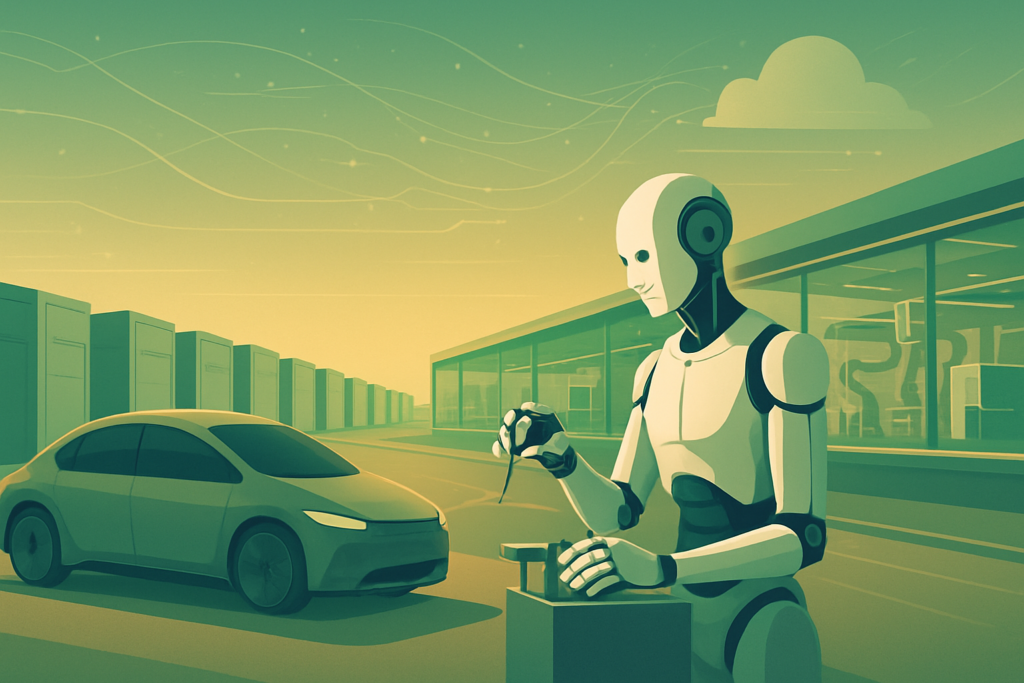
As of April 2, 2026, Tesla, Inc. (NASDAQ: TSLA) stands at the most significant crossroads in its two-decade history. Once defined solely as the disruptor of the internal combustion engine, the company has spent the last 24 months undergoing a radical metamorphosis. The Tesla of 2026 is no longer just an automotive manufacturer; it is an AI and robotics conglomerate that happens to sell electric vehicles (EVs).
With the recent retirement of the flagship Model S and Model X lines to make room for humanoid robot production, and the official start of "Cybercab" mass production this month, Tesla is betting its $700 billion+ market capitalization on the successful commercialization of "Physical AI." This deep dive examines whether Tesla’s pivot from a high-volume carmaker to a specialized AI enterprise justifies its premium valuation in a market where global EV leadership has shifted.
Historical Background
Founded in 2003 by Martin Eberhard and Marc Tarpenning, and led into the mainstream by Elon Musk, Tesla’s journey began with the "Secret Master Plan": build a sports car, use that money to build an affordable car, then use that money to build an even more affordable car. The company survived a near-bankruptcy in 2008 and "production hell" with the Model 3 in 2018, eventually reaching a trillion-dollar valuation in 2021.
However, the 2023-2025 period forced a tactical retreat. Facing intense competition from Chinese manufacturers and a cooling global appetite for high-priced EVs, Tesla transitioned from its "3 million cars per year" ambition to a focused strategy on Autonomy and Robotics. The decommissioning of the Fremont Model S/X lines in January 2026 marked the symbolic end of Tesla’s first chapter as a traditional luxury automaker.
Business Model
Tesla’s revenue streams have diversified significantly over the last three years:
- Automotive (Hardware and Software): While vehicle sales still account for the majority of revenue, the mix has shifted toward software-heavy margins. FSD (Full Self-Driving) subscriptions and the nascent "Tesla Network" ride-hailing fees are becoming core components of the automotive segment.
- Energy Generation and Storage: This is the fastest-growing segment. Through the Megapack and the newly launched "Megablock" for utility-scale applications, Tesla provides the infrastructure for the global renewable transition.
- Services and Other: This includes supercharging (now a global standard), insurance, and the newly launched industrial sales of the Optimus humanoid robot.
- AI as a Service (Future): With the Dojo supercomputer and "Cortex" AI cluster, Tesla is positioning itself to eventually license its FSD stack to legacy OEMs, though no major licensing deals have been finalized as of early 2026.
Stock Performance Overview
Tesla’s stock remains one of the most volatile and debated assets in the S&P 500.
- 10-Year Performance: Investors who held since 2016 have seen gains exceeding 1,200%, outperforming almost every major industrial and tech peer.
- 5-Year Performance: The stock saw a massive peak in 2021, followed by a significant correction in 2022 and 2024 as margins compressed due to price wars.
- 1-Year Performance: Over the past 12 months, the stock has rebounded by approximately 22% from its early 2025 lows. This recovery is driven not by vehicle delivery growth—which has flattened—but by the successful pilot of the unsupervised Robotaxi in Austin and the scaling of the Energy business.
Financial Performance
The fiscal year 2025 was a "reset" year for Tesla. Revenue dipped 3% to $94.8 billion as the company sacrificed volume to maintain price floors. However, Q4 2025 showed a recovery in consolidated gross margins to 20.1%, thanks to falling battery costs and high-margin energy deployments.
The headline for 2026 is Tesla’s aggressive $20 billion+ Capital Expenditure plan. This is a record high, dedicated to building the "unboxed" manufacturing lines for the Cybercab and mass-producing Optimus Gen 3. While Tesla maintains a robust $44 billion cash cushion, some analysts warn that free cash flow could turn negative in 2026 for the first time since 2018, representing a "high-stakes bet" on the AI pivot.
Leadership and Management
Elon Musk remains the central figure, though his role has evolved. His 2025-2026 involvement in the U.S. Department of Government Efficiency (DOGE) has been a double-edged sword. Supporters argue it provides Tesla with a seat at the table for federal autonomous vehicle (AV) framework discussions; critics cite massive "key-man risk" and potential conflicts of interest that could trigger regulatory backlash.
The board, led by Robyn Denholm, continues to face scrutiny regarding its independence, particularly following the 2024-2025 legal battles over Musk’s compensation package. However, the operational leadership under figures like Tom Zhu (Automotive) has provided a stabilizing force during the AI transition.
Products, Services, and Innovations
- The Cybercab: Scheduled for mass production starting this month (April 2026), the Cybercab is a steering-wheel-less, "unboxed" vehicle designed specifically for Tesla’s autonomous ride-hailing network.
- Optimus Gen 3: Tesla’s humanoid robot has moved from a prototype to an industrial tool. As of early 2026, thousands of Optimus units are working within Tesla’s own Giga factories, with the first external shipments to third-party logistics firms commencing this quarter.
- Energy (The Megablock): In 2025, Tesla deployed 46.7 GWh of storage. The new "Megablock"—a 20 MWh pre-integrated unit—is designed to compete directly with traditional natural gas peaker plants.
- FSD v13: The latest iteration of Tesla's software has moved toward "end-to-end neural networks," significantly reducing disengagements and enabling the Austin unsupervised pilot.
Competitive Landscape
The landscape in 2026 is a "tale of two markets."
Globally, BYD (OTC: BYDDF) officially surpassed Tesla in 2025 as the world’s largest BEV seller (2.26M units vs Tesla’s 1.64M). BYD's vertical integration and low-cost dominance in Europe and Southeast Asia have challenged Tesla’s "mass market" dreams.
Conversely, in the United States, Tesla’s market share rebounded to 59% in late 2025. This occurred as legacy giants like Ford and General Motors scaled back their EV investments and pivoted back to hybrids, leaving Tesla as the only Western manufacturer capable of producing profitable, high-volume EVs and autonomous software.
Industry and Market Trends
The "EV Hype" of the early 2020s has been replaced by the "AI Infrastructure" era. Capital is no longer flowing toward companies that just build cars; it is flowing toward those that control the data and the compute. Tesla’s massive investment in H100/B200 GPU clusters and its proprietary Dojo chip places it in a unique category—it is an industrial user of AI that also builds the hardware.
Furthermore, the global shift toward "Grid Firming" (stabilizing renewable energy grids) has created a multi-decade tailwind for Tesla’s Megapack business, which currently enjoys higher margins than the automotive division.
Risks and Challenges
- Regulatory Scrutiny: As of March 2026, the NHTSA has upgraded its FSD probe to an "Engineering Analysis," the final step before a potential mandatory recall. Any adverse ruling regarding FSD safety would devastate the "Robotaxi" thesis.
- Free Cash Flow Pressure: The $20 billion CapEx cycle is immense. If the Cybercab ramp-up faces delays similar to the 2018 Model 3 "hell," Tesla could face a liquidity crunch.
- Geopolitical Risk: With a significant portion of its supply chain and production (Giga Shanghai) tied to China, Tesla remains vulnerable to escalating trade tensions or shifts in Chinese domestic policy favoring BYD and Xiaomi.
Opportunities and Catalysts
- Federal AV Framework: If Musk’s influence leads to a unified federal standard for autonomous driving, Tesla could bypass the state-by-state regulatory patchwork that currently hampers competitors like Waymo.
- FSD Licensing: A single licensing deal with a major legacy automaker (e.g., Ford or VW) would provide high-margin recurring revenue and validate Tesla’s software as the industry standard.
- Optimus Scaling: If Tesla can achieve its target production rate of 1,000 Optimus units per week by the end of 2026, it could create an entirely new multi-billion dollar robotics segment.
Investor Sentiment and Analyst Coverage
Wall Street remains deeply divided. "AI Bulls" (such as Ark Invest and Wedbush) view Tesla as a venture capital play within a public wrapper, valuing the company on the multi-trillion dollar potential of Robotaxis. "Fundamental Bears" (such as JPMorgan and several value-oriented hedge funds) point to the stagnating vehicle deliveries and high valuation multiples (P/E over 60x) as a sign of an overextended stock.
Retail sentiment remains fiercely loyal but increasingly focused on Musk’s political involvement and its impact on the brand’s consumer appeal in liberal demographics.
Regulatory, Policy, and Geopolitical Factors
The regulatory environment in 2026 is highly volatile. While the U.S. Inflation Reduction Act (IRA) continues to subsidize Tesla’s battery production, the European Union has implemented significant tariffs on Chinese-made EVs—a move that ironically helps Tesla’s Giga Berlin but hurts its Giga Shanghai exports.
The DOJ’s ongoing criminal investigation into Tesla’s Autopilot claims remains the "Sword of Damocles" over the company. Any formal charges of wire or securities fraud would likely trigger a leadership crisis and a sharp revaluation of the stock.
Conclusion
Tesla, Inc. in April 2026 is no longer the "car company" it once was. It has evolved into a high-stakes bet on the future of autonomous mobility and humanoid robotics. The company has successfully navigated the "EV plateau" by pivoting its resources toward the Cybercab and the Energy business, which now provides a high-margin floor to its financials.
Investors must weigh the visionary potential of Elon Musk’s AI-driven future against the very real risks of $20 billion in annual spending, stiff Chinese competition, and intensifying federal investigations. Whether Tesla is a "trillion-dollar AI titan" or an "overvalued automaker" depends entirely on the next 18 months of Cybercab and Optimus execution.
This content is intended for informational purposes only and is not financial advice.