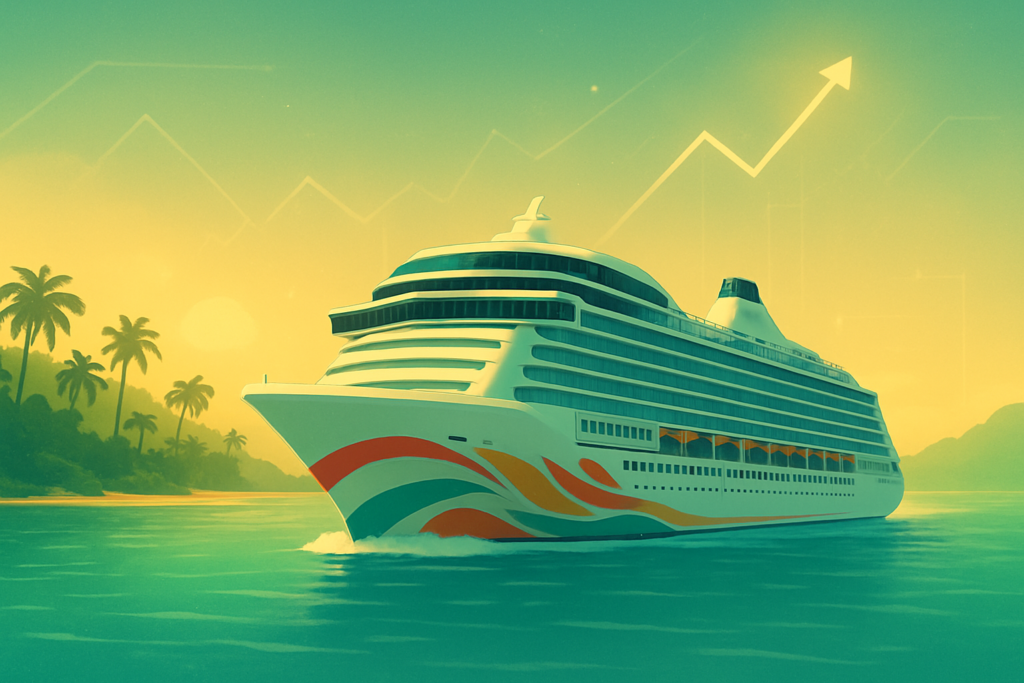
The cruise industry has long been the bellwether for global consumer discretionary spending, and as of February 17, 2026, all eyes are on Norwegian Cruise Line Holdings Ltd. (NYSE: NCLH). After a volatile half-decade defined by pandemic-era shutdowns and a subsequent "revenge travel" boom, NCLH has entered a transformative new chapter. A recent 6.26% rally in the stock price—triggered by a surprise leadership transition and a massive 17-ship expansion agreement—has signaled to Wall Street that the company is shifting its focus from mere survival to operational excellence. As NCLH navigates a landscape of record-breaking booking volumes and tightening environmental regulations, it remains a high-beta favorite for investors betting on the continued "Golden Age" of cruising.
Historical Background
The story of Norwegian Cruise Line (NCL) is one of industry-defining disruption. Founded in 1966 by Knut Kloster and Ted Arison, the company launched the first regularly scheduled Caribbean cruises from Miami with the M/S Sunward. By 1979, NCL had pioneered the "mega-ship" era with the purchase and $100 million conversion of the S/S France into the S/S Norway, then the world’s largest passenger ship.
The turn of the millennium brought NCL's most significant innovation: "Freestyle Cruising." Introduced in 2000, this concept dismantled the rigid traditions of assigned seating and formal dress codes, forcing the entire industry to adopt more flexible, guest-centric models. Following a 2013 IPO, the company underwent a massive structural shift in 2014 by acquiring Prestige Cruise Holdings for $3.025 billion. This move integrated the Oceania Cruises and Regent Seven Seas Cruises brands, creating the diversified powerhouse known today as Norwegian Cruise Line Holdings Ltd.
Business Model
NCLH operates a sophisticated "three-brand" strategy that covers the entire spectrum of the cruise market:
- Norwegian Cruise Line: The "contemporary" brand, targeting families and multi-generational travelers with a focus on innovation and freedom.
- Oceania Cruises: The "upper-premium" segment, catering to culinary enthusiasts and destination-focused travelers.
- Regent Seven Seas Cruises: The "ultra-luxury" pinnacle, offering all-inclusive experiences on smaller, high-end vessels.
The company generates revenue through two primary streams: Ticket Sales (roughly 65-70%) and Onboard Revenue (30-35%). Onboard spending—including casinos, specialty dining, shore excursions, and beverage packages—is a critical margin driver. Unlike its larger competitors, NCLH has traditionally focused on a "yield over volume" strategy, prioritizing higher per-passenger spending over total passenger count.
Stock Performance Overview
NCLH's stock performance over the last decade has been a rollercoaster of macro-economic extremes.
- 10-Year Horizon: In early 2016, NCLH traded near $55. By late 2019, it maintained a steady range of $45–$58.
- The COVID Crash: In March 2020, shares plummeted to a historic low of $7.03 as the global fleet was grounded.
- The Recovery (2023–2026): After lingering in the mid-teens for much of 2022, the stock began a sustained climb. As of mid-February 2026, shares are trading between $21.50 and $23.25. While still significantly below its 2015 all-time high of $63.76, the stock has shown resilience, outperforming broader travel indices during the recent February rally.
Financial Performance
Financial health remains the focal point for NCLH analysts. For the fiscal year 2025, NCLH reported record revenues of approximately $9.7 billion, with an updated full-year EPS guidance of $2.10.
- Margins: The company is aggressively targeting an Adjusted Operational EBITDA Margin of ~39% by the end of 2026.
- The Debt Burden: NCLH carries the heaviest debt load among the "Big Three" cruise lines relative to its size, with net debt sitting at $14.4 billion (a leverage ratio of ~5.4x).
- Valuation: Trading at roughly 10-11x forward earnings, NCLH is often viewed as a "value" play with high leverage, making it highly sensitive to interest rate fluctuations.
Leadership and Management
On February 12, 2026, NCLH shocked the market by announcing that John W. Chidsey would replace Harry Sommer as CEO. Chidsey, the former head of Subway and Burger King, is known for his "operational rigor" and history of successful corporate turnarounds. The board, chaired by Stella David, signaled that this move is intended to accelerate deleveraging and improve operational efficiency, which has lagged behind Royal Caribbean (NYSE: RCL). Chidsey’s background in high-margin, asset-intensive hospitality is seen as a strategic fit for NCLH’s next phase of debt reduction.
Products, Services, and Innovations
Innovation is the engine of NCLH’s competitive edge. In 2026, the company is rolling out the "Prima Plus" class, with the Norwegian Luna scheduled for an April debut. These ships offer more outdoor space, higher staff-to-guest ratios, and expanded "Haven" luxury enclaves.
On the luxury side, the Seven Seas Prestige is set to launch in December 2026, marking the first of a new class of ultra-luxury vessels. Furthermore, NCLH is investing heavily in its private island, Great Stirrup Cay, which is slated to open a new multi-ship pier and expanded waterpark in Summer 2026 to compete with Royal Caribbean’s "Perfect Day at CocoCay."
Competitive Landscape
NCLH is the third-largest cruise operator globally, trailing Carnival Corporation & plc (NYSE: CCL) and Royal Caribbean Cruises Ltd. (NYSE: RCL).
- Versus Royal Caribbean: RCL is currently the industry leader in margins and stock performance, often commanding a premium valuation.
- Versus Carnival: CCL has been more aggressive in paying down debt in 2024 and 2025, making it a favorite for risk-averse value investors.
- NCLH’s Moat: NCLH’s strength lies in its younger fleet and its dominance in the luxury/upper-premium space via Regent and Oceania, which provides a buffer during economic downturns as high-net-worth travelers are less price-sensitive.
Industry and Market Trends
The cruise sector is currently benefiting from a structural shift in consumer behavior. "Experience over things" remains the dominant theme in 2026.
- Record Bookings: Industry-wide, booking windows have extended to 12+ months out, providing high visibility for revenue.
- Family Demographic Shift: NCLH is successfully attracting younger families, moving away from its historical retiree-heavy base.
- Pricing Power: Despite inflation, cruise lines have maintained strong pricing power as cruises remain 20-30% cheaper than comparable land-based luxury resorts.
Risks and Challenges
Despite the optimism, NCLH faces significant headwinds:
- Leverage: With $14.4 billion in debt, any significant economic slowdown could hamper the company’s ability to service its obligations.
- Fuel Costs: While NCLH has hedged 46% of its 2026 fuel needs, price spikes remain a risk.
- Regional Oversupply: An influx of new ships in the Caribbean has led some analysts to worry about "close-in" price discounting in late 2026.
Opportunities and Catalysts
- Fleet Expansion: NCLH has 17 ships on order through 2037, securing its growth pipeline during a period of limited shipyard capacity.
- Deleveraging: If CEO John Chidsey can successfully reduce leverage to the "mid-4x" range by year-end, a significant valuation re-rating is likely.
- The "Luna" Launch: The successful debut of Norwegian Luna in April 2026 could provide a near-term catalyst for earnings beats.
Investor Sentiment and Analyst Coverage
Wall Street maintains a "Moderate Buy" consensus on NCLH.
- Bulls (JPMorgan): Point to record yields and the untapped potential of the luxury brands, with price targets reaching $40.
- Bears (Morgan Stanley): Express concern over the debt-to-equity ratio and the leadership transition's execution risk, keeping targets as low as $19.
Institutional ownership remains high, with major hedge funds recently increasing positions during the early February dip before the 6% rally.
Regulatory, Policy, and Geopolitical Factors
Environmental regulation is the largest non-financial challenge. As of 2026, the EU Emissions Trading System (ETS) has reached 100% coverage, meaning NCLH must pay for all carbon emissions for European voyages. Additionally, geopolitical instability in the Red Sea and Eastern Mediterranean has forced the company to reroute several high-yield Oceania and Regent itineraries, impacting short-term margins.
Conclusion
Norwegian Cruise Line Holdings is at a crossroads. The recent 6% rally and the appointment of John Chidsey suggest a company that is no longer content with being the "third player" in the industry. With a massive fleet expansion underway and record-breaking demand, the potential for upside is significant. However, the shadow of its $14.4 billion debt remains. For investors, NCLH represents a high-reward play on the continued resilience of the global traveler, provided the new management can navigate the choppy waters of operational efficiency and balance sheet repair.
This content is intended for informational purposes only and is not financial advice.