A Slow, Steady Growing Season Sets Up a Standout 2025 Vintage
The 2025 California winegrape harvest concluded in early November after a long, consistent growing season with no major heat events and few surprises. A cool spring and mild summer throughout the state allowed grapes to mature gradually. Mild temperatures continued into the harvest period, inspiring optimism about the vintage statewide.
This press release features multimedia. View the full release here: https://www.businesswire.com/news/home/20251215837429/en/
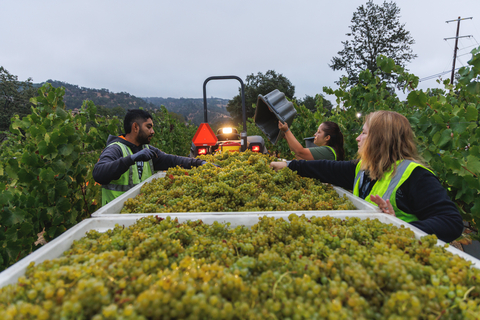
Vineyard workers sort grapes during the 2025 harvest at Lambert Bridge Winery in Sonoma County. Photo by Wyatt Goodale of Goodale Media.
California vintners expect the 2025 wines to show both concentration and balance, with reds possessing depth and structure, and whites displaying energy and precision.
“The 2025 wines will lean toward elegance rather than opulence,” said Melissa Paris, winemaker at Alpha Omega Winery in St. Helena. “This is a vintage that celebrates restraint and vineyard expression.”
Harvest began up to two weeks later than average in some regions due to the cooler start to the season. Late-season rains required vineyard teams to remain agile and to employ meticulous sorting to ensure clean, botrytis-free fruit.
Vintners report that yield volumes are largely average to below average, depending on the region.
The USDA forecasts 2025 California winegrape production at 3 million tons, a 4% increase from 2024 but still 16% below the previous three-year average. The California Association of Winegrape Growers (CAWG) projects a slightly lower estimate at just under 2.5 million tons, compared to 2.88 million tons in 2024.
Cool Weather Enabled Slow Maturation
Although the weather varies across California’s diverse wine regions, temperatures throughout the state were cooler than usual this year.
In Napa Valley, Paris said, “The season felt more classic in pace and tone. It was less dramatic, more deliberate and defined by the kind of slow ripening that winemakers dream of.”
In the Central Valley, the mild growing season inspired early optimism about the vintage.
“Quality was high right out of the gate, with incredible color and flavor development in the early varieties,” said Chris Smith, the director of winegrowing at Bogle Family Wine Collection in Clarksburg.
The start of harvest varied widely, depending on the region.
In the North Coast, at Ram’s Gate Winery in Sonoma County, picking began for Carneros fruit on Aug. 25, but grapes took much longer to ripen near the coast.
“Vineyards closer to the marine influence, along with later-ripening varieties such as Mourvèdre, Syrah and Cabernet Sauvignon, took their time,” said Joe Nielsen, director of winemaking. “They stretched well into October before reaching optimal ripeness.”
Further south, along the Central Coast and inland, regions experienced similar weather patterns. In Paso Robles, following a cool spring, vintners experienced the mildest July on record. Harvest began one week to 10 days later than average.
“If we had eight days that were over 100 degrees for this entire year, I'd be shocked,” said Stasi Seay, director of vineyards at Hope Family Wines in Paso Robles. “That’s not typical.”
Lower Brix levels at harvest contributed to excellent flavor development and strong color in the red varieties.
Late-Season Rains Required Flexibility
Rain during harvest inevitably adds complexity, yet California growers and vintners adapted quickly to mitigate the effects of September and October showers.
Some wineries — including Freeman Winery in Sebastopol, with vineyards in the Russian River Valley and the West Sonoma Coast — opted to pick early and sort out any unripe fruit.
“Pinot Noir all came in in great shape, with low Brix and very good flavors,” said winemaker and co-founder Akiko Freeman. “Half of our Chardonnay came in after the significant rain, but our fantastic growers were able to drop all the problematic clusters before harvest and they sent us beautiful grapes.”
Other wineries, such as Ram’s Gate, opened up fruiting zones to promote better airflow and reduce the risk of mildew.
Paris noted that in Napa Valley, the rain added dimension and concentrated flavors for Cabernet Sauvignon, particularly in well-draining sites.
“In the end,” she said, “the rain tested timing and teamwork more than quality, reminding us that agility is as important as patience in a year like this.”
A Fresh and Lively Vintage
The season’s cool conditions helped grapes achieve maturity at lower sugar levels in several regions. California vintners are expecting to produce wines with plenty of vibrancy and complexity.
“We anticipate the 2025 vintage to be elegant and flavorful,” Freeman added.
White wines are expected to show exceptional acidity, Nielsen added, especially for Chardonnay, Pinot Blanc and Sauvignon Blanc. For reds, extended ripening created a sense of tension and energy on the palate, while later-picked varieties are showing deep color, impressive concentration and finesse.
Napa Valley Cabernet Sauvignon and Cabernet Franc grapes came in with deep color and fine texture, framed by elegant tannins. The region’s Sauvignon Blanc displayed brilliant citrus and stone fruit tones, while Chardonnay brought tension and minerality.
Central Coast winemakers are reporting energy in white varieties, and excellent color and flavor intensity in reds.
Because some vintners picked their Chardonnay at lower-than-normal sugar levels to avoid rain impacts, they expect to see brighter wines for the 2025 vintage.
“There will be some fresher-style wines,” said Steve Peck, the vice president of winemaking at J. Lohr Vineyards & Wines in San Jose, which farms estate vineyards in Monterey County and Arroyo Seco. “Instead of alcohol being closer to 14 and a half percent, we might be a little over 13 and a half, which really leans into the contemporary style as we view it.”
What’s most remarkable, he said, is the character of the Paso Robles reds. “Our vineyards where we grow our $20 bottle of Cabernet taste like they could go into our $50 bottle,” Peck noted. “We've just struck a really nice balance for that this year in Paso.”
View the full 2025 California Harvest Report, including regional reports from Napa Valley, Sonoma County, Suisun Valley, Santa Clara Valley, Lodi, Paso Robles, Santa Barbara, Temecula and San Diego County.
DOWNLOAD THE FULL 2025 CALIFORNIA WINE HARVEST REPORT
About Wine Institute
Established in 1934, Wine Institute is the public policy advocacy group of more than 1,000 California wineries and affiliated businesses that initiates and advocates state, federal and international public policy to enhance the environment for the responsible production, consumption and enjoyment of wine.
View source version on businesswire.com: https://www.businesswire.com/news/home/20251215837429/en/
“The 2025 wines will lean toward elegance rather than opulence. This is a vintage that celebrates restraint and vineyard expression.”
Contacts
Media Contact:
Julie Berge
Wine Institute
jberge@wineinstitute.org