The artificial intelligence boom has a spending problem, and it's a good one. Wall Street analysts can barely keep up with how quickly money is flowing into AI infrastructure, forcing major forecast revisions.
If you're looking for a way to profit from the AI buildout without betting on the chip giants everyone already knows, two under-the-radar software names just landed on Bank of America’s buy list.
Why BofA Upgraded Its Semiconductor Outlook
According to a report from Yahoo Finance:
- Bank of America analyst Vivek Arya sharply raised the firm's global semiconductor revenue target for 2026 from roughly $1 trillion to $1.3 trillion. That's a $300 billion jump in just four months.
- The bank now expects the total semiconductor market to surpass $2 trillion by 2030, indicating a 20% compound annual growth rate (CAGR) over the next four years.
- Arya pointed to artificial intelligence and data center spending as the main engine of growth.
- The analyst argued the industry is now entering a phase of “leading logic intensity,” which means chip designs are getting so complex that specialized design tools are becoming essential.
That's where Cadence Design Systems (CDNS) and Synopsys (SNPS) come in.
The Bull Case for CDNS and SNPS Stock
Arya flagged both companies as rebound opportunities in the electronic design automation (EDA) software space. EDA firms are the “tool makers” of the chip world, and semiconductor companies can't design complex chips without them.
Cadence chief executive Anirudh Devgan explained the dynamic plainly at the Morgan Stanley Technology, Media, and Telecom Conference in March.
He noted that as chips grow in complexity, moving from three-nanometer to two-nanometer and eventually one-nanometer designs, the workload for design tools grows exponentially. AI increases this demand, as engineers run more optimization passes to squeeze out better performance.
"If the workload is not growing, workload is linear to the number of people," Devgan said. "But in our case...there's a wide projection in five years, the chip size will be 5x to 10x bigger."
Cadence recently launched ChipStack, a new artificial intelligence-powered super-agent that can write design code and verification test benches: two tasks that previously had no automation at all. The company is also building out its hardware emulation product, Palladium, which has posted six straight years of record growth.
Synopsys CEO Sassine Ghazi made a similar case at the same conference. With the completion of its acquisition of simulation giant Ansys, Synopsys has expanded from a silicon design tool provider into a full silicon-to-systems engineering platform.
The company is also rolling out "AgentEngineers," which are artificial intelligence agents that work within the chip design workflow to speed up tasks and improve outcomes. "AI is a great opportunity for us," Ghazi said. "It's actually driving the opportunity to monetize more."
Are the Chip Stocks Undervalued?
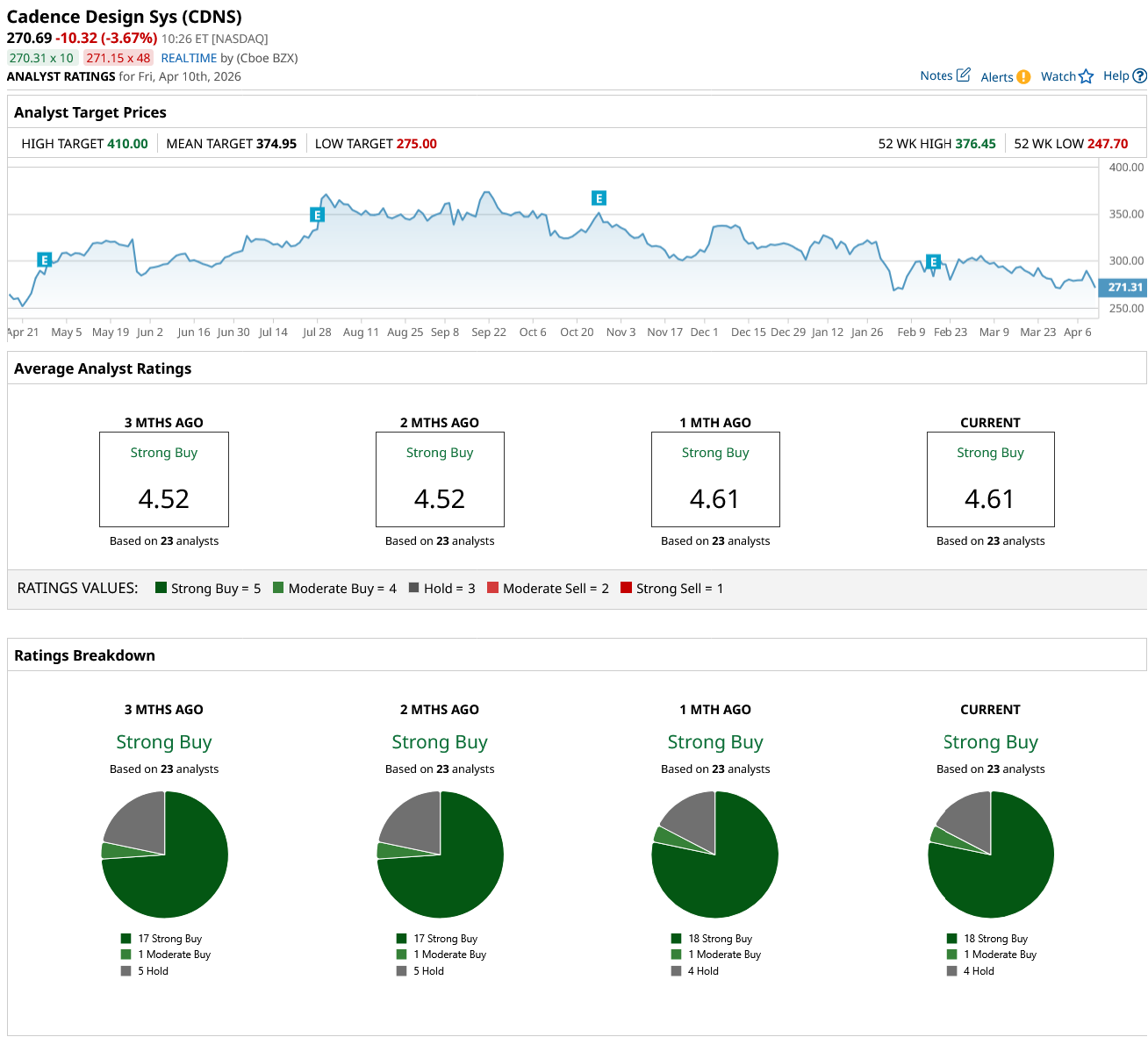
Out of the 23 analysts covering CDNS stock, 18 recommend “Strong Buy,” one recommends “Moderate Buy,” and four recommend “Hold.” The average CDNS stock price target is $374.95, above the current price of about $281.
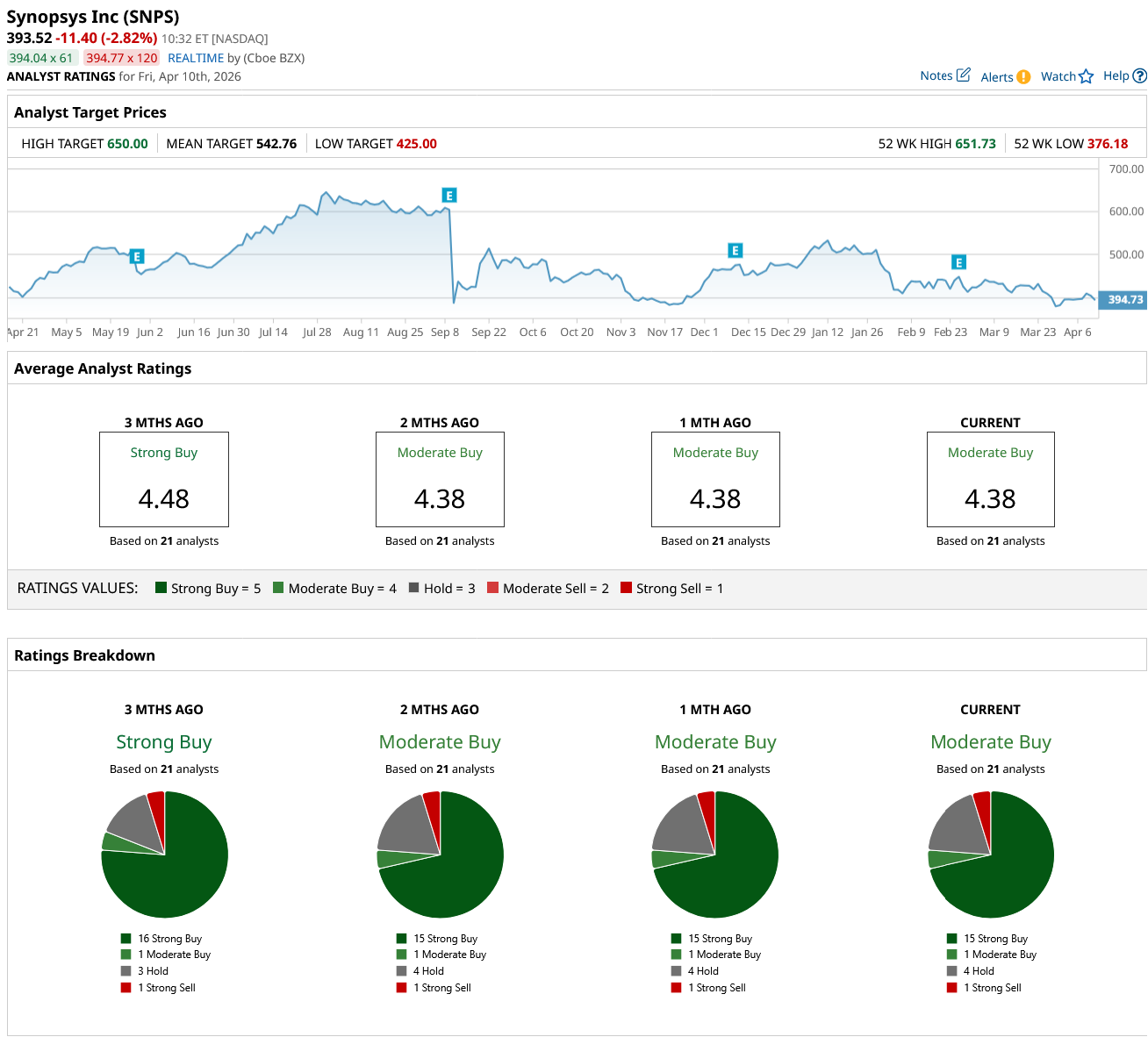
Out of the 21 analysts covering SNPS stock, 15 recommend “Strong Buy,” one recommends “Moderate Buy,” four recommend “Hold,” and one recommends “Strong Sell.” The average SNPS stock price target is $542.76, above the current price of about $393.
For Cadence and Synopsys, the near-term debate is about how quickly they can monetize their new artificial intelligence tools. Both companies are moving toward usage-based and token-based pricing models, a shift that could significantly expand their revenue per customer if adoption accelerates.
The AI infrastructure buildout is still in its early chapters. And if BofA is right, the companies supplying the design tools may be among the most durable winners of all.
On the date of publication, Aditya Raghunath did not have (either directly or indirectly) positions in any of the securities mentioned in this article. All information and data in this article is solely for informational purposes. For more information please view the Barchart Disclosure Policy here.