Market volatility is as low as we’ve seen in the last six months as measured by the CBOE Volatility (VIX) Index.
VIX is a real-time index that represents the market expectation for near-term volatility in the S&P 500 index.
Investors and traders have long used VIX as a measure of the level of risk, fear or stress in the market.
Yesterday, the VIX Index closed at 14.75, which is towards the lower end of the range for the year.
Today, we’re going to look at a long call butterfly using VIX options as a way to profit if volatility starts to rise next year.
A long call butterfly is constructed through buying a call option, selling two higher calls and buying one call even higher.
The trade is entered for a net debit meaning the trader pays to enter the trade. This debit is also the maximum possible loss.
Usually, a butterfly is placed roughly at-the-money, but today we are looking at placing it out-of-the-money.
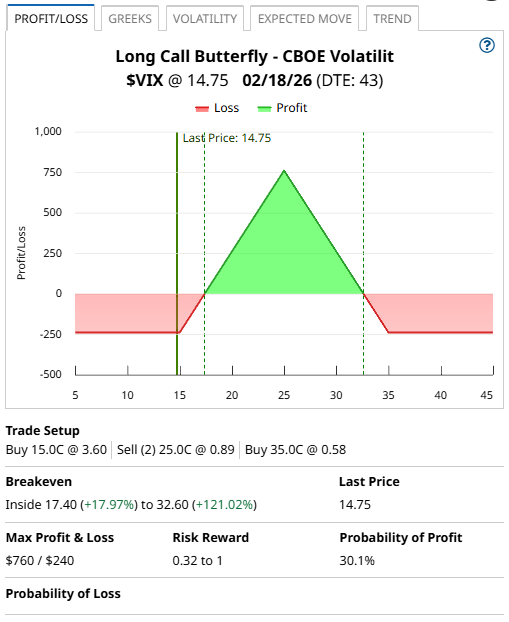
Using the February 18th expiry, the trade would involve buying the 15 strike call, selling two of the 20 strike calls and buying one of the 35 strike calls.
The cost for the trade would be $250 which is the most the trade could lose. The maximum potential gain is $750, which would occur is VIX closed right at 25 at expiration. The lower breakeven price is 17.40 and the upper breakeven price is 32.60.
There are three general outcomes with this butterfly.
- VIX below 15 – Trade loses $250. This scenario should be reasonably acceptable for most investors. While the option trade suffers a full loss, hopefully stocks have been stable or rising.
- VIX between 20 and 30 – Good for the VIX butterfly, but potentially bad for stock portfolios.
- VIX above 30 – Full loss on the VIX trade and potentially big drops in stock portfolio.
So VIX above 30 is the main scenario that hurts in this case, but how likely is that?
Using VIX options can be simple and cheap way to buy some protection against a sharp selloff in stocks between now and January. The trade can be placed relatively cheaply at $250 per contract.
VIX options behave differently to regular stock options, so it is important that any trader using this product fully understands the risks involved. As always, do your own research and due diligence before risking any of your hard-earned capital.
One of the key reasons this type of VIX butterfly can be attractive is the asymmetry it offers in a low-volatility environment. When volatility is already depressed, the downside risk in VIX is naturally capped, while even a modest volatility expansion can have an outsized impact on option pricing. This creates a situation where you are not necessarily betting on a full-blown market crash, but rather a normalization of volatility back toward its longer-term average.
From a portfolio construction perspective, this trade can also act as a form of tactical hedge. Many investors are heavily exposed to equity risk, whether through index funds, individual stocks, or equity-based income strategies. A position like this does not require a large allocation to potentially provide meaningful diversification benefits if markets become unsettled.
It’s also worth noting that timing matters with VIX butterflies. These are not “set and forget” positions. If volatility spikes sharply before expiration, it may make sense to take profits early rather than holding out for the ideal expiration outcome. Managing expectations and being flexible with exits is often more important than squeezing out every last dollar of theoretical profit.
Please remember that options are risky, and investors can lose 100% of their investment. This article is for education purposes only and not a trade recommendation. Remember to always do your own due diligence and consult your financial advisor before making any investment decisions.
On the date of publication, Gavin McMaster did not have (either directly or indirectly) positions in any of the securities mentioned in this article. All information and data in this article is solely for informational purposes. For more information please view the Barchart Disclosure Policy here.
More news from Barchart