Rising Maternal Health Awareness, Expanding Prenatal-to-Postpartum Product Demand, and Growth of Subscription-Based Maternity Solutions Fuel Market Expansion Through 2036
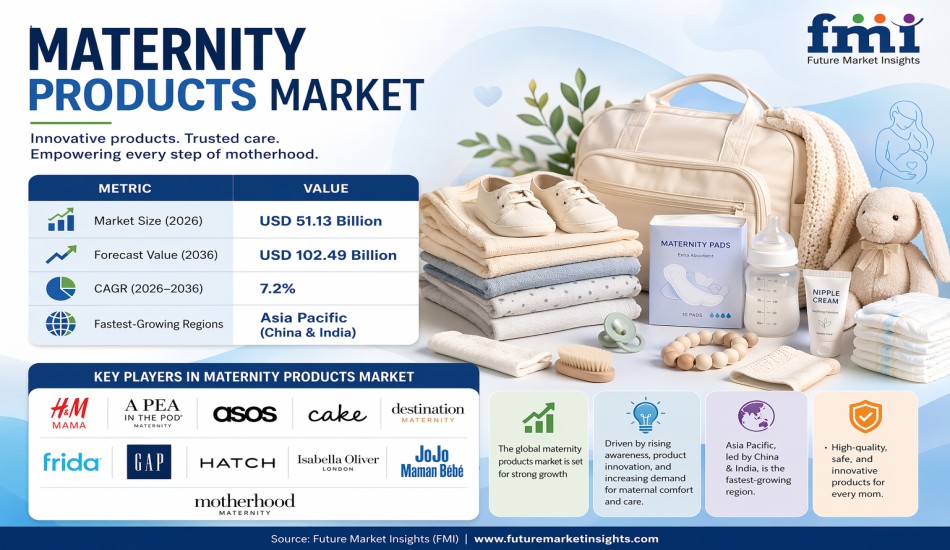
NEWARK, DE / ACCESS Newswire / April 10, 2026 / According to Future Market Insights, the global maternity products market is undergoing strong expansion, driven by rising maternal health awareness, increasing consumer spending on pregnancy wellness, and the evolution of maternity care into a comprehensive lifestyle ecosystem. The market is valued at USD 51.13 billion in 2026 and is projected to reach USD 102.49 billion by 2036, registering a CAGR of 7.2% over the forecast period. This growth reflects a transition from single-product purchases to integrated, multi-category maternity solutions spanning prenatal to postpartum care.
Market Snapshot: Maternity Products Market
Key Market Metrics
Market Size (2026): USD 51.13 Billion
Forecast Value (2036): USD 102.49 Billion
CAGR (2026-2036): 7.2%
Leading Product Segment: Maternal Apparel (42.3% share)
Dominant Application: Pregnancy Stage (63.8% share)
Leading Price Segment: Medium Pricing (47.5% share)
Fastest-Growing Regions: Asia Pacific (China & India)
Key Players in Maternity Products Market: H&M Mama, A Pea in the Pod, ASOS, Cake, Destination, Frida, Gap, HATCH, Isabella Oliver, JoJo Maman Bébé, Motherhood, Old Navy, PinkBlush, Seraphine, The Moms Co.
Get detailed market forecasts, competitive benchmarking, and pricing trends: https://www.futuremarketinsights.com/reports/sample/rep-gb-24827
Growth Dynamics and Demand Drivers
The market is experiencing accelerated demand due to a shift toward holistic maternal wellness. Consumers are increasingly viewing maternity products not as isolated purchases but as part of a continuous care journey covering pregnancy through postpartum recovery.
Rising awareness of prenatal nutrition, skincare, and physical comfort is significantly expanding demand across product categories such as supplements, personal care, and maternity accessories. Expectant mothers are prioritizing safety, convenience, and comfort, driving higher adoption of specialized maternity solutions.
Another major growth driver is the rise of subscription-based and bundled offerings. E-commerce platforms are enabling curated maternity kits and trimester-based delivery models, increasing purchase frequency and average transaction value.
Additionally, growing urbanization, increasing disposable income, and the rising number of working women are reinforcing demand for functional, stylish, and convenient maternity products.
Segment Insights
By Product Type
Maternal apparel leads with 42.3% share due to high purchase frequency
Personal care products and nutritional supplements gaining traction
Accessories such as support belts and nursing aids expanding steadily
By Application
Pregnancy stage dominates (63.8%) due to concentrated product needs
Postnatal segment growing with recovery and nursing-related products
By Pricing
Medium-priced products lead (47.5%), balancing affordability and quality
Premium segment driven by wellness-focused and branded offerings
Low-cost segment supported by emerging market demand
By Distribution Channel
Online channels expanding rapidly with subscription and DTC models
Offline retail remains strong for apparel and essential purchases
Speak to Analyst: Customize insights for your business strategy : https://www.futuremarketinsights.com/customization-available/rep-gb-24827
Supply Chain and Industry Structure
The maternity products market operates as a multi-category ecosystem involving apparel manufacturers, personal care producers, supplement companies, and accessory suppliers. Raw material sourcing includes textiles, skincare ingredients, and nutritional compounds, followed by product design, manufacturing, and distribution.
E-commerce platforms play a critical role in streamlining the supply chain by enabling direct-to-consumer delivery, subscription services, and personalized product recommendations. Offline channels such as specialty maternity stores and large retail chains continue to support product accessibility and brand visibility.
The industry is increasingly shifting toward integrated product ecosystems, where brands offer bundled solutions covering multiple stages of the maternity lifecycle.
Pricing and Value Trends
Pricing trends indicate a shift toward value-based purchasing behavior. Consumers are evaluating maternity products based on durability, multi-functionality, and lifecycle utility rather than upfront cost.
Medium-priced products dominate due to their balance of quality and affordability, while premium brands are leveraging innovation, comfort, and wellness positioning to justify higher price points.
Bundled offerings and subscription services are also enhancing perceived value by providing convenience and cost savings over time.
Competitive Landscape
The market is highly competitive, with a mix of global apparel brands, specialty maternity companies, and emerging direct-to-consumer players.
Leading companies such as H&M Mama, A Pea in the Pod, and ASOS focus on stylish, functional maternity wear, while others like Cake and HATCH specialize in niche categories such as maternity lingerie and premium essentials.
Brands like Gap, Old Navy, and Motherhood emphasize affordability and accessibility, whereas Seraphine, Isabella Oliver, and The Moms Co. differentiate through premium designs, sustainability, and wellness-focused products.
Competition is increasingly driven by product innovation, comfort, fabric technology, and omnichannel distribution strategies.
Regional Analysis
Asia Pacific (High Growth Hub)
China (9.7% CAGR): Largest and fastest-growing market
India (9.0% CAGR): Driven by urbanization and healthcare awareness
Europe
Germany (8.3%): Strong demand for premium maternity products
France (7.6%): Growth driven by prenatal wellness culture
North America
United States (6.1%): Mature market with high per-capita spending
Growth driven by premiumization and innovation
Other Markets
United Kingdom (6.8%): Expansion of subscription services
Brazil (5.4%): Growth supported by improving maternal care access
Future Outlook and Opportunities
The maternity products market is expected to evolve into a fully integrated wellness ecosystem. Growth opportunities lie in:
Cross-category product bundling (apparel, supplements, personal care)
Subscription-based delivery models
Eco-friendly and hypoallergenic product innovations
Expansion into emerging markets with rising healthcare awareness
Technological advancements in fabric design, wearable health monitoring, and personalized nutrition will further enhance product value and differentiation.
Buy Full Report: Unlock 360° insights for strategic decision making and investment planning - https://www.futuremarketinsights.com/checkout/24827
Conclusion
The maternity products market is transitioning from fragmented product categories to a cohesive, lifecycle-driven ecosystem. As consumer expectations shift toward convenience, comfort, and holistic wellness, demand for integrated maternity solutions will continue to rise.
Companies that successfully combine product innovation, affordability, and multi-channel distribution will be best positioned to capitalize on the market's strong growth trajectory through 2036.
Explore More Research Reports by FMI
Warm Cap Market: https://www.futuremarketinsights.com/reports/warm-cap-market
Kids Toys Market: https://www.futuremarketinsights.com/reports/kids-toys-market
Apparel Market: https://www.futuremarketinsights.com/reports/apparel-market
Premium Outdoor Apparel Market: https://www.futuremarketinsights.com/reports/premium-outdoor-apparel-market
Garment Interlining Market: https://www.futuremarketinsights.com/reports/garment-interlining-market
About Future Market Insights (FMI)
Future Market Insights (FMI) is a leading provider of market intelligence and consulting services, serving clients in over 150 countries. Headquartered in Delaware, USA, with a global delivery center in India and offices in the UK and UAE, FMI delivers actionable insights to businesses across industries including automotive, technology, consumer products, manufacturing, energy, and chemicals.
An ESOMAR-certified research organization, FMI provides custom and syndicated market reports and consulting services, supporting both Fortune 1,000 companies and SMEs. Its team of 300+ experienced analysts ensures credible, data-driven insights to help clients navigate global markets and identify growth opportunities.
For Press & Corporate Inquiries
Rahul Singh
AVP - Marketing and Growth Strategy
Future Market Insights, Inc.
+91 8600020075
For Sales - sales@futuremarketinsights.com
For Media - Rahul.singh@futuremarketinsights.com
For web - https://www.futuremarketinsights.com/
SOURCE: Future Market Insights, Inc.
View the original press release on ACCESS Newswire