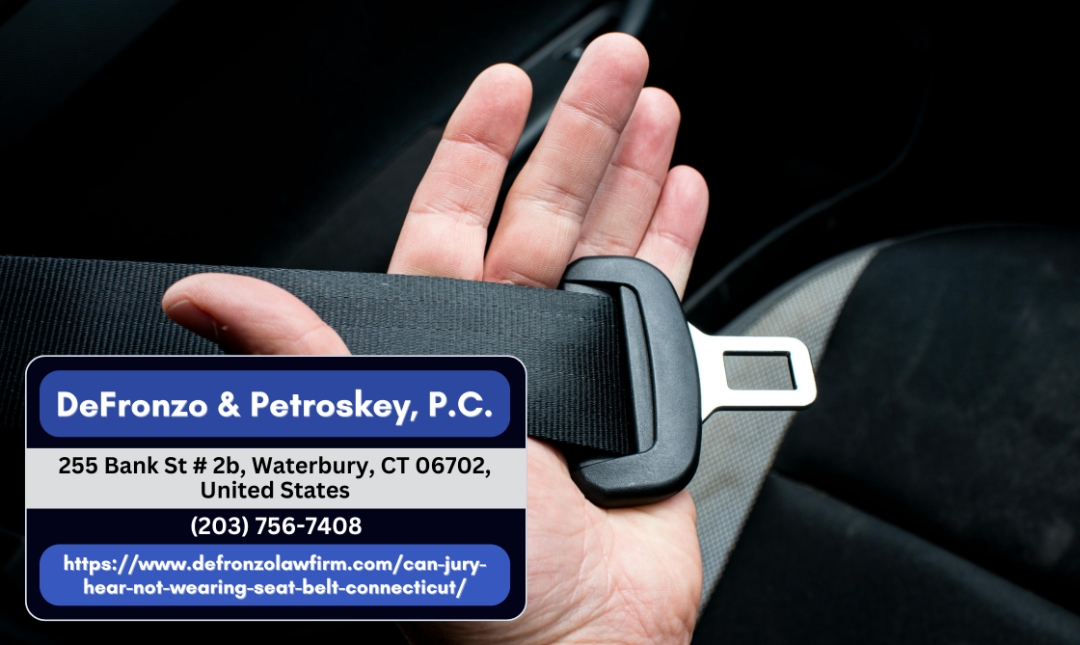
WATERBURY, CT - Connecticut law bars insurance defense attorneys from telling a civil jury that an injured driver or passenger was not wearing a seat belt at the time of a crash, a rule that often makes a substantial difference in the outcome of a Waterbury car accident case. Waterbury car accident attorney Dan Petroskey of DeFronzo & Petroskey, P.C. (https://www.defronzolawfirm.com/can-jury-hear-not-wearing-seat-belt-connecticut/) is explaining how Connecticut General Statutes § 14-100a(c)(3) operates, why the legislature enacted it, and how courts have applied it for the past three decades.
According to Waterbury car accident attorney Dan Petroskey, the controlling statute provides that failure to wear a seat safety belt shall not be considered as contributory negligence, nor shall such failure be admissible in any civil action. The legislature enacted this provision in 1985 through Public Act 85-429, and the language is intentionally broad. It blocks the evidence for any civil purpose, including any attempt to argue contributory fault or to reduce damages. "The rule applies whether the injured person was the driver or a passenger, and whether they were in the front seat or the back seat," explains Petroskey. "Insurance defense attorneys cannot revive the seat belt defense through creative arguments."
Waterbury car accident attorney Dan Petroskey emphasizes that the policy reasoning behind the statute is straightforward. The legislature wanted to require drivers and front-seat passengers to buckle up but did not want that requirement to give negligent drivers a way to escape responsibility for the crashes they cause. A driver who runs a red light at an East Main Street intersection is the cause of the resulting collision. Whether the victim happened to be belted does not change who chose to run the light. Allowing the defense would shift blame from the wrongdoer to the injured party for a separate decision unrelated to the crash itself.
Petroskey notes that the Connecticut Appellate Court upheld the constitutionality of § 14-100a(c)(3) in Bower v. D'Onfro, 38 Conn. App. 685 (1995). The case involved a passenger hurt when a high-speed driver lost control and struck a tree in Cheshire. The defense tried to introduce evidence that the passenger was unbelted to reduce damages. Both the trial court and the Appellate Court rejected the attempt, holding that the legislature acted within its authority and rejecting challenges based on due process, equal protection, and the right to a jury trial. The ruling has been the controlling authority on this issue ever since.
The firm points out that the statute bars more than a simple statement that the injured person was unbelted. Defense attorneys sometimes try to introduce the same fact through indirect channels, and Connecticut courts treat those efforts as covered by the rule. Inadmissible evidence includes officer testimony about the absence of a belt, scene photographs showing an unfastened belt after the crash, medical record notations such as "unrestrained driver" or "unrestrained passenger," expert biomechanical opinions about how injuries would have differed with a belt, and cross-examination questions designed to suggest non-use. When these issues arise, plaintiff's counsel can object and ask the court to exclude the evidence or redact medical records before they reach the jury.
DeFronzo & Petroskey, P.C. handles seat belt evidence issues across the full range of car accident cases in New Haven County, including rear-end and intersection collisions, fatal motor vehicle crashes, catastrophic injury cases involving traumatic brain and spinal cord injuries, motorcycle and pedestrian crashes, and truck and commercial vehicle collisions. The firm's familiarity with the procedural mechanics of suppression and redaction allows the team to enforce the rule from the first day of representation.
"The same statute also applies to child passengers," advises Petroskey. "Section 14-100a(d) covers child restraint systems, and the law states that failure to use an approved child seat shall not be considered contributory negligence and shall not be admissible in any civil action. This protects injured children whose parents or caregivers may not have used a car seat properly. The negligent driver who caused the crash cannot argue that improper child restraint reduces what the child can recover."
Attorney Petroskey notes that the civil bar has one important boundary. The statute applies to civil actions, not to criminal proceedings. If the police charge a driver with a seat belt infraction under the same statute, the State can prove the violation in that ticket case. The base statutory fine is $50, with state surcharges and fees typically bringing the total payable amount to about $92. That criminal exception does not affect the injury claim. A seat belt ticket is handled separately from the civil lawsuit and has no bearing on the right to recover damages.
The firm emphasizes that the seat belt rule does not give injured people a free pass on every careless act. If a driver was using a handheld device at the moment of impact or contributed to the crash in another way, that conduct can still be considered under Connecticut's modified comparative negligence rule in § 52-572h. The seat belt statute only blocks the seat belt evidence itself. Other negligent conduct can still affect the percentage of fault assigned by a jury or insurance adjuster.
For people who were unbelted at the time of a crash and are now considering a claim, full transparency with counsel is essential. The lawyer needs the complete factual picture to anticipate any defense effort and prepare the appropriate objections in advance. Insurance adjusters sometimes ask about seat belt use during recorded statements, and there is no legal obligation to provide a recorded statement to the other driver's insurer before consulting with an attorney.
About DeFronzo & Petroskey, P.C.:
DeFronzo & Petroskey, P.C. is a Waterbury-based personal injury firm representing injured clients across Connecticut since 1961. Led by attorney Dan Petroskey, who was admitted to the Connecticut Bar in 2004, the firm focuses exclusively on plaintiff personal injury work, including motor vehicle accidents, premises liability, and wrongful death claims throughout Waterbury and New Haven County. The office at 255 Bank Street, Suite 2B, Waterbury, CT 06702 serves clients across the greater New Haven County region. For consultations, call (203) 756-7408.
Embeds:
Youtube Video: https://www.youtube.com/watch?v=dk3wIJPi_gc
GMB: https://www.google.com/maps?cid=2074756120617399372
Email and website
Email: iacruz@defronzolaw.com
Website: https://www.defronzolawfirm.com/
Media Contact
Company Name: DeFronzo & Petroskey, P.C.
Contact Person: Dan Petroskey
Email: Send Email
Phone: (203) 756-7408
Address:255 Bank St #2b
City: Waterbury
State: Connecticut 06702
Country: United States
Website: https://www.defronzolawfirm.com/