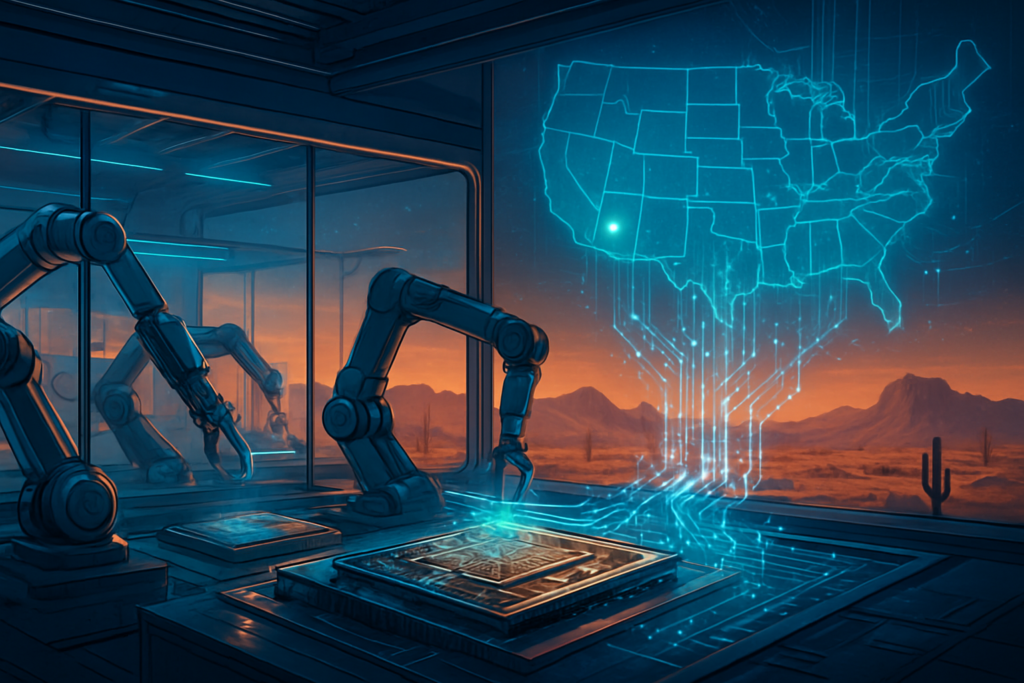
TSMC’s first major fabrication plant in Arizona has officially reached a historic milestone, successfully entering high-volume production for NVIDIA’s Blackwell GPUs. Utilizing the cutting-edge N4P process, the Phoenix-based facility, known as Fab 21, is reportedly achieving silicon yields comparable to TSMC’s flagship "GigaFabs" in Taiwan.
This achievement marks a transformative moment in the "onshoring" of critical AI hardware. By shifting the manufacturing of the world’s most powerful processors for Large Language Model (LLM) training to American soil, NVIDIA is providing a stabilized, domestically sourced supply chain for hyperscale giants like Microsoft and Amazon. This move is expected to alleviate long-standing geopolitical concerns regarding the concentration of advanced semiconductor manufacturing in East Asia.
Technical Milestones: Achieving Yield Parity in the Desert
The transition to high-volume production at Fab 21 is centered on the N4P process—a performance-enhanced 4-nanometer node that serves as the foundation for the NVIDIA (NASDAQ: NVDA) Blackwell architecture. Technical reports from the facility indicate that yield rates have reached the high-80% to low-90% range, effectively matching the efficiency of TSMC’s (NYSE: TSM) long-established facilities in Tainan. This parity is a major victory for the U.S. semiconductor initiative, as it proves that domestic labor and operational standards can compete with the hyper-optimized ecosystems of Taiwan.
The Blackwell B200 and B300 (Blackwell Ultra) GPUs currently rolling off the Arizona line represent a massive leap over the previous Hopper architecture. Featuring 208 billion transistors and a multi-die "chiplet" design, these processors are the most complex chips ever manufactured in the United States. While the initial wafers are fabricated in Arizona, they currently still undergo a "logistical loop," being shipped back to Taiwan for TSMC’s proprietary CoWoS (Chip-on-Wafer-on-Substrate) advanced packaging. However, this is seen as a temporary phase as domestic packaging infrastructure begins to mature.
Industry experts have reacted with surprise at the speed of the yield ramp-up. Earlier skepticism regarding the cultural and regulatory challenges of bringing TSMC's "always-on" manufacturing culture to Arizona appears to have been mitigated by aggressive training programs and the relocation of over 1,000 veteran engineers from Taiwan. The success of the N4P lines in Arizona has also cleared the path for the facility to begin installing equipment for the even more advanced 3nm (N3) process, which will support NVIDIA’s upcoming "Vera Rubin" architecture.
The Hyperscale Land Grab: Microsoft and Amazon Secure US Supply
The successful production of Blackwell GPUs in Arizona has triggered a strategic shift among the world’s largest cloud providers. Microsoft (NASDAQ: MSFT) and Amazon (NASDAQ: AMZN) have moved aggressively to secure the lion's share of the Arizona fab’s output. Microsoft, in particular, has reportedly pre-booked nearly the entire available capacity of Fab 21 for 2026, intending to market its "Made in USA" Blackwell clusters to government, defense, and highly regulated financial sectors that require strict supply chain provenance.
For Amazon Web Services (AWS), the domestic production of Blackwell provides a crucial hedge against global supply chain disruptions. Amazon has integrated these Arizona-produced GPUs into its next-generation "AI Factories," pairing them with its own custom-designed Trainium 3 chips. This dual-track strategy—using both domestic Blackwell GPUs and proprietary silicon—gives AWS a competitive advantage in pricing and reliability. Other major players, including Meta (NASDAQ: META) and Alphabet Inc. (NASDAQ: GOOGL), are also in negotiations to shift a portion of their 2026 GPU allocations to the Arizona site.
The competitive implications are stark: companies that can prove their AI infrastructure is built on "sovereign silicon" are finding it easier to win lucrative government contracts and secure national security certifications. This "sovereign AI" trend is creating a two-tier market where domestically produced chips command a premium for their perceived security and supply-chain resilience, further cementing NVIDIA's dominance at the top of the AI hardware stack.
Onshoring the Future: The Broader AI Landscape
The production of Blackwell in Arizona fits into a much larger trend of technological decoupling and the resurgence of American industrial policy. This milestone follows the landmark $250 billion US-Taiwan trade agreement signed earlier this month, which provided the regulatory framework for TSMC to treat its Arizona operations as a primary hub. The development of a "Gigafab" cluster in Phoenix—which TSMC aims to expand to up to 11 individual fabs—signals that the U.S. is no longer just a designer of AI, but is once again a premier manufacturer.
However, challenges remain, most notably the "packaging bottleneck." While the silicon wafers are now produced in the U.S., the final assembly—the CoWoS process—is still largely overseas. This creates a strategic vulnerability that the U.S. government is racing to address through partnerships with firms like Amkor Technology, which is currently building a multi-billion dollar packaging plant in Peoria, Arizona. Until that facility is online in 2028, the "Made in USA" label remains a partial achievement.
Comparatively, this milestone is being likened to the first mass-production of high-end microprocessors in the 1990s, yet with much higher stakes. The ability to manufacture the "brains" of artificial intelligence domestically is seen as a matter of national security. Critics point out the high environmental costs and the massive energy demands of these fabs, but for now, the momentum behind AI onshoring appears unstoppable as the U.S. seeks to insulate its tech economy from volatility in the Taiwan Strait.
Future Horizons: From Blackwell to Rubin
Looking ahead, the Arizona campus is expected to serve as the launchpad for NVIDIA’s most ambitious projects. Near-term, the facility will transition to the Blackwell Ultra (B300) series, which features enhanced HBM3e memory integration. By 2027, the site is slated to upgrade to the N3 process to manufacture the Vera Rubin architecture, which promises another 3x to 5x increase in AI training performance.
The long-term vision for the Arizona site includes a fully integrated "Silicon-to-System" pipeline. Experts predict that within the next five years, Arizona will not only host the fabrication and packaging of GPUs but also the assembly of entire liquid-cooled rack systems, such as the GB200 NVL72. This would allow hyperscalers to order complete AI supercomputers that never leave the state of Arizona until they are shipped to their final data center destination.
One of the primary hurdles will be the continued demand for skilled technicians and the massive amounts of water and power required by these expanding fab clusters. Arizona officials have already announced plans for a "Semiconductor Water Pipeline" to ensure the facility’s growth doesn't collide with the state's long-term conservation goals. If these logistical challenges are met, Phoenix is on track to become the "AI Capital of the West."
A New Chapter in AI History
The entry of NVIDIA’s Blackwell GPUs into high-volume production at TSMC’s Arizona fab is more than just a manufacturing update; it is a fundamental shift in the geography of the AI revolution. By achieving yield parity with Taiwan, the Arizona facility has proven that the most complex hardware in human history can be reliably produced in the United States. This move secures the immediate needs of Microsoft, Amazon, and other hyperscalers while laying the groundwork for a more resilient global tech economy.
As we move deeper into 2026, the industry will be watching for the first deliveries of these "Arizona-born" GPUs to data centers across North America. The key metrics to monitor will be the stability of these high yields as production scales and the progress of the domestic packaging facilities required to close the loop. For now, NVIDIA has successfully extended its reach from the design labs of Santa Clara to the factory floors of Phoenix, ensuring that the next generation of AI will be "Made in America."
This content is intended for informational purposes only and represents analysis of current AI developments.
TokenRing AI delivers enterprise-grade solutions for multi-agent AI workflow orchestration, AI-powered development tools, and seamless remote collaboration platforms.
For more information, visit https://www.tokenring.ai/.