As the Q2 earnings season comes to a close, it’s time to take stock of this quarter’s best and worst performers in the oilfield services industry, including Liberty Energy (NYSE: LBRT) and its peers.
Oilfield services companies provide equipment, technology, and services enabling exploration and production activities, including drilling, completion, well intervention, and reservoir evaluation. Their fortunes closely track upstream capital spending cycles. Tailwinds include increased drilling activity during favorable commodity environments, demand for efficiency-enhancing technologies, and growing offshore and unconventional resource development. Headwinds include significant revenue volatility tied to oil and gas price swings and producer spending discipline. Intense competition pressures pricing and margins, while the energy transition may structurally reduce long-term demand. Workforce availability and technological disruption require continuous adaptation.
The 26 oilfield services stocks we track reported a very strong Q2. As a group, revenues beat analysts’ consensus estimates by 4.4%.
Luckily, oilfield services stocks have performed well with share prices up 10.7% on average since the latest earnings results.
Liberty Energy (NYSE: LBRT)
Operating approximately 40 active fleets across North America's most productive shale basins, Liberty Energy (NYSE: LBRT) provides hydraulic fracturing services that help oil and gas companies extract resources from shale formations.
Liberty Energy reported revenues of $1.19 billion, up 14% year on year. This print exceeded analysts’ expectations by 8.5%. Overall, it was a very strong quarter for the company with a beat of analysts’ EPS and EBITDA estimates.
“The second quarter demonstrated strong operational execution as our team continued to deliver proven quality services amidst commodity price volatility and heightened geopolitical uncertainty. Liberty delivered revenue of $1.2 billion and Adjusted EBITDA of $151 million, leveraging the benefits of our strategic investments and AI-driven technology advancements as the industry modestly strengthened from early year cyclical lows,” commented Ron Gusek, Chief Executive Officer.
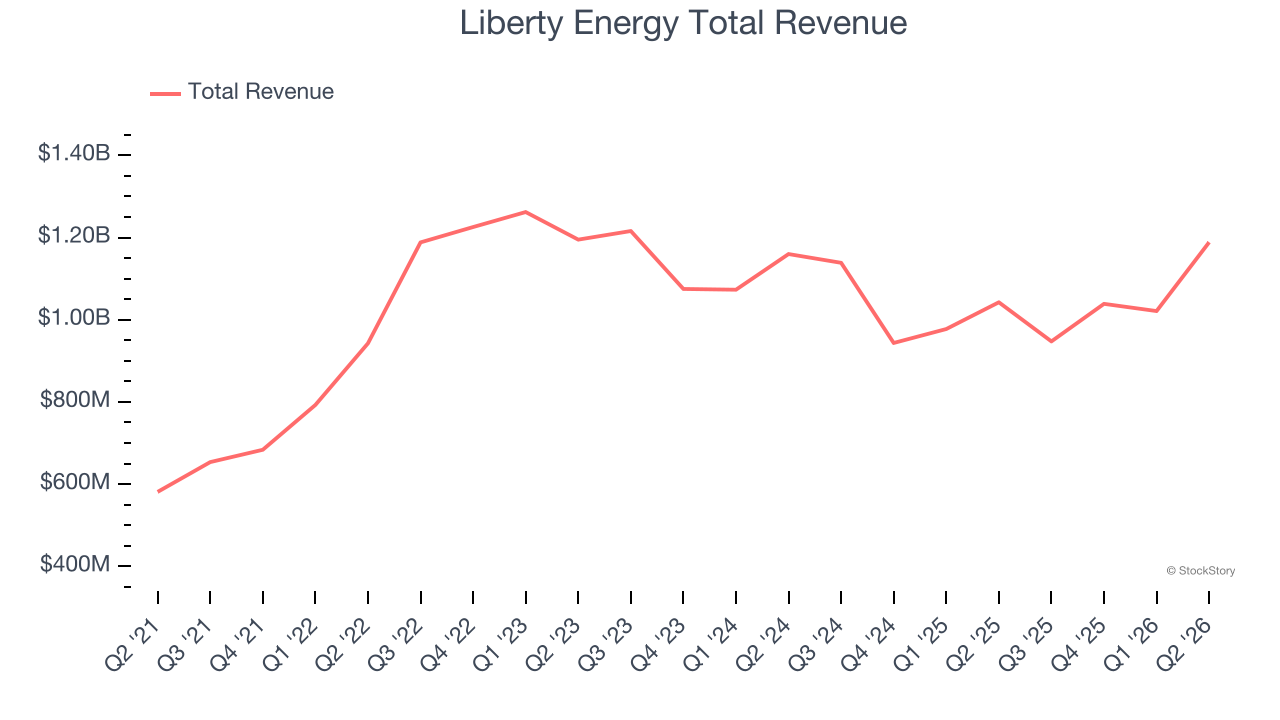
Investor expectations, however, were likely higher than Wall Street’s published projections, leaving some wishing for even better results (analysts’ consensus estimates are those published by big banks and advisory firms, not the investors who make buy and sell decisions). The stock is down 23% since reporting and currently trades at $19.35.
Is now the time to buy Liberty Energy? Access our full analysis of the earnings results here, it’s free.
Best Q2: World Kinect (NYSE: WKC)
Serving over 150,000 customers from commercial jets to cargo ships to heating oil consumers, World Kinect (NYSE: WKC) procures and delivers fuel and energy products to airlines, shipping companies, trucking fleets, and industrial businesses worldwide.
World Kinect reported revenues of $13.59 billion, up 50.3% year on year, outperforming analysts’ expectations by 27.7%. The business had an incredible quarter with a beat of analysts’ EPS and EBITDA estimates.
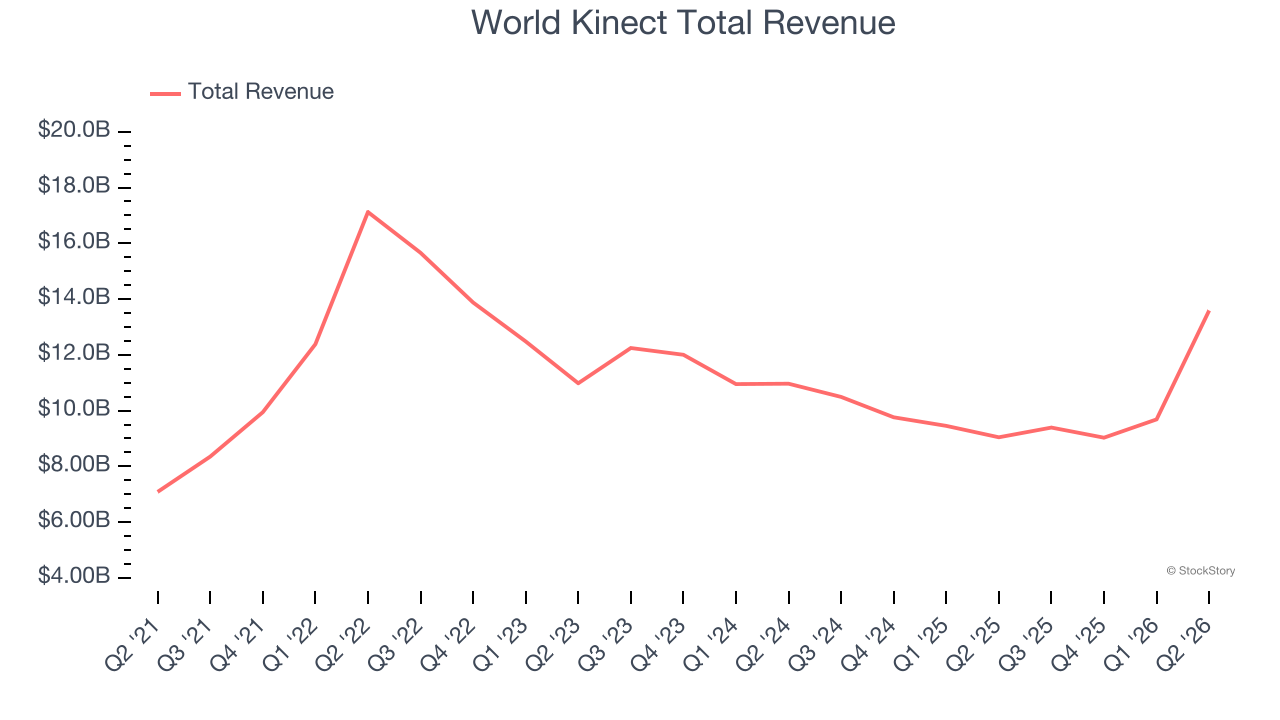
World Kinect scored the biggest analyst estimate beat in the group. Although it had a fine quarter compared to its peers, the market seems unhappy with the results as the stock is down 3.3% since reporting. It currently trades at $35.09.
Is now the time to buy World Kinect? Access our full analysis of the earnings results here, it’s free.
Weakest Q2: ProPetro (NYSE: PUMP)
Operating exclusively in the Permian Basin—one of America's most prolific oil-producing regions—ProPetro (NYSE: PUMP) provides hydraulic fracturing services that pump high-pressure fluid and sand into oil wells to release trapped hydrocarbons.
ProPetro reported revenues of $305.8 million, down 6.2% year on year, falling short of analysts’ expectations by 1.6%. It was a disappointing quarter as it posted a significant miss of analysts’ EBITDA estimates and a significant miss of analysts’ EPS estimates.
Interestingly, the stock is up 6.8% since the results and currently trades at $11.39.
Read our full analysis of ProPetro’s results here.
Helmerich & Payne (NYSE: HP)
Operating the largest fleet of super-spec rigs in North America with technology that can drill horizontal wells over two miles long, Helmerich & Payne (NYSE: HP) provides drilling rigs and crews to oil and gas companies that need wells drilled to extract hydrocarbons from underground.
Helmerich & Payne reported revenues of $1.03 billion, flat year on year. This print surpassed analysts’ expectations by 5.4%. It was a strong quarter as it also logged an impressive beat of analysts’ EBITDA estimates.
The stock is up 28.1% since reporting and currently trades at $42.63.
Read our full, actionable report on Helmerich & Payne here, it’s free.
RPC (NYSE: RES)
Operating primarily in the Permian Basin with 10 hydraulic fracturing fleets, RPC (NYSE: RES) provides specialized services and equipment like hydraulic fracturing, coiled tubing, and cementing to help oil and gas companies complete and maintain wells.
RPC reported revenues of $460.9 million, up 9.5% year on year. This result beat analysts’ expectations by 1.1%. It was a stunning quarter as it also produced a beat of analysts’ EPS estimates and an impressive beat of analysts’ EBITDA estimates.
The stock is up 25.1% since reporting and currently trades at $6.41.
Read our full, actionable report on RPC here, it’s free.
Market Update
Over the past year, investors have been forced to repeatedly answer the same question: what is the market’s biggest risk? The answer has changed several times, and each shift has reshaped market leadership.
Late in 2025 and early 2026, artificial intelligence became the market’s primary uncertainty. Investors questioned whether AI would erode software pricing power and weaken competitive moats as AI made it easier to replicate once-differentiated products.
By the spring, technology took a back seat to geopolitics. The U.S. conflict with Iran briefly became the market’s dominant narrative, raising concerns about oil prices, inflation, and global growth. But as energy markets remained orderly and fears of a prolonged supply disruption faded, investors quickly turned their focus back to fundamentals.
Want to invest in winners with rock-solid fundamentals? Check out our Top 5 Quality Compounder Stocks and add them to your watchlist. These companies are poised for growth regardless of the political or macroeconomic climate.