Global financial services giant JPMorgan Chase (NYSE: JPM) announced better-than-expected revenue in Q2 CY2026, with sales up 27% year on year to $58.02 billion. Its GAAP profit of $7.70 per share was 31.7% above analysts’ consensus estimates.
Is now the time to buy JPMorgan Chase? Find out by accessing our full research report, it’s free.
JPMorgan Chase (JPM) Q2 CY2026 Highlights:
- Net Interest Income: $25.51 billion vs analyst estimates of $25.65 billion (9.9% year-on-year growth, 0.6% miss)
- Revenue: $58.02 billion vs analyst estimates of $51.35 billion (27% year-on-year growth, 13% beat due to big beat in equities)
- EPS (GAAP): $7.70 vs analyst estimates of $5.85 (31.7% beat)
- Tangible Book Value per Share: $113.35 vs analyst estimates of $111.47 (10.8% year-on-year growth, 1.7% beat)
- Market Capitalization: $896.4 billion
Company Overview
Tracing its roots back to 1799 when its earliest predecessor was founded by Aaron Burr, JPMorgan Chase (NYSE: JPM) is a leading financial services company offering investment banking, consumer banking, commercial banking, and asset management services globally.
Sales Growth
Two primary revenue streams drive bank earnings. While net interest income, which is earned by charging higher rates on loans than paid on deposits, forms the foundation, fee-based services across banking, credit, wealth management, and trading operations provide additional income. Thankfully, JPMorgan Chase’s 10.6% annualized revenue growth over the last five years was decent. Its growth was slightly above the average banking company and shows its offerings resonate with customers.
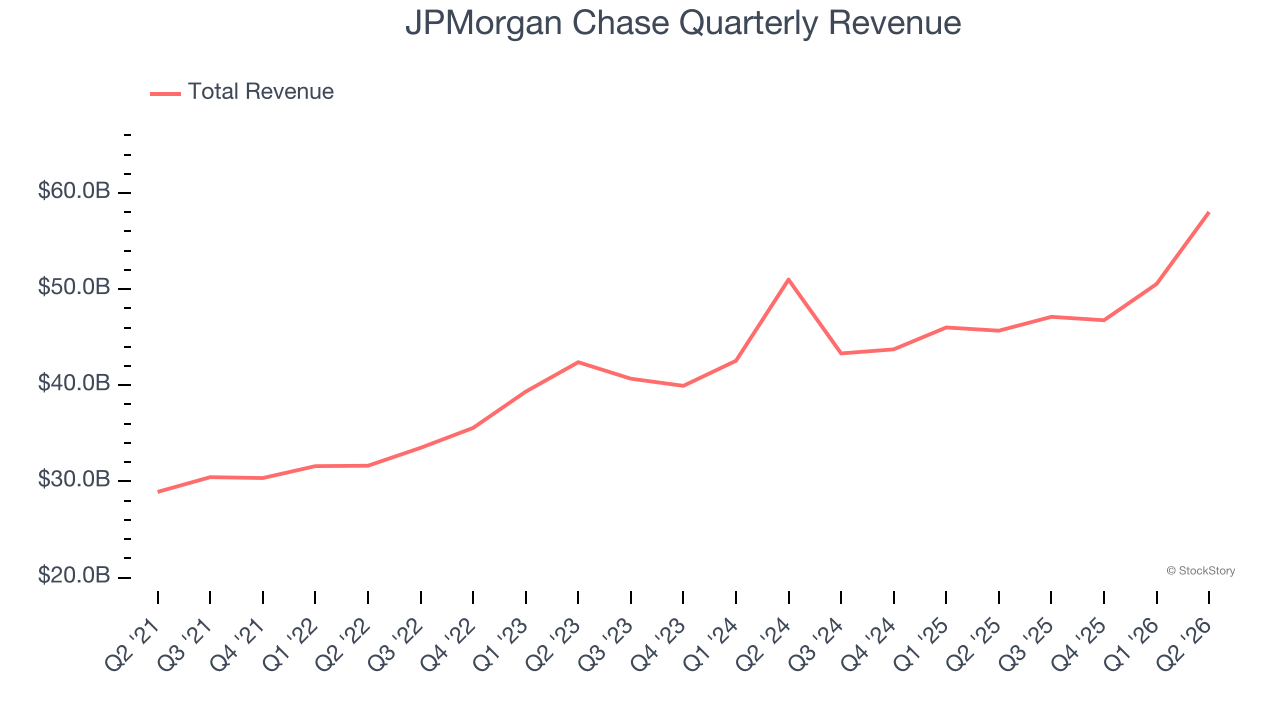
We at StockStory place the most emphasis on long-term growth, but within financials, a half-decade historical view may miss recent interest rate changes, market returns, and industry trends. JPMorgan Chase’s recent performance shows its demand has slowed as its annualized revenue growth of 7.8% over the last two years was below its five-year trend. We’re wary when companies in the sector see decelerations in revenue growth, as it could signal changing consumer tastes aided by low switching costs. 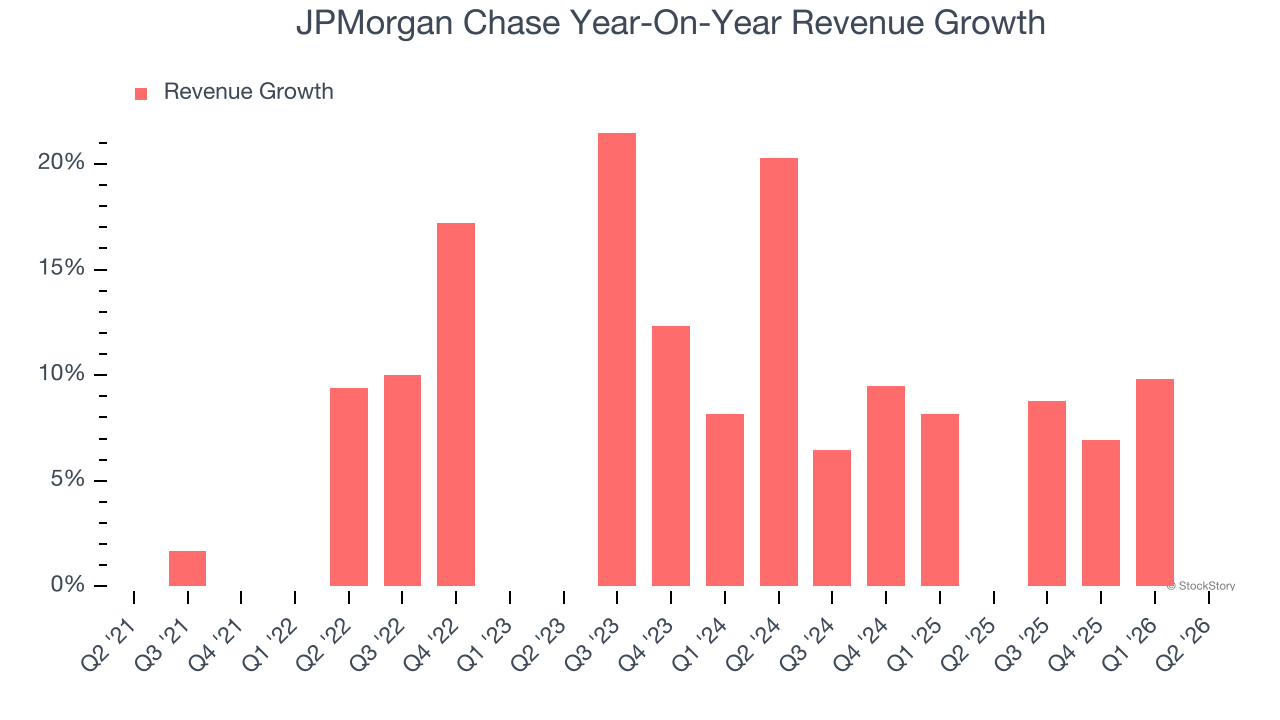 Note: Quarters not shown were determined to be outliers because they were impacted by outsized investment gains/losses that are not indicative of the recurring fundamentals of the business.
This quarter, JPMorgan Chase reported robust year-on-year revenue growth of 27%, and its $58.02 billion of revenue topped Wall Street estimates by 13%.
Net interest income made up 50.7% of the company’s total revenue during the last five years, meaning JPMorgan Chase’s growth drivers strike a balance between lending and non-lending activities.
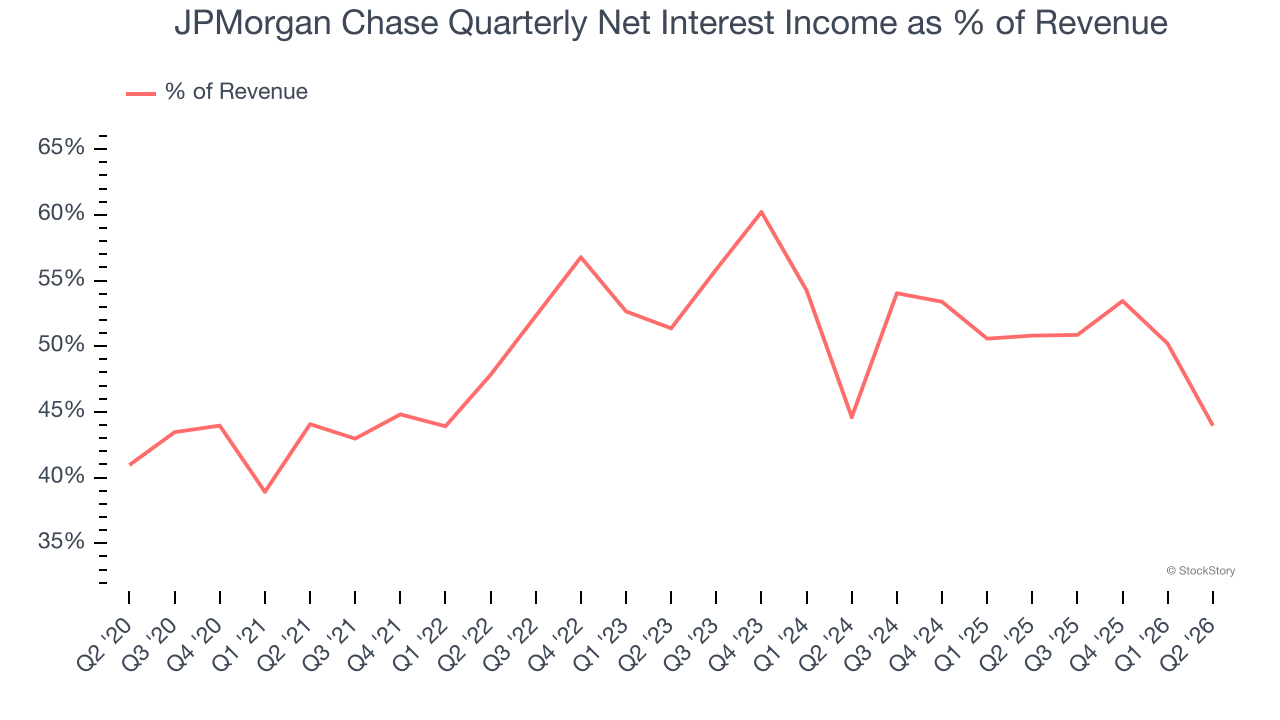
Our experience and research show the market cares primarily about a bank’s net interest income growth as non-interest income is considered a lower-quality and non-recurring revenue source.
ONE MORE THING: The $21 AI Application Stock Wall Street Forgot. While Wall Street obsesses over who’s building AI, one company is already using it to print money. And nobody’s paying attention.
AI chip stocks trade at ridiculous valuations. This company processes a trillion consumer signals monthly using AI and trades at a third of the price. The gap won’t last. The institutions will figure it out. You need to see this first. Read the FREE Report Before They Notice.
Tangible Book Value Per Share (TBVPS)
The balance sheet drives banking profitability since earnings flow from the spread between borrowing and lending rates. As such, valuations for these companies concentrate on capital strength and sustainable equity accumulation potential.
Because of this, tangible book value per share (TBVPS) emerges as the critical performance benchmark. By excluding intangible assets with uncertain liquidation values, this metric captures real, liquid net worth per share. Traditional metrics like EPS are helpful but face distortion from M&A activity and loan loss accounting rules.
JPMorgan Chase’s TBVPS grew at an incredible 10.7% annual clip over the last five years. The last two years show a similar trajectory as TBVPS grew by 11.2% annually from $91.73 to $113.35 per share.
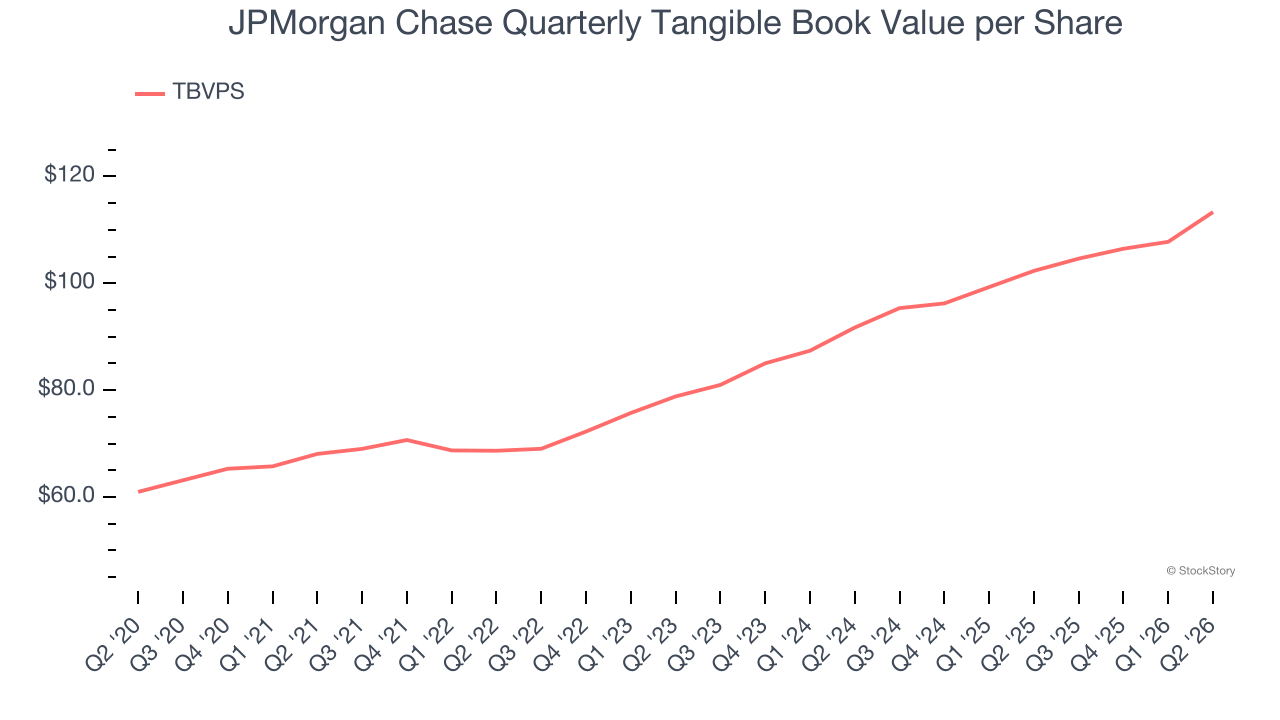
Over the next 12 months, Consensus estimates call for JPMorgan Chase’s TBVPS to grow by 6.3% to $120.44, lousy growth rate.
Key Takeaways from JPMorgan Chase’s Q2 Results
It was good to see JPMorgan Chase exceeded analysts’ revenue expectations due to a big beat in equities. EPS also beat by a wide margin. On the other hand, its net interest income slightly missed. Zooming out, we think this was a good print with some key areas of upside. The stock remained flat at $335.21 immediately after reporting.
Sure, JPMorgan Chase had a solid quarter, but if we look at the bigger picture, is this stock a buy? When making that decision, it’s important to consider its valuation, business qualities, as well as what has happened in the latest quarter. We cover that in our actionable full research report which you can read here (it’s free).