The end of an earnings season can be a great time to discover new stocks and assess how companies are handling the current business environment. Let’s take a look at how GE HealthCare (NASDAQ: GEHC) and the rest of the healthcare equipment and supplies stocks fared in Q1.
The healthcare equipment and supplies sector thrives on innovation in medical devices and consumables, the latter providing recurring revenue. Future growth is buoyed by an aging population with increasing chronic diseases and a shift towards minimally-invasive surgery. Advancements in materials science and AI-driven diagnostics also offer significant opportunities. Key headwinds remain, including pricing pressure from cost-conscious healthcare providers, evolving regulations, and potential supply chain disruptions.
The 37 healthcare equipment and supplies stocks we track reported a satisfactory Q1. As a group, revenues beat analysts’ consensus estimates by 2.3% while next quarter’s revenue guidance was 1.3% below.
In light of this news, share prices of the companies have held steady. On average, they are relatively unchanged since the latest earnings results.
GE HealthCare (NASDAQ: GEHC)
Spun off from industrial giant General Electric in 2023 after over a century as its healthcare division, GE HealthCare (NASDAQ: GEHC) provides medical imaging equipment, patient monitoring systems, diagnostic pharmaceuticals, and AI-enabled healthcare solutions to hospitals and clinics worldwide.
GE HealthCare reported revenues of $5.13 billion, up 7.4% year on year. This print exceeded analysts’ expectations by 2.1%. Despite the top-line beat, it was still a slower quarter for the company with a significant miss of analysts’ full-year EPS guidance estimates and a significant miss of analysts’ EPS estimates.
GE HealthCare President and CEO Peter Arduini said, “As we start the year, we’re pleased with topline performance, which came in at the high end of our expectations. Growth was driven by strong commercial execution in Pharmaceutical Diagnostics, including Flyrcado, Advanced Visualization Solutions, and Imaging, as well as services. We are maintaining our topline growth guidance driven by healthy customer demand globally.
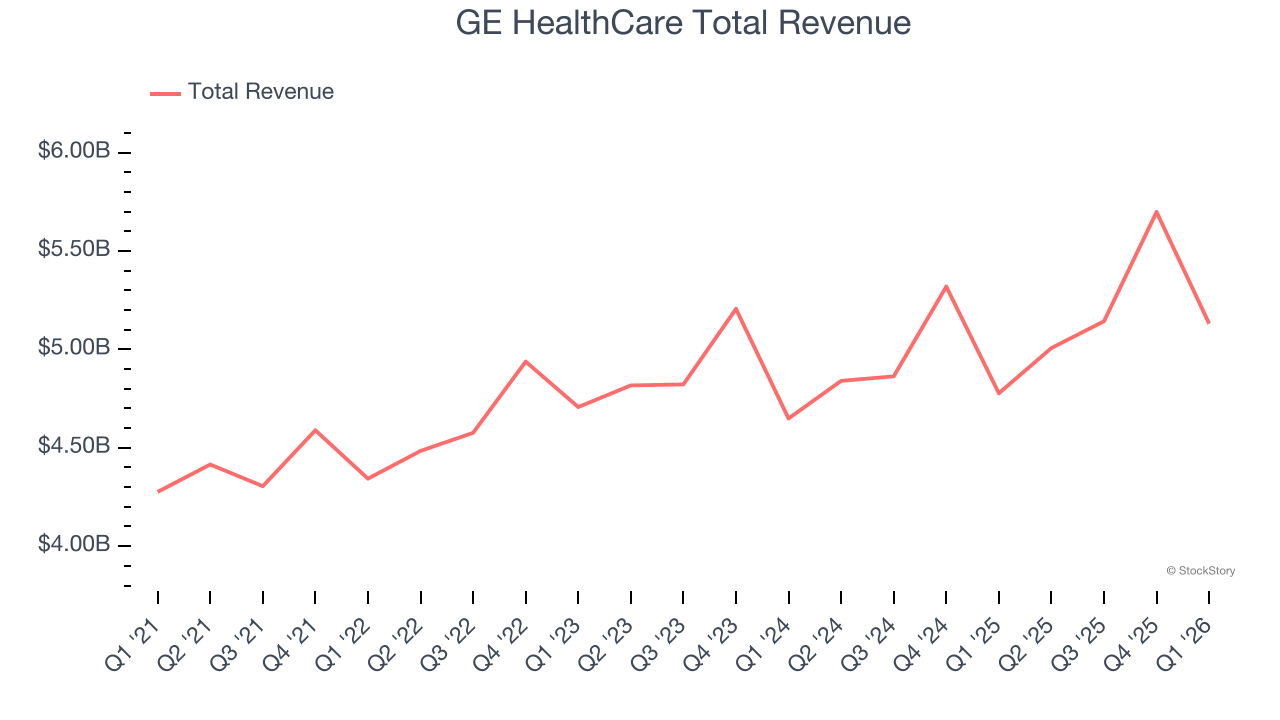
The market seems disappointed with the results as the stock is down 11.1% since reporting and currently trades at $60.91.
Read our full report on GE HealthCare here, it’s free.
Best Q1: STAAR Surgical (NASDAQ: STAA)
With over 2.5 million implants performed worldwide, STAAR Surgical (NASDAQ: STAA) designs and manufactures implantable lenses that correct vision problems without removing the eye's natural lens.
STAAR Surgical reported revenues of $93.52 million, up 120% year on year, outperforming analysts’ expectations by 20.8%. The business had an incredible quarter with a beat of analysts’ EPS estimates.
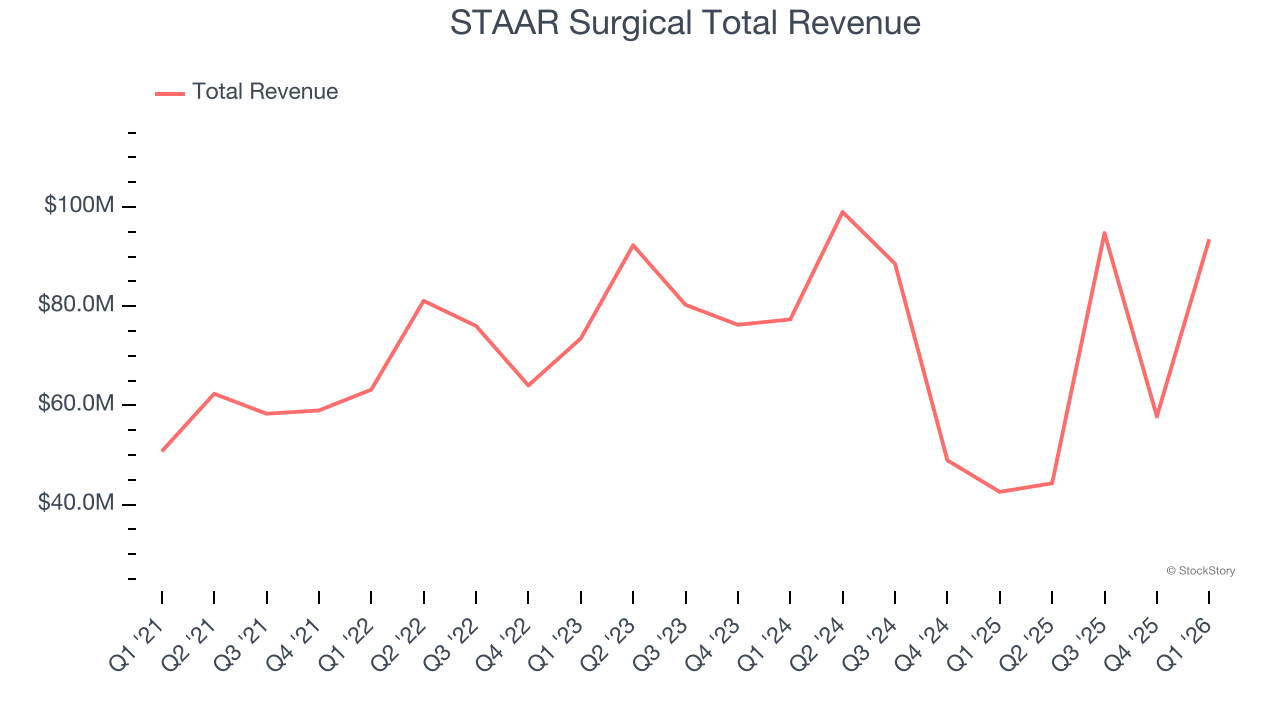
STAAR Surgical scored the biggest analyst estimate beat and fastest revenue growth among its peers. However, the results were likely priced into the stock as it’s traded sideways since reporting. Shares currently sit at $29.12.
Is now the time to buy STAAR Surgical? Access our full analysis of the earnings results here, it’s free.
Weakest Q1: Stryker (NYSE: SYK)
With over 150 million patients impacted annually through its innovative healthcare technologies, Stryker (NYSE: SYK) develops and manufactures advanced medical devices and equipment across orthopedics, surgical tools, neurotechnology, and patient care solutions.
Stryker reported revenues of $6.02 billion, up 2.6% year on year, falling short of analysts’ expectations by 5%. It was a disappointing quarter as it posted a significant miss of analysts’ EPS and organic revenue estimates.
As expected, the stock is down 2.1% since the results and currently trades at $308.42.
Read our full analysis of Stryker’s results here.
DexCom (NASDAQ: DXCM)
Founded in 1999 and receiving its first FDA approval in 2006, DexCom (NASDAQ: DXCM) develops and sells continuous glucose monitoring systems that allow people with diabetes to track their blood sugar levels without repeated finger pricks.
DexCom reported revenues of $1.19 billion, up 15% year on year. This print surpassed analysts’ expectations by 1.4%. Aside from that, it was a satisfactory quarter as it also recorded a beat of analysts’ EPS estimates but a slight miss of analysts’ organic revenue estimates.
The stock is up 23% since reporting and currently trades at $73.22.
Read our full, actionable report on DexCom here, it’s free.
iRhythm (NASDAQ: IRTC)
Pioneering the shift from bulky, short-term heart monitors to sleek, wire-free patches, iRhythm Technologies (NASDAQ: IRTC) provides wearable cardiac monitoring devices and AI-powered analysis services that help physicians detect and diagnose heart rhythm disorders.
iRhythm reported revenues of $199.4 million, up 25.7% year on year. This result beat analysts’ expectations by 2.8%. It was a very strong quarter as it also put up a beat of analysts’ EPS estimates and full-year revenue guidance meeting analysts’ expectations.
The stock is down 17.4% since reporting and currently trades at $106.74.
Read our full, actionable report on iRhythm here, it’s free.
Market Update
Late in 2025 into early 2026, there was hand-wringing around artificial intelligence. For software companies, the fear was that AI would erode pricing power and compress margins as new tools made it easier to replicate what once required expensive enterprise platforms. Crypto investors had their own version of the same anxiety: if AI agents could trade, allocate capital, and manage wallets autonomously, what exactly was the long-term value of today’s crypto infrastructure?
These concerns triggered a noticeable rotation away from these sectors and into safer havens. But markets rarely dwell on one narrative for long. Spring 2026 came, and the focus shifted abruptly from technological disruption to geopolitical risk. The US’ conflict with Iran became the dominant driver of market psychology, and when geopolitics takes center stage, the script changes quickly. Investors stop debating growth rates and start worrying about oil supply, inflation, and global stability.
Want to invest in winners with rock-solid fundamentals? Check out our Strong Momentum Stocks and add them to your watchlist. These companies are poised for growth regardless of the political or macroeconomic climate.
StockStory’s analyst team — all seasoned professional investors — uses quantitative analysis and automation to deliver market-beating insights faster and with higher quality.