Quarterly earnings results are a good time to check in on a company’s progress, especially compared to its peers in the same sector. Today we are looking at Five Below (NASDAQ: FIVE) and the best and worst performers in the discount retailer industry.
Discount retailers understand that many shoppers love a good deal, and they focus on providing excellent value to shoppers by selling general merchandise at major discounts. They can do this because of unique purchasing, procurement, and pricing strategies that involve scouring the market for trendy goods or buying excess inventory from manufacturers and other retailers. They then turn around and sell these snacks, paper towels, toys, clothes, and myriad other products at highly enticing prices. Despite the unique draw and lure of discounts, these discount retailers must also contend with the secular headwinds of online shopping and challenged retail foot traffic in places like suburban strip malls.
The 5 discount retailer stocks we track reported a satisfactory Q4. As a group, revenues beat analysts’ consensus estimates by 1.5% while next quarter’s revenue guidance was 0.6% below.
Thankfully, share prices of the companies have been resilient as they are up 5.8% on average since the latest earnings results.
Best Q4: Five Below (NASDAQ: FIVE)
Often facilitating a treasure hunt shopping experience, Five Below (NASDAQ: FIVE) is an American discount retailer that sells a variety of products from mobile phone cases to candy to sports equipment for largely $5 or less.
Five Below reported revenues of $1.73 billion, up 24.3% year on year. This print exceeded analysts’ expectations by 1.1%. Overall, it was a very strong quarter for the company with EPS and revenue guidance for next quarter exceeding analysts’ expectations.
Winnie Park, CEO of Five Below, said, "Our outstanding fourth quarter results capped off a transformational year that firmly established Five Below as THE destination for the Kid and the Kid in all of us. These exceptional, broad-based results reflect our Crew’s amazing execution of our customer-centric strategy and demonstrate the progress we’ve made building a stronger, more agile brand."
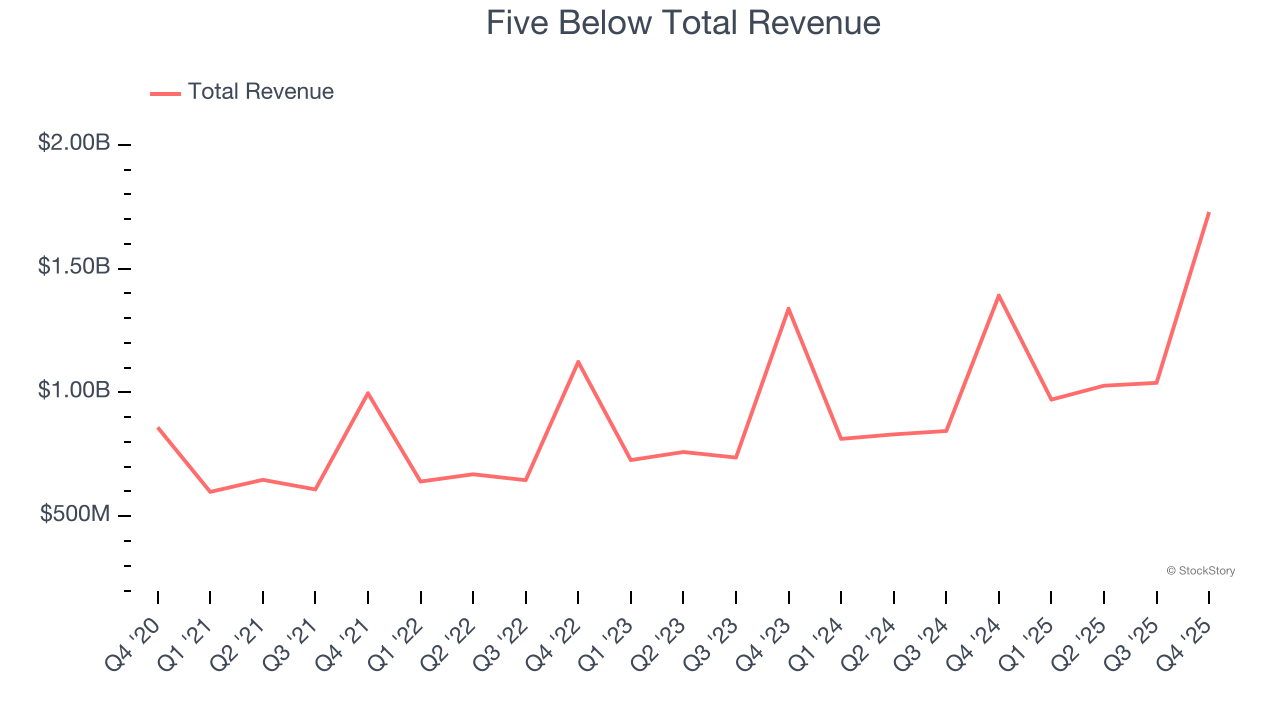
Five Below pulled off the fastest revenue growth but had the weakest full-year guidance update of the whole group. Unsurprisingly, the stock is up 9.2% since reporting and currently trades at $232.07.
Is now the time to buy Five Below? Access our full analysis of the earnings results here, it’s free.
Ross Stores (NASDAQ: ROST)
Selling excess inventory or overstocked items from other retailers, Ross Stores (NASDAQ: ROST) is an off-price concept that sells apparel and other goods at prices much lower than department stores.
Ross Stores reported revenues of $6.64 billion, up 12.2% year on year, outperforming analysts’ expectations by 3.2%. The business had a strong quarter with an impressive beat of analysts’ gross margin and revenue estimates.
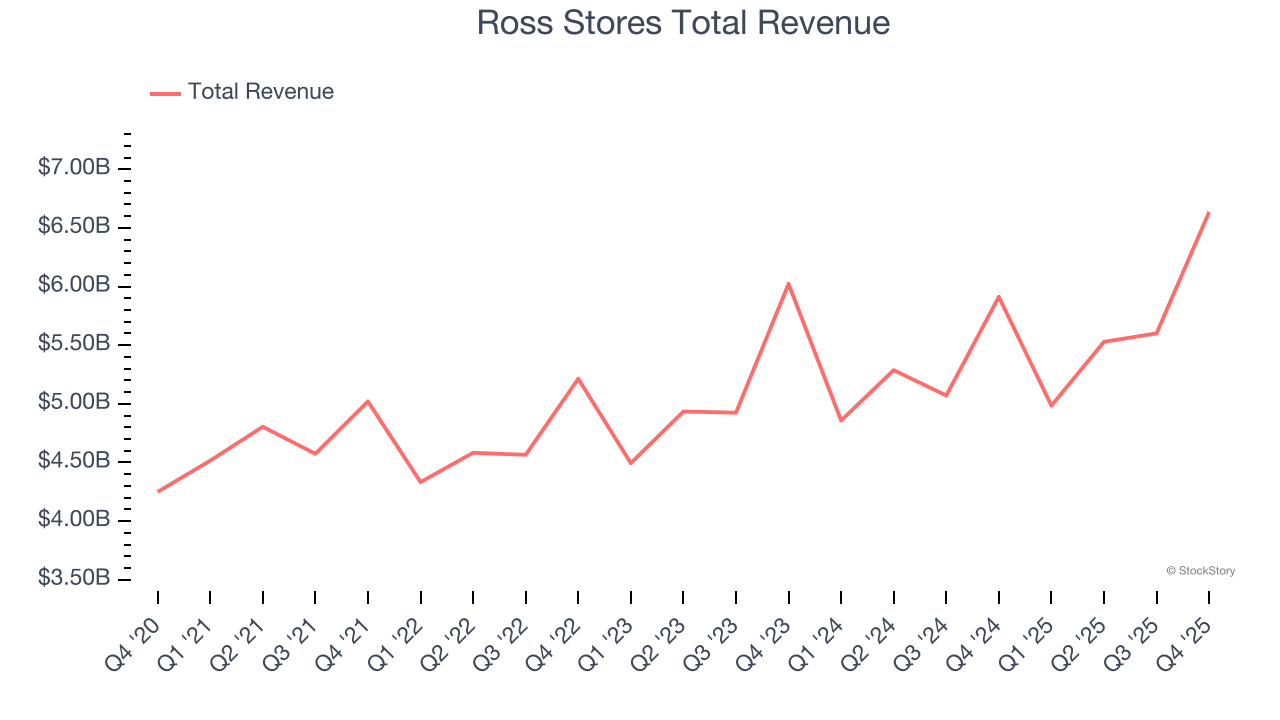
Ross Stores achieved the biggest analyst estimates beat among its peers. The market seems happy with the results as the stock is up 11.4% since reporting. It currently trades at $220.10.
Is now the time to buy Ross Stores? Access our full analysis of the earnings results here, it’s free.
Slowest Q4: Ollie's (NASDAQ: OLLI)
Often located in suburban or semi-rural shopping centers, Ollie’s Bargain Outlet (NASDAQ: OLLI) is a discount retailer that acquires excess inventory then sells at meaningful discounts.
Ollie's reported revenues of $779.3 million, up 16.8% year on year, falling short of analysts’ expectations by 0.5%. It was a mixed quarter as it posted a narrow beat of analysts’ gross margin estimates but full-year EPS guidance missing analysts’ expectations.
Ollie's delivered the highest full-year guidance raise but had the weakest performance against analyst estimates in the group. As expected, the stock is down 5.9% since the results and currently trades at $97.30.
Read our full analysis of Ollie’s results here.
TJX (NYSE: TJX)
Initially based on a strategy of buying excess inventory from manufacturers or other retailers, TJX (NYSE: TJX) is an off-price retailer that sells brand-name apparel and other goods at prices much lower than department stores.
TJX reported revenues of $17.74 billion, up 8.5% year on year. This number topped analysts’ expectations by 2.3%. Taking a step back, it was a mixed quarter as it also produced an impressive beat of analysts’ EBITDA estimates but EPS guidance for next quarter missing analysts’ expectations.
TJX had the slowest revenue growth among its peers. The stock is up 1.7% since reporting and currently trades at $160.33.
Read our full, actionable report on TJX here, it’s free.
Burlington (NYSE: BURL)
Founded in 1972 as a discount coat and outerwear retailer, Burlington Stores (NYSE: BURL) is now an off-price retailer that has broadened into general apparel, footwear, and home goods.
Burlington reported revenues of $3.65 billion, up 11.3% year on year. This print beat analysts’ expectations by 1.6%. More broadly, it was a mixed quarter as it also recorded an impressive beat of analysts’ EBITDA estimates but EPS guidance for next quarter missing analysts’ expectations significantly.
The stock is up 12.5% since reporting and currently trades at $338.21.
Read our full, actionable report on Burlington here, it’s free.
Market Update
Late in 2025 into early 2026, there was hand wringing around artificial intelligence. For software companies, the fear was that AI would erode pricing power and compress margins as new tools made it easier to replicate what once required expensive enterprise platforms. Crypto investors had their own version of the same anxiety: if AI agents could trade, allocate capital, and manage wallets autonomously, what exactly was the long-term value of today’s crypto infrastructure?
These concerns triggered a noticeable rotation away from these sectors and into safer havens. But markets rarely dwell on one narrative for long. Spring 2026 came, and the focus shifted abruptly from technological disruption to geopolitical risk. The US’ conflict with Iran became the dominant driver of market psychology, and when geopolitics takes center stage, the script changes quickly. Investors stop debating growth rates and start worrying about oil supply, inflation, and global stability.
Want to invest in winners with rock-solid fundamentals? Check out our Top 6 Stocks and add them to your watchlist. These companies are poised for growth regardless of the political or macroeconomic climate.
StockStory’s analyst team — all seasoned professional investors — uses quantitative analysis and automation to deliver market-beating insights faster and with higher quality.