Biopharmaceutical company Bristol Myers Squibb (NYSE: BMY) announced better-than-expected revenue in Q1 CY2026, with sales up 2.6% year on year to $11.49 billion. On the other hand, the company’s full-year revenue guidance of $46.75 billion at the midpoint came in 0.8% below analysts’ estimates. Its non-GAAP profit of $1.58 per share was 11.1% above analysts’ consensus estimates.
Is now the time to buy Bristol-Myers Squibb? Find out by accessing our full research report, it’s free.
Bristol-Myers Squibb (BMY) Q1 CY2026 Highlights:
- Revenue: $11.49 billion vs analyst estimates of $10.69 billion (2.6% year-on-year growth, 7.4% beat)
- Adjusted EPS: $1.58 vs analyst estimates of $1.42 (11.1% beat)
- Adjusted Operating Income: $3.24 billion vs analyst estimates of $3.72 billion (28.2% margin, 12.9% miss)
- The company reconfirmed its revenue guidance for the full year of $46.75 billion at the midpoint
- Management reiterated its full-year Adjusted EPS guidance of $6.20 at the midpoint
- Operating Margin: 28.2%, down from 29.6% in the same quarter last year
- Market Capitalization: $117.6 billion
Company Overview
With roots dating back to 1887 and a transformative merger in 1989 that gave the company its current name, Bristol-Myers Squibb (NYSE: BMY) discovers, develops, and markets prescription medications for serious diseases including cancer, blood disorders, immunological conditions, and cardiovascular diseases.
Revenue Growth
A company’s long-term sales performance is one signal of its overall quality. Any business can have short-term success, but a top-tier one grows for years. Over the last five years, Bristol-Myers Squibb grew its sales at a tepid 2.6% compounded annual growth rate. This was below our standards and is a poor baseline for our analysis.
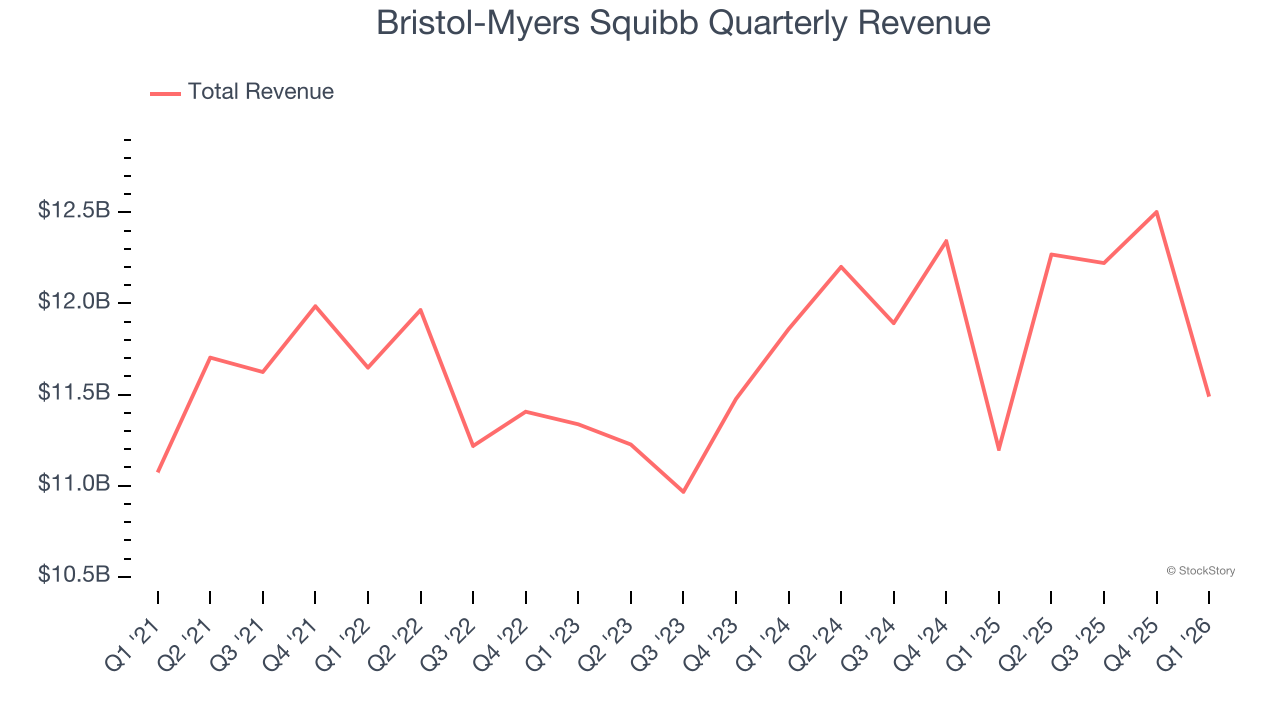
Long-term growth is the most important, but within healthcare, a half-decade historical view may miss new innovations or demand cycles. Bristol-Myers Squibb’s annualized revenue growth of 3.2% over the last two years aligns with its five-year trend, suggesting its demand was consistently weak. 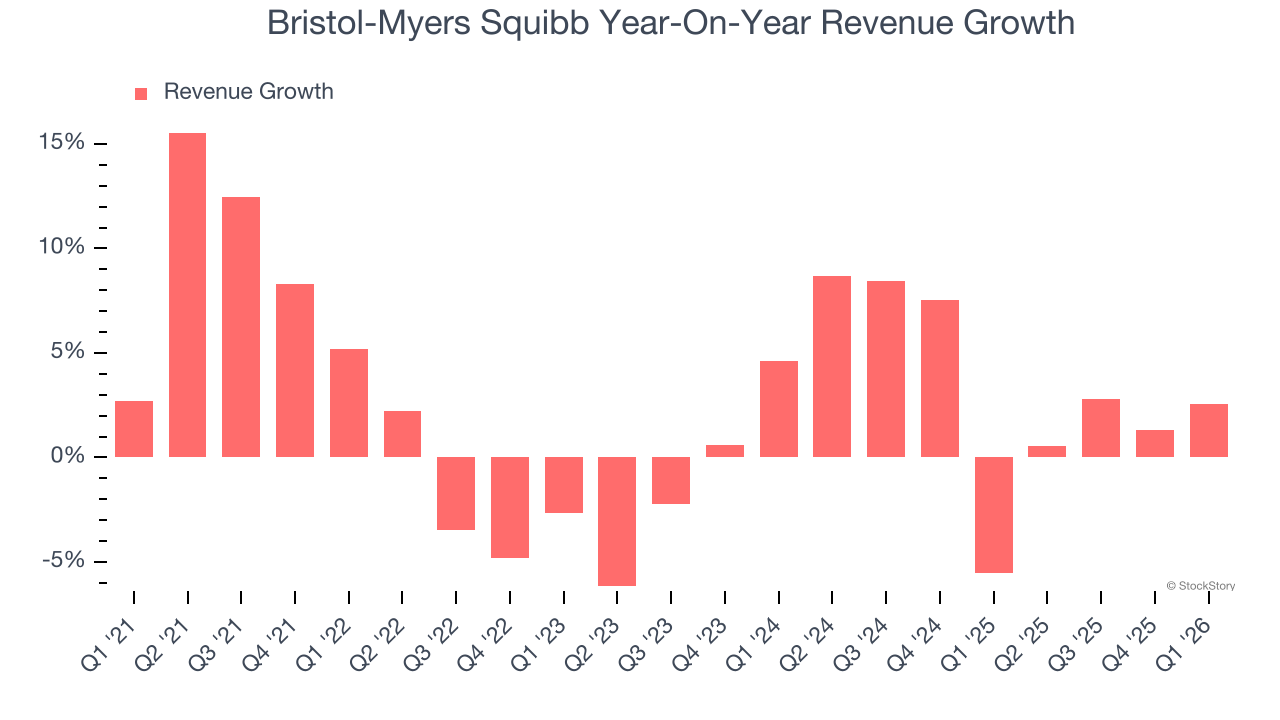
Bristol-Myers Squibb also breaks out the revenue for its most important segment, Growth Portfolio. Over the last two years, Bristol-Myers Squibb’s Growth Portfolio revenue averaged 16% year-on-year growth. This segment has outperformed its total sales during the same period, lifting the company’s performance. 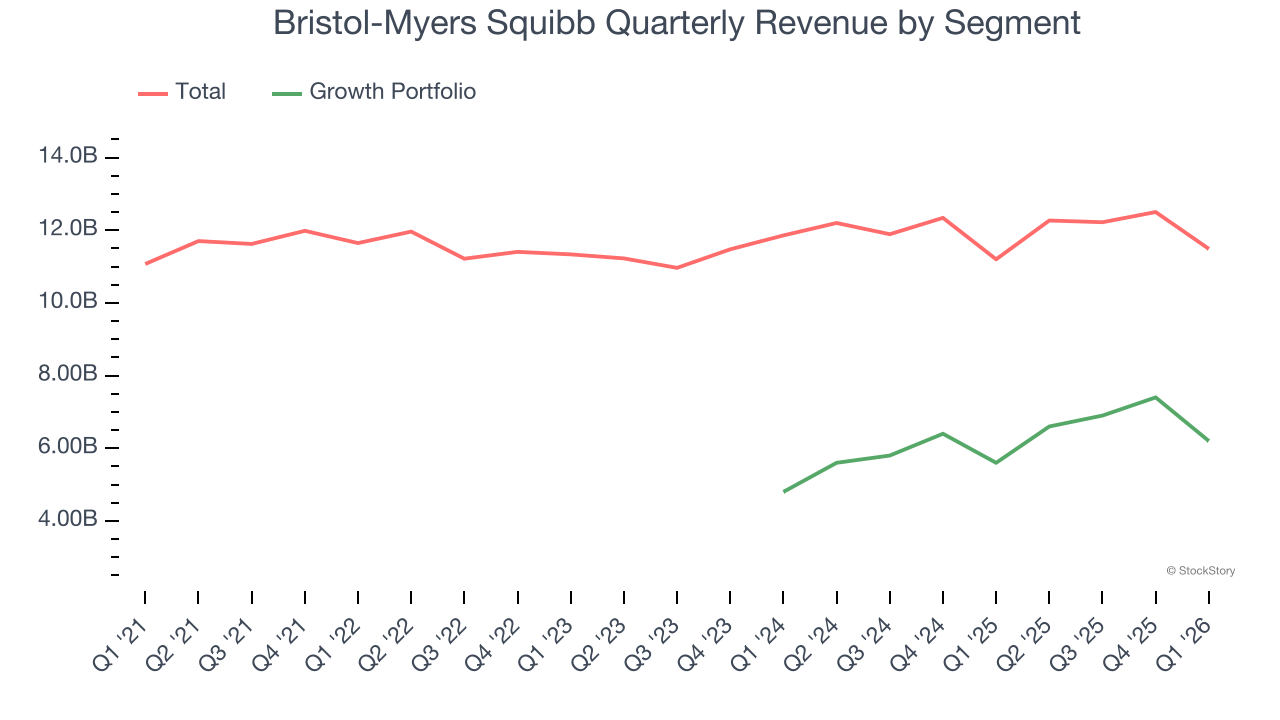
This quarter, Bristol-Myers Squibb reported modest year-on-year revenue growth of 2.6% but beat Wall Street’s estimates by 7.4%.
Looking ahead, sell-side analysts expect revenue to decline by 5.1% over the next 12 months, a deceleration versus the last two years. This projection is underwhelming and suggests its products and services will see some demand headwinds.
ONE MORE THING: The $21 AI Application Stock Wall Street Forgot. While Wall Street obsesses over who’s building AI, one company is already using it to print money. And nobody’s paying attention.
AI chip stocks trade at ridiculous valuations. This company processes a trillion consumer signals monthly using AI and trades at a third of the price. The gap won’t last. The institutions will figure it out. You need to see this first. Read the FREE Report Before They Notice.
Adjusted Operating Margin
Adjusted operating margin is a key measure of profitability. Think of it as net income (the bottom line) excluding the impact of non-recurring expenses, taxes, and interest on debt - metrics less connected to business fundamentals.
Bristol-Myers Squibb has been a well-oiled machine over the last five years. It demonstrated elite profitability for a healthcare business, boasting an average adjusted operating margin of 30.9%.
Looking at the trend in its profitability, Bristol-Myers Squibb’s adjusted operating margin decreased by 12.3 percentage points over the last five years, but it rose by 20.2 percentage points on a two-year basis. Still, shareholders will want to see Bristol-Myers Squibb become more profitable in the future.
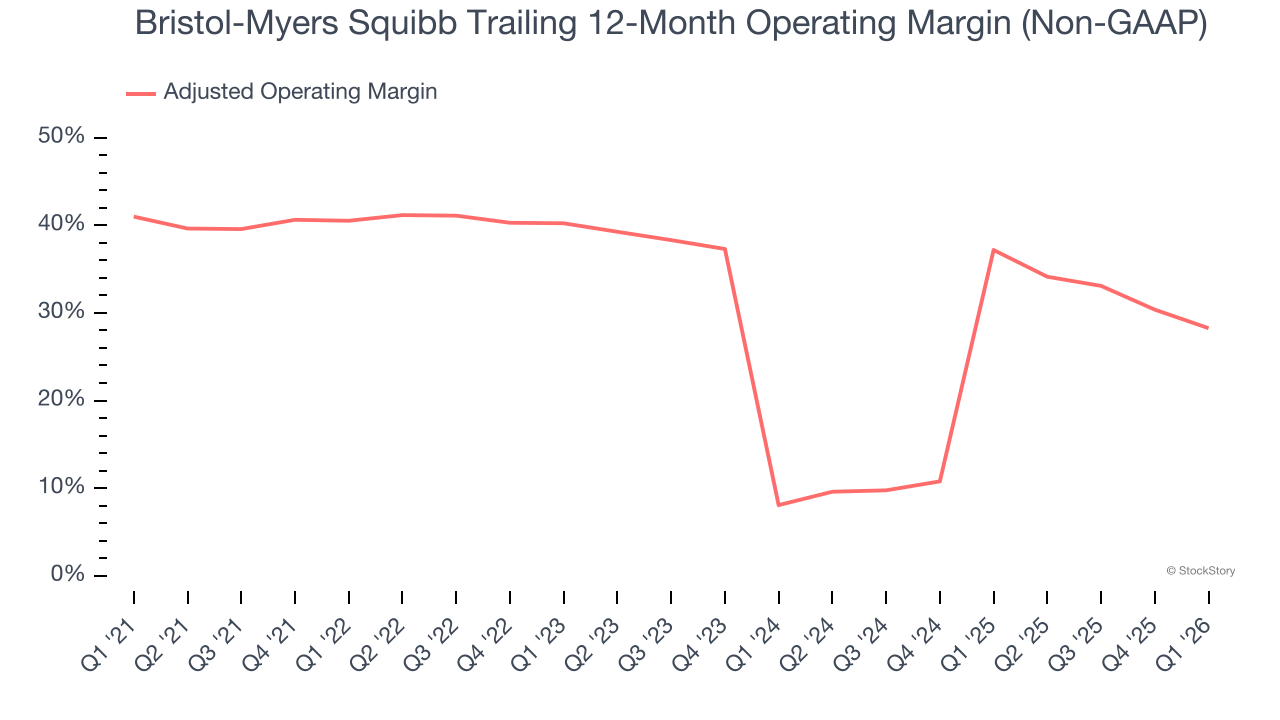
This quarter, Bristol-Myers Squibb generated an adjusted operating margin profit margin of 28.2%, down 9.1 percentage points year on year. This contraction shows it was less efficient because its expenses grew faster than its revenue.
Earnings Per Share
Revenue trends explain a company’s historical growth, but the long-term change in earnings per share (EPS) points to the profitability of that growth – for example, a company could inflate its sales through excessive spending on advertising and promotions.
Sadly for Bristol-Myers Squibb, its EPS declined by 1.7% annually over the last five years while its revenue grew by 2.6%. This tells us the company became less profitable on a per-share basis as it expanded due to non-fundamental factors such as interest expenses and taxes.
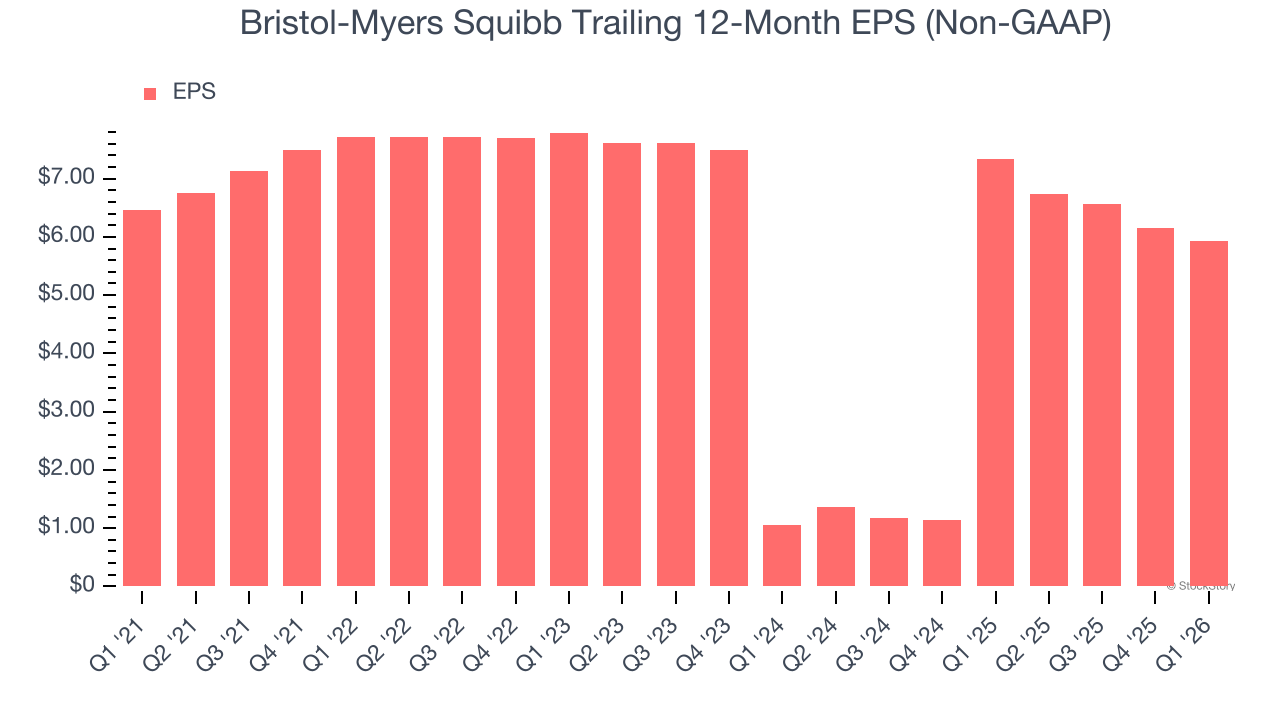
We can take a deeper look into Bristol-Myers Squibb’s earnings to better understand the drivers of its performance. As we mentioned earlier, Bristol-Myers Squibb’s adjusted operating margin declined by 12.3 percentage points over the last five years. This was the most relevant factor (aside from the revenue impact) behind its lower earnings; interest expenses and taxes can also affect EPS but don’t tell us as much about a company’s fundamentals.
In Q1, Bristol-Myers Squibb reported adjusted EPS of $1.58, down from $1.80 in the same quarter last year. Despite falling year on year, this print easily cleared analysts’ estimates. Over the next 12 months, Wall Street expects Bristol-Myers Squibb’s full-year EPS of $5.93 to grow 4.8%.
Key Takeaways from Bristol-Myers Squibb’s Q1 Results
We were impressed by how significantly Bristol-Myers Squibb blew past analysts’ revenue expectations this quarter. We were also glad its EPS outperformed Wall Street’s estimates. On the other hand, its full-year EPS guidance slightly missed and its full-year revenue guidance fell slightly short of Wall Street’s estimates. Overall, this print was mixed but still had some key positives. The stock remained flat at $57.96 immediately following the results.
Is Bristol-Myers Squibb an attractive investment opportunity at the current price? The latest quarter does matter, but not nearly as much as longer-term fundamentals and valuation, when deciding if the stock is a buy. We cover that in our actionable full research report which you can read here (it’s free).