
Healthcare company Baxter International (NYSE: BAX) reported revenue ahead of Wall Street’s expectations in Q1 CY2026, with sales up 2.9% year on year to $2.70 billion. Its non-GAAP profit of $0.36 per share was 15.9% above analysts’ consensus estimates.
Is now the time to buy Baxter? Find out by accessing our full research report, it’s free.
Baxter (BAX) Q1 CY2026 Highlights:
- Revenue: $2.70 billion vs analyst estimates of $2.61 billion (2.9% year-on-year growth, 3.5% beat)
- Adjusted EPS: $0.36 vs analyst estimates of $0.31 (15.9% beat)
- Adjusted Operating Income: $230 million vs analyst estimates of $273.6 million (8.5% margin, 16% miss)
- Management reiterated its full-year Adjusted EPS guidance of $1.95 at the midpoint
- Operating Margin: 2.4%, in line with the same quarter last year
- Constant Currency Revenue fell 1% year on year (5% in the same quarter last year)
- Market Capitalization: $8.72 billion
Company Overview
With a history dating back to 1931 and products used in over 100 countries, Baxter International (NYSE: BAX) provides essential healthcare products including dialysis therapies, IV solutions, infusion systems, surgical products, and patient monitoring technologies to hospitals and clinics worldwide.
Revenue Growth
Reviewing a company’s long-term sales performance reveals insights into its quality. Any business can put up a good quarter or two, but the best consistently grow over the long haul. Unfortunately, Baxter struggled to consistently increase demand as its $11.32 billion of sales for the trailing 12 months was close to its revenue five years ago. This wasn’t a great result and is a sign of poor business quality.
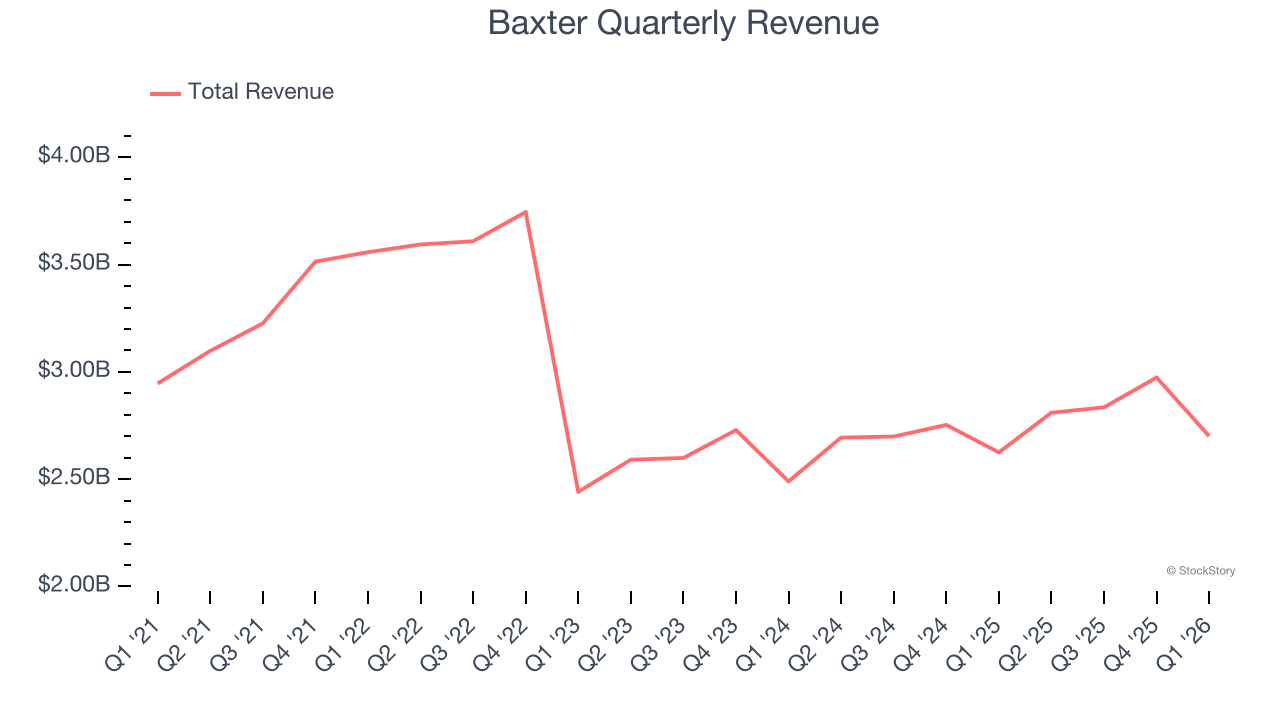
We at StockStory place the most emphasis on long-term growth, but within healthcare, a half-decade historical view may miss recent innovations or disruptive industry trends. Baxter’s annualized revenue growth of 4.3% over the last two years is above its five-year trend, which is encouraging. 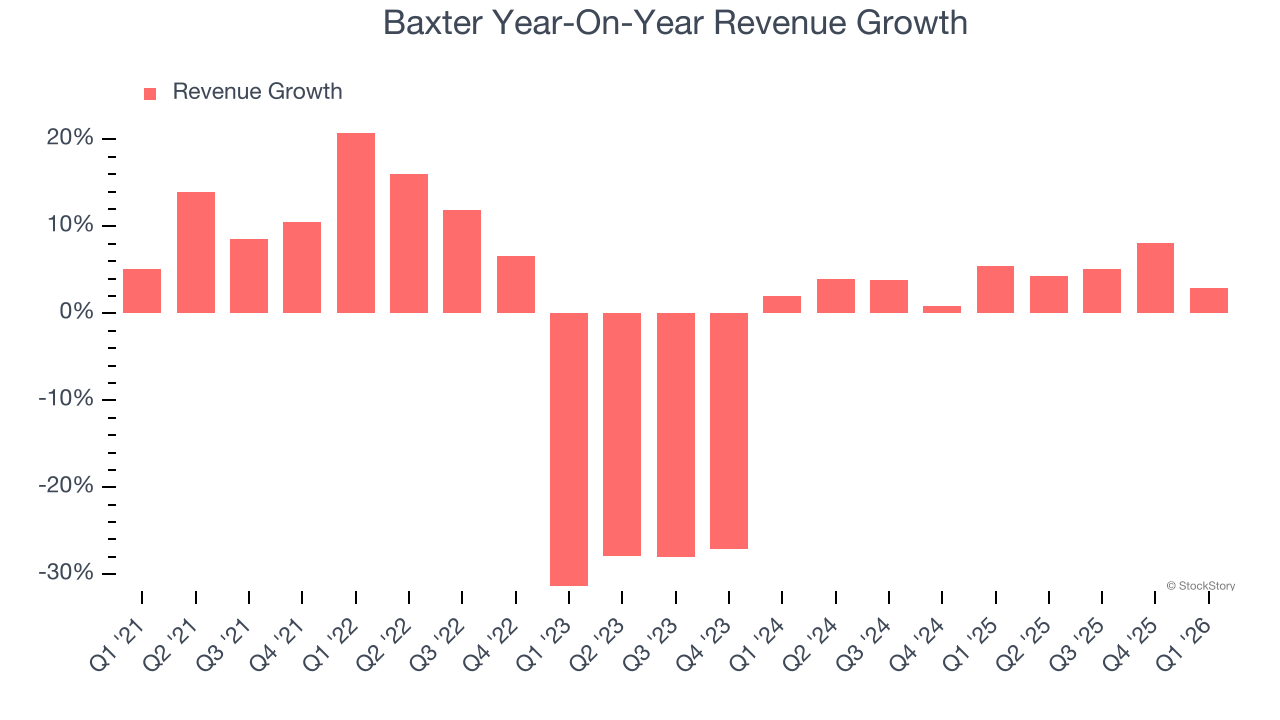
Baxter also reports sales performance excluding currency movements, which are outside the company’s control and not indicative of demand. Over the last two years, its constant currency sales averaged 2.5% year-on-year growth. Because this number is lower than its normal revenue growth, we can see that foreign exchange rates have boosted Baxter’s performance. 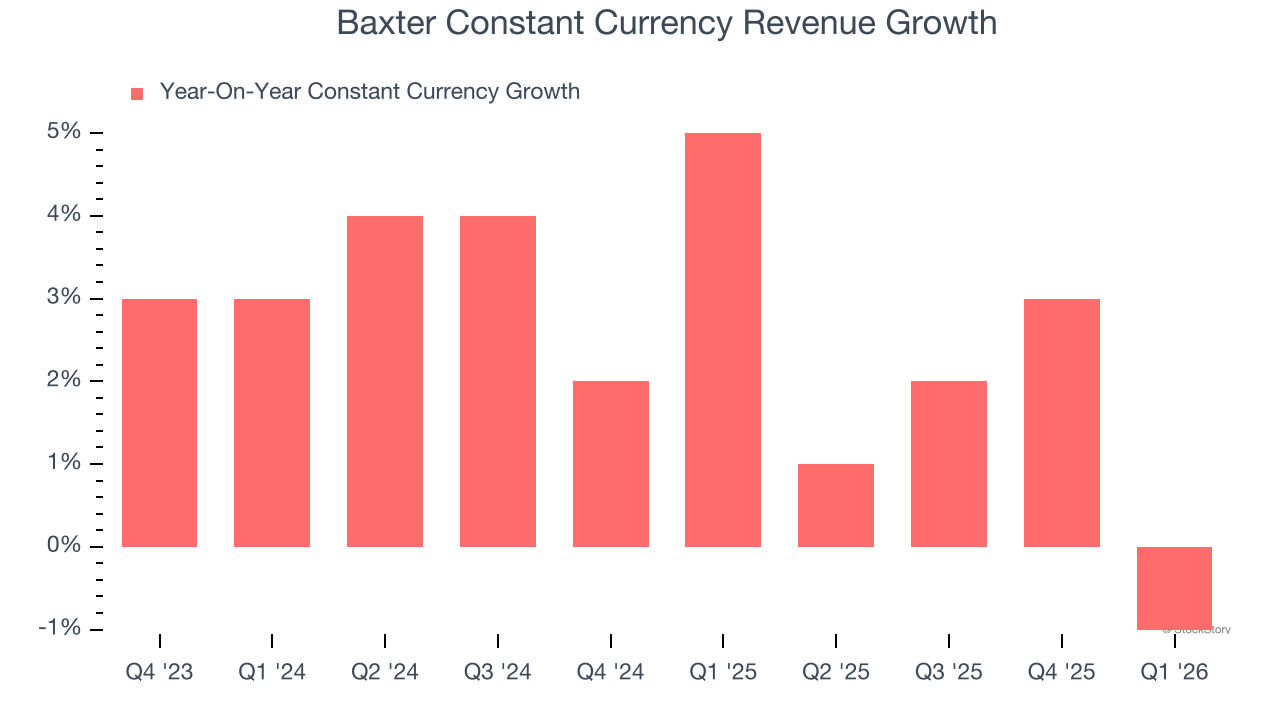
This quarter, Baxter reported modest year-on-year revenue growth of 2.9% but beat Wall Street’s estimates by 3.5%.
Looking ahead, sell-side analysts expect revenue to remain flat over the next 12 months, a deceleration versus the last two years. This projection doesn't excite us and implies its products and services will face some demand challenges.
WHILE YOU’RE HERE: The Next Palantir? One satellite company captures images of every point on Earth. Every single day. The Pentagon wants it. Hedge funds are using it to beat earnings. You’ve probably never heard of it.
This is what the early days of Palantir looked like before it became a $437 billion giant. Same playbook. Different technology. If you missed Palantir, you need to see this. Claim The Stock Ticker for Free HERE.
Adjusted Operating Margin
Baxter has managed its cost base well over the last five years. It demonstrated solid profitability for a healthcare business, producing an average adjusted operating margin of 15.2%.
Looking at the trend in its profitability, Baxter’s adjusted operating margin decreased by 5.9 percentage points over the last five years. The company’s two-year trajectory also shows it failed to get its profitability back to the peak as its margin fell by 2 percentage points. This performance was poor no matter how you look at it - it shows its expenses were rising and it couldn’t pass those costs onto its customers.
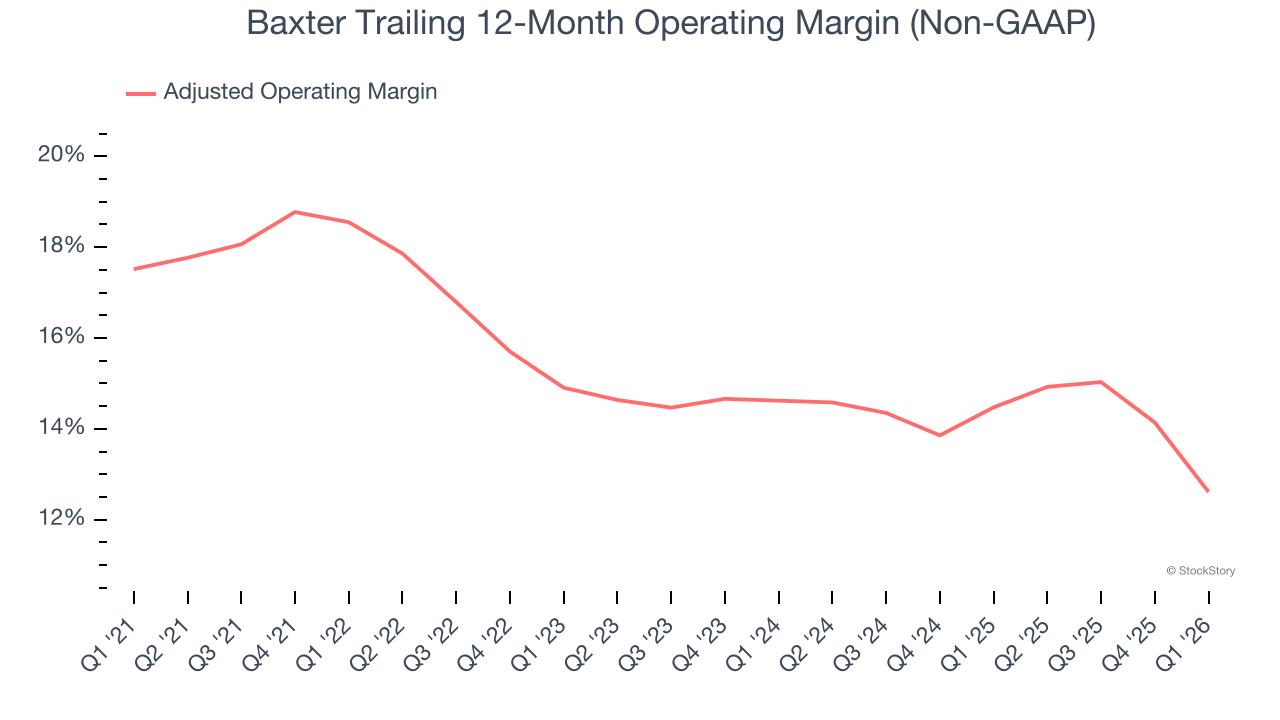
In Q1, Baxter generated an adjusted operating margin profit margin of 8.5%, down 6.4 percentage points year on year. This contraction shows it was less efficient because its expenses grew faster than its revenue.
Earnings Per Share
Revenue trends explain a company’s historical growth, but the long-term change in earnings per share (EPS) points to the profitability of that growth – for example, a company could inflate its sales through excessive spending on advertising and promotions.
Sadly for Baxter, its EPS declined by 7.2% annually over the last five years while its revenue was flat. This tells us the company struggled because its fixed cost base made it difficult to adjust to choppy demand.
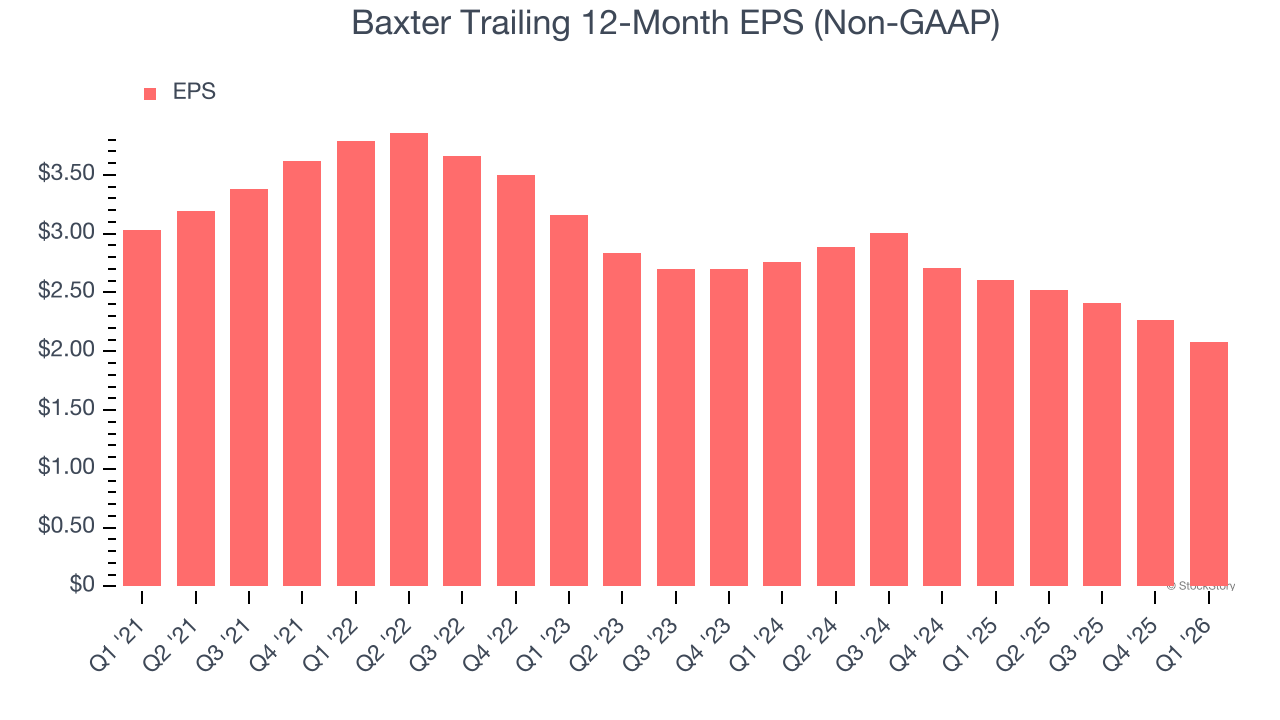
Diving into the nuances of Baxter’s earnings can give us a better understanding of its performance. As we mentioned earlier, Baxter’s adjusted operating margin declined by 5.9 percentage points over the last five years. This was the most relevant factor (aside from the revenue impact) behind its lower earnings; interest expenses and taxes can also affect EPS but don’t tell us as much about a company’s fundamentals.
In Q1, Baxter reported adjusted EPS of $0.36, down from $0.55 in the same quarter last year. Despite falling year on year, this print easily cleared analysts’ estimates. Over the next 12 months, Wall Street expects Baxter’s full-year EPS of $2.08 to shrink by 4.1%.
Key Takeaways from Baxter’s Q1 Results
We enjoyed seeing Baxter beat analysts’ revenue expectations this quarter. We were also glad its EPS outperformed Wall Street’s estimates. Zooming out, we think this was a solid print. The stock traded up 7.6% to $18.19 immediately following the results.
Sure, Baxter had a solid quarter, but if we look at the bigger picture, is this stock a buy? When making that decision, it’s important to consider its valuation, business qualities, as well as what has happened in the latest quarter. We cover that in our actionable full research report which you can read here (it’s free).