Snack food company J&J Snack Foods (NASDAQ: JJSF) missed Wall Street’s revenue expectations in Q4 CY2025, with sales falling 5.2% year on year to $343.8 million. Its non-GAAP profit of $0.33 per share was 8.3% below analysts’ consensus estimates.
Is now the time to buy J&J Snack Foods? Find out by accessing our full research report, it’s free.
J&J Snack Foods (JJSF) Q4 CY2025 Highlights:
- Revenue: $343.8 million vs analyst estimates of $360.7 million (5.2% year-on-year decline, 4.7% miss)
- Adjusted EPS: $0.33 vs analyst expectations of $0.36 (8.3% miss)
- Adjusted EBITDA: $27.03 million vs analyst estimates of $28.17 million (7.9% margin, 4% miss)
- Operating Margin: 0.2%, down from 1.7% in the same quarter last year
- Free Cash Flow Margin: 4.9%, similar to the same quarter last year
- Market Capitalization: $1.81 billion
“Our first quarter results reflect disciplined execution of our key priorities to drive profitability,” said Dan Fachner, J&J Snack Foods Chairman, President, and CEO.
Company Overview
Best known for its SuperPretzel soft pretzels and ICEE frozen drinks, J&J Snack Foods (NASDAQ: JJSF) produces a range of snacks and beverages and distributes them primarily to supermarket and food service customers.
Revenue Growth
A company’s long-term sales performance can indicate its overall quality. Any business can have short-term success, but a top-tier one grows for years.
With $1.56 billion in revenue over the past 12 months, J&J Snack Foods is a small consumer staples company, which sometimes brings disadvantages compared to larger competitors benefiting from economies of scale and negotiating leverage with retailers.
As you can see below, J&J Snack Foods grew its sales at a sluggish 3.4% compounded annual growth rate over the last three years. This shows it failed to generate demand in any major way and is a rough starting point for our analysis.
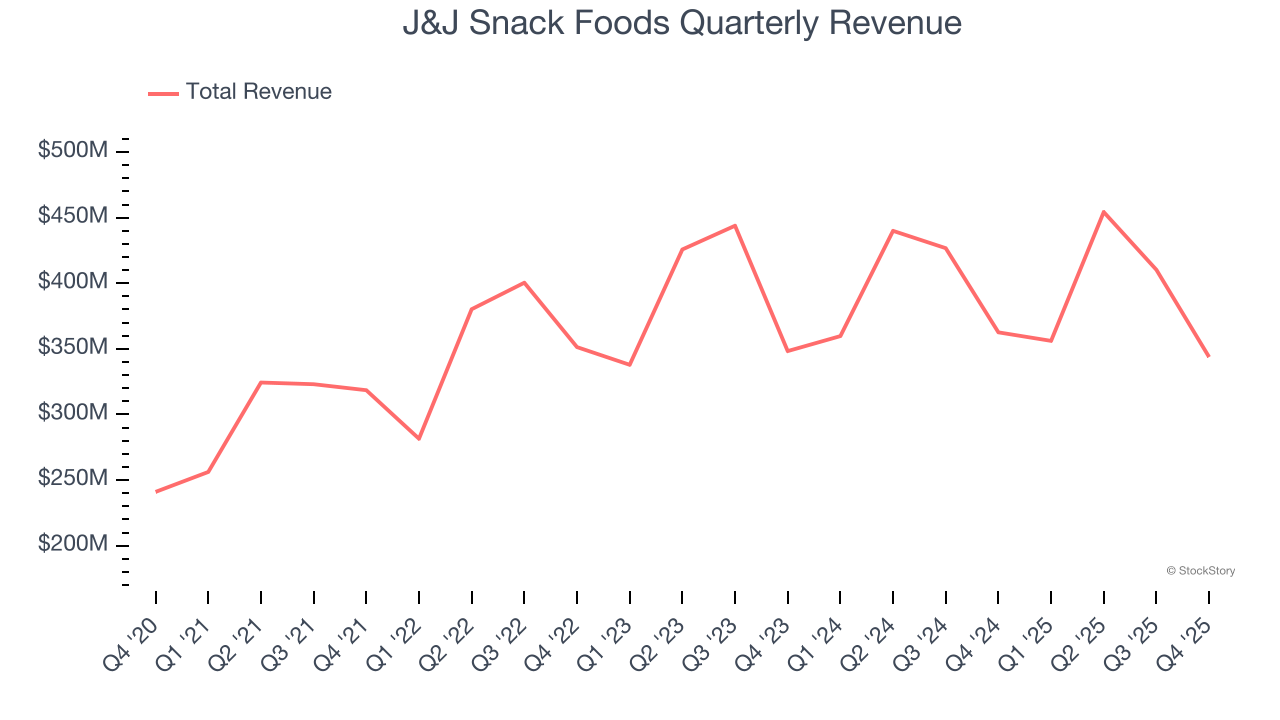
This quarter, J&J Snack Foods missed Wall Street’s estimates and reported a rather uninspiring 5.2% year-on-year revenue decline, generating $343.8 million of revenue.
Looking ahead, sell-side analysts expect revenue to grow 3.7% over the next 12 months, similar to its three-year rate. This projection doesn't excite us and indicates its newer products will not catalyze better top-line performance yet.
Software is eating the world and there is virtually no industry left that has been untouched by it. That drives increasing demand for tools helping software developers do their jobs, whether it be monitoring critical cloud infrastructure, integrating audio and video functionality, or ensuring smooth content streaming. Click here to access a free report on our 3 favorite stocks to play this generational megatrend.
Cash Is King
Free cash flow isn't a prominently featured metric in company financials and earnings releases, but we think it's telling because it accounts for all operating and capital expenses, making it tough to manipulate. Cash is king.
J&J Snack Foods has shown decent cash profitability, giving it some flexibility to reinvest or return capital to investors. The company’s free cash flow margin averaged 5.4% over the last two years, slightly better than the broader consumer staples sector.
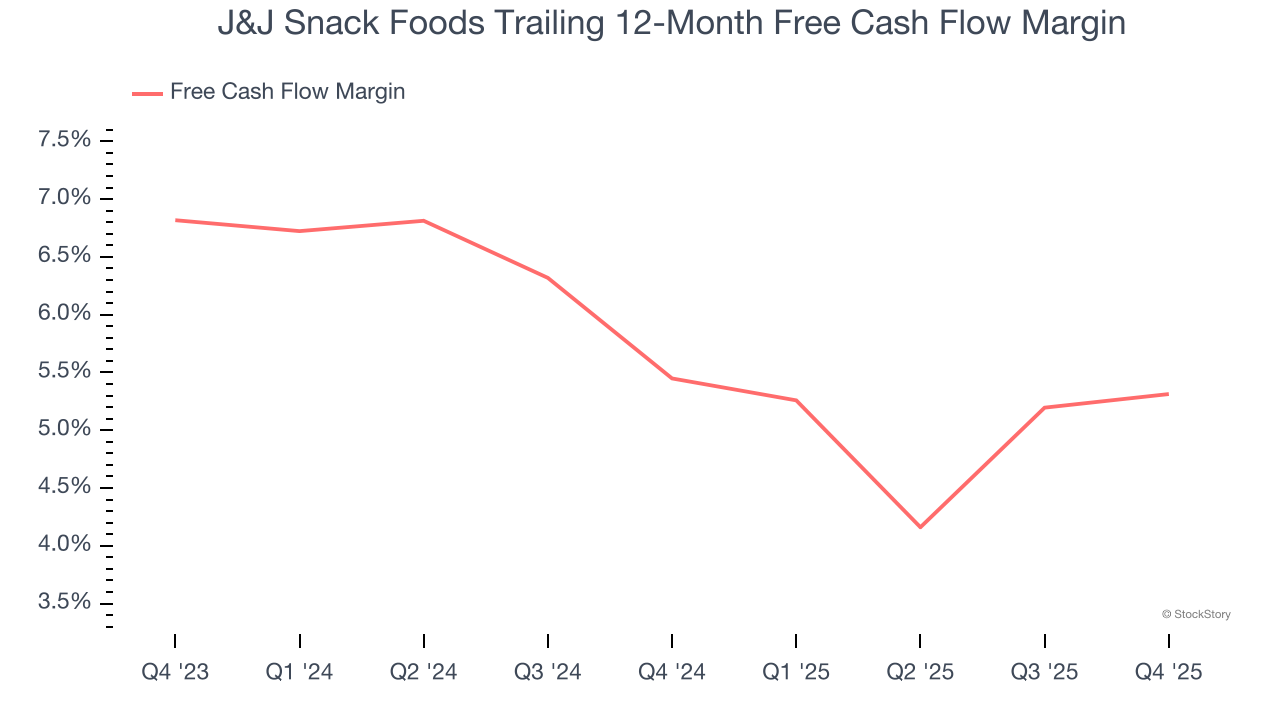
J&J Snack Foods’s free cash flow clocked in at $16.96 million in Q4, equivalent to a 4.9% margin. This cash profitability was in line with the comparable period last year and its two-year average.
Key Takeaways from J&J Snack Foods’s Q4 Results
We enjoyed seeing J&J Snack Foods beat analysts’ gross margin expectations this quarter. On the other hand, its revenue missed and its EPS fell short of Wall Street’s estimates. Overall, this quarter could have been better. The stock remained flat at $95.22 immediately following the results.
Big picture, is J&J Snack Foods a buy here and now? If you’re making that decision, you should consider the bigger picture of valuation, business qualities, as well as the latest earnings. We cover that in our actionable full research report which you can read here (it’s free).