As AI clusters push more data across fiber, GPD frames photodetection as a material-selection challenge across monitoring, alignment, testing and high-speed optical links - not a one-size-fits-all component decision.
Salem, NH (PRUnderground) July 23rd, 2026
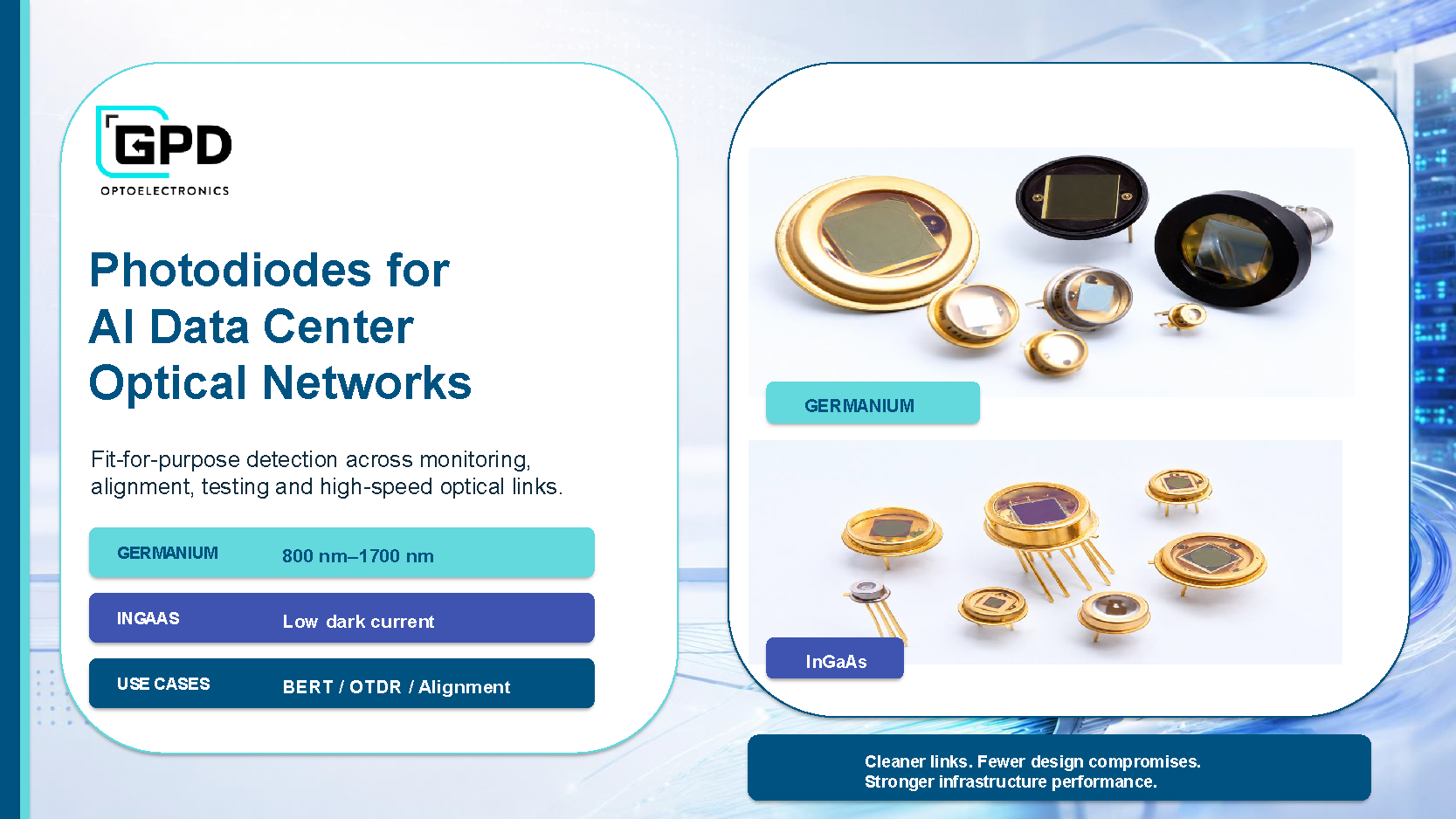
GPD Optoelectronics Corp. today described how its Germanium and InGaAs photodiode portfolio supports one of the practical engineering challenges emerging inside AI data centers: selecting the right detector material for the right point in the optical path.
As optical links extend across GPU racks, switching fabrics and data center interconnects, system performance increasingly depends on how accurately those links are converted, monitored, aligned, tested and validated.
The AI boom is becoming a physical infrastructure boom. To feed massive GPU clusters and high-density server racks, modern data centers require faster, cleaner and more efficient data movement. For decades, copper wiring handled much of this work, but high-frequency electrical signals degrade quickly over copper, generating heat and wasting valuable energy.
The industry’s move toward fiber-optic infrastructure is not simply a cabling change. As networks scale toward 800G, 1.6T and beyond, performance depends on how well optical links are monitored, aligned, tested and converted back into usable electrical information. At GPD Optoelectronics, we see this transition showing up in practical engineering decisions: how optical power is measured, how high-speed signals are detected, how co-packaged optics are aligned, and how optical links are tested using BERT and OTDR-based methods.
At the center of this transition sit photodiodes. These specialized components convert light into electrical signals, and their material properties directly affect signal integrity, link margin, monitoring accuracy and validation confidence across the optical network.
“The next constraint in AI infrastructure is not only how much compute can be deployed, but how reliably data moves through the optical network that connects it,” said Stuart David, Senior Vice President of Sales and Marketing at GPD Optoelectronics. “That puts photodetection closer to the center of system design. At each light-to-electrical conversion point, the detector affects signal integrity, link margin, monitoring accuracy and validation confidence. Germanium and InGaAs solve different engineering problems: Germanium supports shorter-reach, high-signal and cost-sensitive links, while InGaAs delivers the low dark current, sensitivity and speed required for longer-reach and lower-noise optical paths. At AI data-center scale, those material choices can mean cleaner links, fewer design compromises and stronger infrastructure performance.”
Fiber-optic communication relies heavily on the near-infrared spectrum, particularly wavelengths around 1310 nm and 1550 nm, because these wavelengths experience lower signal loss and scattering as they travel through glass fiber. Silicon, however, is physically transparent to wavelengths longer than 1100 nm. To convert incoming light pulses back into electrical data, optical systems require detector materials with narrower bandgaps. This is where Germanium and InGaAs step in.
Germanium photodiodes have long served as a reliable workhorse in near-infrared detection. Germanium sensors provide strong linearity and broad spectral response covering 800 nm to 1700 nm, making them useful across multiple transmission bands. Because Germanium is more cost-efficient to process than complex compound semiconductors, Ge photodiodes can be a practical option for high-volume, shorter-reach and higher-signal environments where extreme sensitivity is not the primary constraint.
InGaAs is used where higher-speed and lower-noise detection performance is required. InGaAs devices offer lower dark current and higher shunt resistance compared with Germanium, supporting cleaner signal-to-noise performance for high-speed and lower-light optical applications. This makes InGaAs well suited for longer-reach links, low-signal optical monitoring and demanding test environments.
For data-center engineers, the practical question is not whether Germanium or InGaAs is universally better. The question is where each material fits across the optical path: short-reach monitoring, 2 km links, 10 km+ data-center interconnects, co-packaged optics alignment, bit-error-rate testing and optical time-domain reflectometry.
GPD’s portfolio includes Germanium, standard InGaAs, extended InGaAs, high-speed InGaAs, specialty and multi-cell photodiode options, supported by packaging capabilities such as fiber coupling, optical filters, windows, mounting configurations and thermoelectric cooling. These capabilities support optical communications, semiconductor, aerospace, defense, industrial sensing and scientific instrumentation applications.
For engineers evaluating photodetector tradeoffs beyond the data-center environment, GPD also provides a Photodetector Buyer’s Guide that explains how specifications such as wavelength range, dark current, responsivity, stability and packaging translate into system performance, lifecycle cost and time to market.
“Detector selection is ultimately about matching performance to the application,” said Peter Dixon, Chief Operating Officer at GPD Optoelectronics. “A power monitor, alignment sensor, test instrument and high-speed receiver each place different demands on wavelength, bandwidth, noise and packaging. Understanding those tradeoffs early helps engineers avoid overengineering the solution.”
As AI data-center infrastructure expands, photodetection is becoming part of the performance layer behind high-speed optical networks. GPD’s Germanium and InGaAs portfolio gives engineers a fit-for-purpose path across speed, reach, noise, wavelength, package and cost considerations, helping them make detector choices that support cleaner links, fewer design compromises and stronger infrastructure performance at scale.
About GPD Optoelectronics
Founded in 1973 and headquartered in Salem, New Hampshire, GPD Optoelectronics Corp. is a leading U.S. manufacturer of InGaAs and Germanium photodiodes, position sensing devices, and custom optical detectors. GPD’s products serve aerospace, defense, telecommunications, industrial, and research applications worldwide. With a proven track record in both custom and commercial off-the-shelf (COTS) solutions, GPD is dedicated to delivering precision, reliability, and innovation under its brand promise: Sensing Further.
The post GPD Optoelectronics Positions Germanium and InGaAs Photodiodes Around Fit-for-Purpose Detection in AI Data Center Optical Networks first appeared on
Original Press Release.