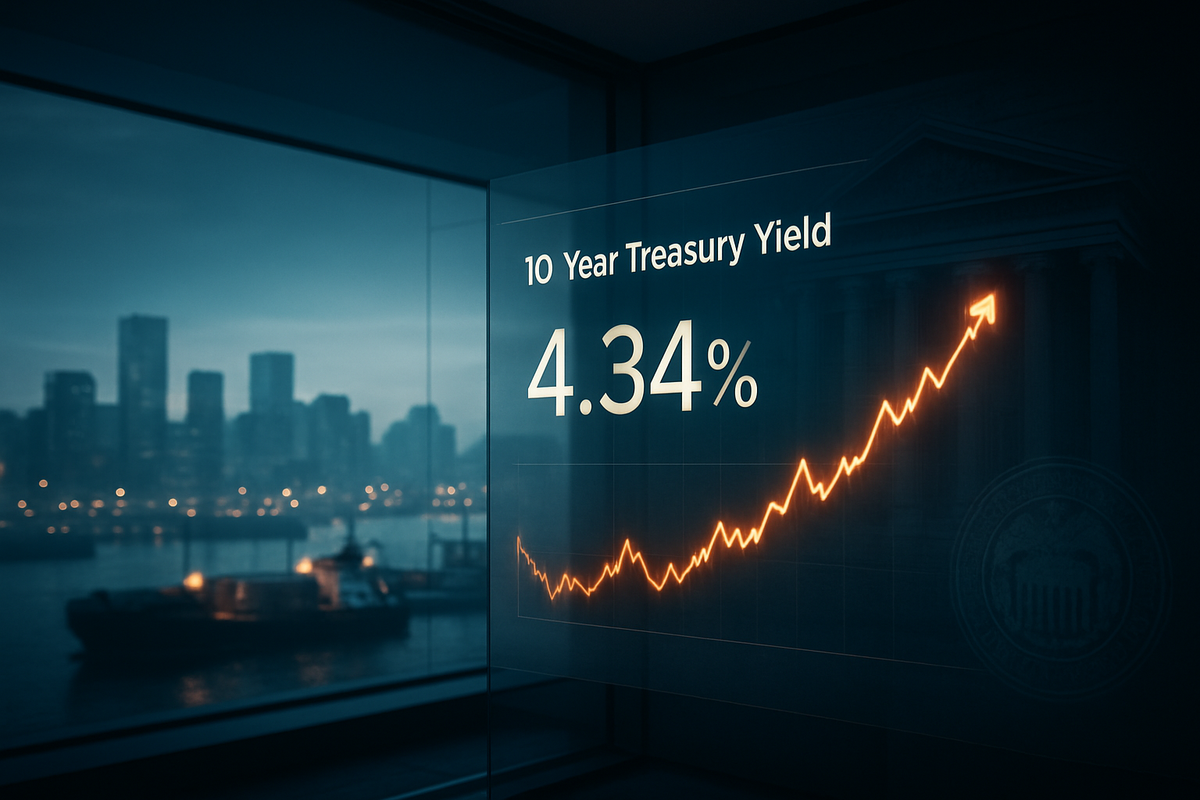
The U.S. bond market is sending a stark message to investors as the 10-year Treasury note yield climbed to 4.34% today, April 7, 2026. This move marks a critical juncture for the financial markets, reflecting a complex interplay of resilient economic data, surging energy prices, and persistent concerns over the federal government’s massive borrowing requirements. The breach of the 4.34% level, a threshold that has historically triggered significant volatility, suggests that the "higher-for-longer" interest rate environment is not just a temporary phase but a structural reality of the late 2020s economy.
As yields rise, the immediate implications are felt across every corner of the economy, from mortgage rates to corporate valuations. The 10-year yield is a primary benchmark for long-term lending; its ascent signals that the cost of capital is once again recalibrating upward. For investors, this shift indicates a growing consensus that inflation remains "sticky" and that the Federal Reserve may have very little room to cut rates in the near future, despite previous market hopes for a more dovish pivot.
The Perfect Storm: Inflation, Employment, and the Deficit
The surge to 4.34% did not happen in a vacuum. It is the culmination of a "perfect storm" of macroeconomic factors that converged in early 2026. Primarily, geopolitical instability in the Middle East has pushed Brent crude prices above $110 per barrel, reigniting fears of an energy-driven inflationary spiral. This "oil shock" has effectively neutralized the downward trend in consumer prices seen earlier in the year, forcing bond investors to demand higher yields to compensate for the eroding purchasing power of future interest payments.
Compounding the inflation narrative is the surprising resilience of the U.S. labor market. The March 2026 jobs report revealed a staggering 178,000 new jobs added, nearly triple the consensus estimate of 60,000. In a typical economic cycle, strong employment is welcomed, but in the current climate, it signals to the market that the economy is still "running hot," potentially fueling further wage-price pressures. This data has effectively moved the goalposts for the Federal Reserve, with many analysts now predicting that rate cuts may be sidelined until late 2027.
Finally, the sheer scale of U.S. government borrowing continues to weigh heavily on the Treasury market. With persistent fiscal deficits requiring the issuance of vast amounts of new debt, the supply of Treasuries has begun to outpace demand at lower yield levels. This imbalance has increased the "term premium"—the extra compensation investors require to hold long-term debt over short-term debt—adding a structural floor to yields that remains independent of Federal Reserve policy.
Winners and Losers in the New Yield Regime
The move to 4.34% has created a sharp divide between market winners and losers. In the banking sector, giants like JPMorgan Chase & Co. (NYSE: JPM) and Goldman Sachs Group Inc. (NYSE: GS) have found a silver lining. A steepening yield curve typically expands Net Interest Margins (NIMs), allowing these institutions to earn more on the gap between what they pay depositors and what they earn on loans and long-term investments. Shares in major financial institutions have seen a corresponding uptick as investors bet on improved profitability.
Conversely, the high-growth technology sector has borne the brunt of the yield spike. Companies such as Microsoft Corp. (NASDAQ: MSFT), Salesforce Inc. (NYSE: CRM), and Oracle Corp. (NYSE: ORCL) are particularly sensitive to rising yields because their valuations are largely based on the present value of future cash flows. When the "discount rate" (derived from Treasury yields) rises, the current value of those future earnings drops, leading to multiple compression and sell-offs in the tech-heavy Nasdaq index.
In the consumer and industrial sectors, the impact is equally bifurcated. United Airlines Holdings (NASDAQ: UAL) and Carnival Corp (NYSE: CCL) have seen their stock prices tumble as they face the dual threat of rising fuel costs and higher interest expenses on their substantial debt loads. Meanwhile, NVIDIA Corp. (NASDAQ: NVDA) has managed to remain relatively resilient, as its dominant position in the artificial intelligence sector allows it to outpace the headwinds of rising rates with explosive earnings growth, proving that "quality" and "growth" are being redefined by AI-driven productivity.
A Structural Shift in Global Finance
The return of the 10-year yield to the 4.34% range is more than just a headline number; it represents a broader shift in industry trends and historical precedents. For the better part of the last decade, investors operated in a world of "zero-bound" interest rates and low inflation. However, the current environment mirrors the stagflationary pressures of the late 1970s or the yield-driven volatility of 2023-2024. This "New Normal" suggests that the 4.30% to 4.50% range has become a structural ceiling that, when approached, triggers a systemic rotation of capital.
Furthermore, the rising yield environment has significant regulatory and policy implications. As the cost of servicing the national debt increases, the U.S. Treasury may face mounting pressure to adjust its auction calendars or seek new ways to incentivize domestic and foreign buyers. On the corporate side, the "refinancing wall" of 2026—a period where many companies must roll over debt taken out during the low-rate era—is becoming a major concern for regulators, as higher rates could lead to a spike in corporate defaults for over-leveraged firms.
The ripple effects also extend to the housing market. As Treasury yields climb, mortgage rates generally follow, with the average 30-year fixed rate now hovering near 7%. This has essentially frozen the residential real estate market, as both buyers and sellers remain sidelined by high costs and a lack of inventory. The historical comparison to the "Great Moderation" era is fading, replaced by a more volatile, supply-constrained economic landscape where fiscal policy and geopolitics play as large a role as central bank actions.
What Comes Next: The 2026 Outlook
Looking ahead, the market is divided on where yields will go from here. Short-term scenarios suggest a period of consolidation; if oil prices stabilize or the labor market finally shows signs of cooling, yields could retreat toward the 4.00% mark. However, long-term projections from institutions like RBC Wealth Management suggest that the 10-year could reach as high as 4.55% by the end of 2026, driven by the persistent need for the government to fund its deficit through increased Treasury supply.
Strategic pivots are already underway. Corporations are increasingly looking to deleverage their balance sheets, while retail investors are shifting away from speculative "meme stocks" toward fixed-income products and high-yield savings. The market opportunity now lies in "inflation hedges" and companies with strong pricing power. If the yield continues its ascent toward 5.0%, we may see a more aggressive shift in asset allocation, moving toward value-oriented sectors and defensive utilities that can weather the storm of high borrowing costs.
Final Assessment and Key Takeaways
The rise of the 10-year Treasury yield to 4.34% is a watershed moment for 2026. It underscores the reality that inflation and government borrowing are now the primary drivers of market sentiment, superseding the Federal Reserve's previous "forward guidance." The key takeaway for investors is that the era of "cheap money" is firmly in the rearview mirror. Moving forward, the market will likely reward companies with robust cash flows and low debt, while penalizing those reliant on cheap financing for growth.
As we move through the remainder of 2026, the primary indicators to watch will be monthly CPI prints, geopolitical developments in the Middle East, and the size of upcoming Treasury auctions. If the 4.34% level is sustained or exceeded, it will likely serve as a headwind for the broader equity market, forcing a continued repricing of risk across all asset classes. For now, the bond market is sounding the alarm, and the rest of the financial world is listening intently.
This content is intended for informational purposes only and is not financial advice.