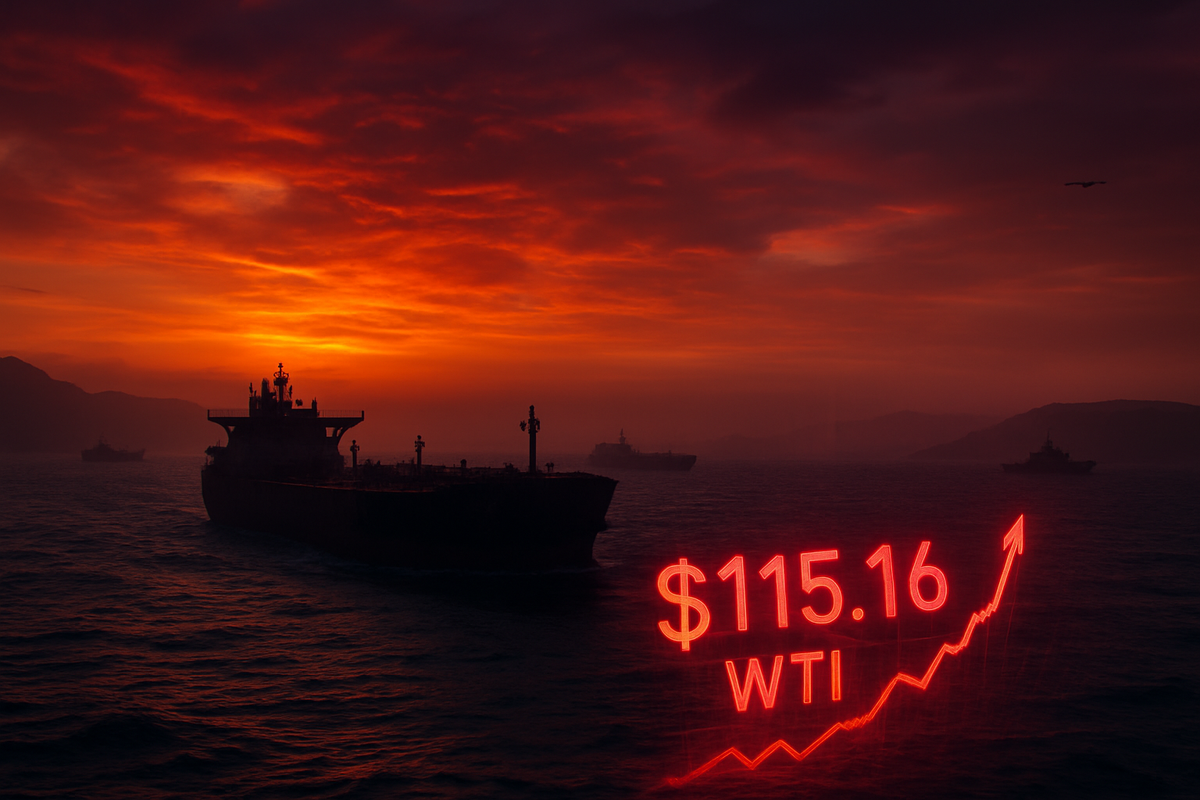
WASHINGTON D.C. — Global energy markets were thrown into a state of high-velocity panic on the morning of April 7, 2026, as West Texas Intermediate (WTI) crude oil futures surged past the $115 per barrel mark. The spike follows a dramatic military escalation in the Middle East, centered on the Strait of Hormuz, the world’s most critical maritime oil artery. With Iran maintaining a de facto blockade and the United States responding with targeted strikes on military infrastructure, the specter of a prolonged global energy shortage has become the defining concern for investors and policymakers alike.
The immediate implications are stark: gas prices across the United States have already breached a national average of $4.14 per gallon, with analysts warning that a $5.00 handle is likely by month's end. As the 8:00 p.m. ET deadline set by the Trump administration for the reopening of the Strait approaches, the market is bracing for a potential "super-spike" that could see Brent crude reach as high as $150 per barrel. For the American consumer, the sudden surge represents an estimated $100 billion hit to annual purchasing power, threatening to derail a delicate post-inflationary recovery and trigger a new wave of cost-push inflation across the globe.
The Kharg Island Crisis
The current crisis traces its immediate roots to the early hours of April 7, 2026, when the U.S. military conducted high-precision strikes on military targets on Kharg Island. While the administration emphasized that the island's vast energy infrastructure—which handles roughly 90% of Iran’s crude exports—was not the primary target, the proximity of the explosions sent shockwaves through the physical oil market. This military action was a response to several weeks of rising tensions during which Iranian forces allegedly mined sections of the Strait of Hormuz, effectively halting the passage of nearly 21 million barrels of oil and liquefied natural gas (LNG) per day.
The situation reached a fever pitch when the White House issued a unilateral "final warning" to Tehran. President Donald Trump, speaking from the Oval Office, established a hard deadline of 8:00 p.m. ET tonight for the cessation of maritime interference. "The era of strategic patience is over," the President stated, implying that civilian infrastructure could be next if the blockade persists. This ultimatum has created a "binary" market environment where traders are either pricing in a catastrophic regional war or a sudden, forced de-escalation.
The market reaction has been characterized by "extreme backwardation," a condition where the price for immediate delivery of oil is significantly higher than the price for future delivery. This indicates a desperate, near-term scramble for physical barrels as approximately 9.1 million barrels per day of production from Saudi Arabia, Kuwait, and the UAE remain "shut in" behind the closed Strait. The Energy Information Administration (EIA) has noted that global inventories are already at ten-year lows, leaving virtually no buffer to absorb a disruption of this magnitude.
Corporate Winners and Losers
In the equity markets, the divergence between sectors has been profound. The traditional "Big Oil" players have seen their valuations soar as they benefit from the highest margins in nearly two decades. ExxonMobil (NYSE: XOM) and Chevron (NYSE: CVX) have both seen their stock prices rise by more than 30% since the start of the year, while Occidental Petroleum (NYSE: OXY) has become a favorite among hedge funds looking for domestic U.S. production exposure. However, the gains are not limited to producers. The shipping sector has seen a radical shift in fortunes, with tanker giant Frontline (NYSE: FRO) reporting record daily charter rates. As ships are forced to bypass the Strait and take the long route around the Cape of Good Hope, the increased "tonne-mile" demand has pushed VLCC (Very Large Crude Carrier) rates to an astronomical $423,000 per day.
Conversely, the "losers" of this crisis are feeling the immediate heat of fuel-price volatility. The airline industry, traditionally the most sensitive to energy costs, has seen shares of Delta Air Lines (NYSE: DAL) and United Airlines Holdings (NASDAQ: UAL) trade under heavy pressure. While both carriers have attempted to mitigate losses through aggressive fuel surcharges and premium pricing, the doubling of jet fuel prices in a single quarter represents a multi-billion dollar headwind. Logistics and container shipping firms are also struggling; while A.P. Moller - Maersk (CPH: MAERSK-B) has implemented "automatic" fuel surcharges to protect its bottom line, the general slowdown in global trade and the rising cost of bunker fuel are squeezing margins across the maritime industry.
A surprising bright spot has emerged in the defense sector. Lockheed Martin (NYSE: LMT) and Northrop Grumman (NYSE: NOC) have both hit all-time highs this week. The conflict has served as a real-world demonstration of advanced missile defense systems and surveillance technology, leading to a surge in international orders from Middle Eastern allies. For these companies, the crisis is not just a temporary spike but a validation of long-term strategic shifts toward "AI-driven" defense and stealth capabilities, with Northrop’s B-21 Raider program seeing renewed interest from Pentagon planners.
A Historic Shock in a Modern Context
The current situation invites inevitable comparisons to the 1973 Arab Oil Embargo and the 1990 Gulf War. However, the 2026 crisis is technically more severe in terms of the volume of oil at risk. While the 1973 embargo involved a supply loss of roughly 5 million barrels per day, the potential closure of the Strait of Hormuz threatens up to 20 million barrels. This event fits into a broader industry trend of "re-globalization," where energy security is once again being prioritized over the transition to renewables. The sudden scarcity of hydrocarbons has forced even the most climate-conscious European nations to reconsider their reliance on distant energy sources, potentially accelerating a pivot back toward nuclear and domestic coal in the short term.
Regulatory and policy implications are already manifesting. In Washington, there are renewed calls for a permanent expansion of the Strategic Petroleum Reserve (SPR), which was depleted during previous price spikes. There is also significant pressure on the Federal Reserve to reconsider its interest rate path; while high oil prices are inflationary, they also act as a "tax" on consumers that can lead to a recession. This "stagflationary" threat creates a nightmare scenario for central bankers who must decide whether to hike rates to fight energy-led inflation or cut them to support a weakening consumer.
Historically, such price spikes have led to "demand destruction," where prices become so high that consumers simply stop buying. In the 1970s, this led to the rise of the fuel-efficient Japanese car; in 2026, it is likely to accelerate the adoption of electric vehicles (EVs) and heat pumps. However, the immediate ripple effects on partners and competitors—such as the rising cost of Chinese manufacturing due to higher energy inputs—suggest that the inflationary "pains" of 2026 will be felt far beyond the gas station.
The 8:00 P.M. Deadline and Beyond
What comes next depends almost entirely on the outcome of the 8:00 p.m. ET deadline tonight. If a diplomatic "off-ramp" is found, or if Iran signals a willingness to allow limited commercial passage, the market could see a "relief sell-off" that sends WTI back toward the $90 range almost overnight. However, the long-term strategic pivot is already underway. Most major corporations are now building "high-energy cost" scenarios into their five-year plans, moving away from "just-in-time" supply chains toward "just-in-case" models that prioritize regional stability over the lowest possible cost.
Market opportunities are likely to emerge in the "energy transition" sector as a secondary effect of this crisis. If oil remains above $100 for a prolonged period, the economic case for green hydrogen and large-scale battery storage becomes undeniable. Investors should also watch for strategic adaptations in the transportation sector, such as the accelerated deployment of autonomous, electric short-haul trucking to mitigate the rising cost of diesel and human labor in the logistics chain.
Navigating a Volatile Horizon
In summary, the breach of the $115 per barrel level is more than just a psychological milestone; it is a signal of a structural shift in global geopolitics and energy economics. The de facto closure of the Strait of Hormuz has exposed the fragility of global supply chains and the enduring power of physical energy as a tool of statecraft. For investors, the takeaway is clear: the "peace dividend" of the last decade has evaporated, replaced by a "volatility premium" that rewards defense, domestic energy production, and corporate resilience.
Moving forward, the market will remain hyper-sensitive to every headline out of the Persian Gulf. Investors should keep a close eye on weekly EIA inventory reports and any shifts in the "backwardation" of the oil curve, which will signal whether the physical scramble for oil is easing or intensifying. While the immediate focus is on the 8:00 p.m. deadline, the lasting impact of this crisis will be felt in the 4.2% projected inflation rate and the permanent re-rating of the energy and defense sectors. In this new era of "crude reality," the only certainty is that the era of cheap, reliable energy has once again been put on hold.
This content is intended for informational purposes only and is not financial advice.