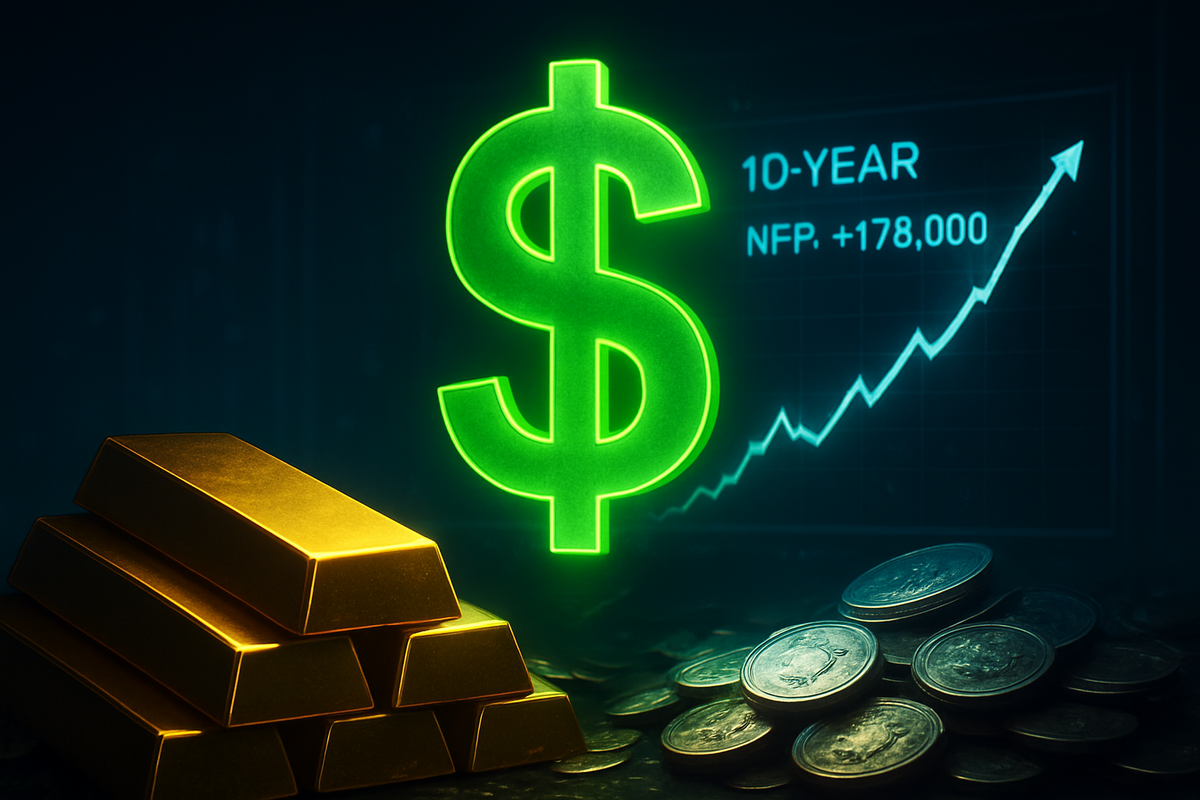
The U.S. financial landscape shifted violently this week as a blockbuster March jobs report collided with the hawkish momentum of the "Warsh Shock," sending shockwaves through the precious metals and bond markets. On Friday, the Bureau of Labor Statistics revealed that nonfarm payrolls rose by a staggering 178,000 in March—nearly tripling consensus expectations of 60,000—a feat that has fundamentally rewritten the script for the Federal Reserve’s 2026 trajectory.
The immediate aftermath saw the 10-year Treasury yield surge to 4.38%, its highest level in months, as traders aggressively priced out hopes for a series of rate cuts later this year. This "Sound Money" pivot, spearheaded by the nomination of Kevin Warsh as Federal Reserve Chairman-nominee, has reinvigorated the U.S. Dollar Index (DXY), which decisively cleared the 100.00 psychological threshold. For gold and silver, the result was a bloodbath; spot gold plummeted to approximately $4,658 an ounce, while silver fell to $72.31, marking a definitive end to the speculative mania that had gripped the sector earlier this year.
A Perfect Storm: The Jobs Beat and the Warsh Doctrine
The March employment data arrived at a precarious moment for the markets. While the headline number of 178,000 jobs created seems robust, analysts were quick to point out that the figure was bolstered by the return of 76,000 healthcare workers following a series of regional strikes. However, even when adjusting for these idiosyncratic factors, the labor market displayed a resilience that caught the "recession-is-imminent" crowd off guard. The unemployment rate ticked down to 4.3%, further complicating the Federal Reserve’s mandate to balance price stability with full employment.
This data served as the ultimate catalyst for what is being called the "Warsh Shock." Since his nomination by the Trump administration in January 2026, Kevin Warsh has signaled a departure from the "data-dependent" volatility of the Jerome Powell era. Warsh’s proposed doctrine of "Productive Dovishness"—the idea that the Fed should aggressively shrink its balance sheet while maintaining higher-for-longer real interest rates to promote long-term investment—has fundamentally strengthened the greenback. The March jobs report provided the first major piece of evidence that the economy may be strong enough to withstand the "Leaner Fed" strategy Warsh intends to implement upon his expected confirmation on April 16.
The reaction in the fixed-income market was instantaneous. The 10-year Treasury yield’s jump to 4.38% represents a "bear steepening" of the curve, reflecting the market's belief that inflation may be stickier than expected, or that the Fed’s new leadership will simply tolerate higher yields in exchange for a "scarcity-driven" U.S. dollar. As the "Dollar King" remains the dominant force in global finance, international capital has begun a massive rotation out of emerging markets and precious metals, flowing back into the safety and yield of U.S. sovereign debt.
Winners and Losers: A Tale of Two Tickers
The primary casualties of this paradigm shift are the precious metals mining giants. Newmont Corporation (NYSE: NEM), the world’s largest gold miner, saw its shares tumble as the underlying price of gold fell over $500 from its January highs. Similarly, Barrick Gold Corporation (NYSE: GOLD) faced heavy selling pressure as the rising "carry cost" of holding non-yielding assets made gold increasingly unattractive to institutional investors. The silver market was not spared, with Pan American Silver Corp. (NASDAQ: PAAS) and Wheaton Precious Metals Corp. (NYSE: WPM) both seeing significant valuations wiped out as silver prices cratered toward the $72.31 mark.
Conversely, the rise in yields and the strengthening dollar have created a favorable environment for large-cap financial institutions. JPMorgan Chase & Co. (NYSE: JPM) and Bank of America Corporation (NYSE: BAC) have benefited from widening net interest margins as the yield curve steepens. Investors are betting that these banks will reap the rewards of a "Warsh Fed" that prioritizes banking sector stability and "sound money" principles over the quantitative easing cycles of the past two decades.
The technology sector has presented a more nuanced picture. While higher rates typically discount the future earnings of growth stocks, companies leading the "Productivity Revolution" have remained resilient. NVIDIA Corporation (NASDAQ: NVDA) and Microsoft Corporation (NASDAQ: MSFT) have managed to weather the storm, as the "Warsh Doctrine" explicitly ties future rate cuts to AI-driven productivity gains. In this view, if AI can indeed do more with less, the Fed may find room to lower rates without sparking inflation—a scenario that keeps the "AI darlings" in high demand even as the rest of the market reels.
Wider Significance: The End of the 'Easy Money' Era?
The current market volatility is more than just a reaction to a single jobs report; it represents a historical pivot in American monetary policy. For nearly twenty years, the Federal Reserve has operated under a "Fed Put" mentality, where any sign of economic weakness was met with liquidity injections. The "Warsh Shock" suggests those days are over. By advocating for a "Leaner Fed" and integrating AI to automate Fed analytical functions, Warsh is signaling a move toward a more mechanical, market-based approach to central banking.
This shift has profound ripple effects on global trade. With the DXY past 100, the cost of servicing dollar-denominated debt for emerging economies has spiked overnight. This "Dollar Dominance" is a double-edged sword; while it keeps U.S. inflation in check by making imports cheaper, it risks destabilizing global partners who are already struggling with the transition to a high-rate environment. The historical precedent most cited by analysts is the "Volcker Shock" of the early 1980s, though the modern version is tempered by the hope that technological productivity—rather than just sheer rate hikes—will do the heavy lifting of cooling the economy.
Furthermore, the downsizing of the federal government’s workforce—largely attributed to the Department of Government Efficiency (DOGE) initiatives—is beginning to show up in the data. The loss of 18,000 federal jobs in March is part of a broader trend of 355,000 public sector cuts since late 2024. This fiscal tightening, paired with Warsh’s monetary "Sound Money" stance, creates a policy environment not seen in the U.S. for generations: a synchronized push for a smaller government and a stronger currency.
What Comes Next: The Path to the April Confirmation
In the short term, all eyes are on the Senate confirmation hearing for Kevin Warsh on April 16. This "Senate Gauntlet" will be a defining moment for the future of the American dollar. If Warsh doubles down on his "QT-for-Cuts" framework, we could see the DXY extend its rally toward the 105 level, potentially pushing gold down to find support near the $4,400 range. Investors should watch for any rhetoric regarding the "scarcity" of the dollar, as this will be the primary driver of currency markets through the summer.
Strategic pivots are already underway among hedge funds and institutional desks. The "reflation trade" that dominated early 2026 is being dismantled in favor of "quality and carry." This means moving away from speculative commodities and into high-yielding U.S. debt and cash-flow-positive tech stocks. However, the risk of a "policy error" remains high; if the Fed tightens too aggressively into a labor market that is actually weaker than the headline numbers suggest (once the healthcare strike bounce is fully removed), the "Warsh Shock" could turn into a "Warsh Winter."
The Bottom Line: Long Live the King
The March jobs report has solidified the narrative that the U.S. economy is currently in a league of its own, but it has done so by sacrificing the momentum of the precious metals market. The "Dollar King" has returned to his throne, supported by a hawkish Fed-nominee and a labor market that refuses to buckle under the weight of 4.38% yields.
For investors, the key takeaway is that the "Easy Money" playbook of the 2010s is officially obsolete. Moving forward, the market will likely be defined by a "Sound Money" regime where the U.S. dollar is treated as a premium asset rather than a debased currency. In the coming months, the critical metrics to watch will be the pace of balance sheet reduction and the real-time feedback from the 10-year Treasury market. While gold at $4,658 may seem like a bargain compared to the $5,400 peaks of January, in the age of the "Warsh Shock," the true value is found in the greenback.
This content is intended for informational purposes only and is not financial advice.