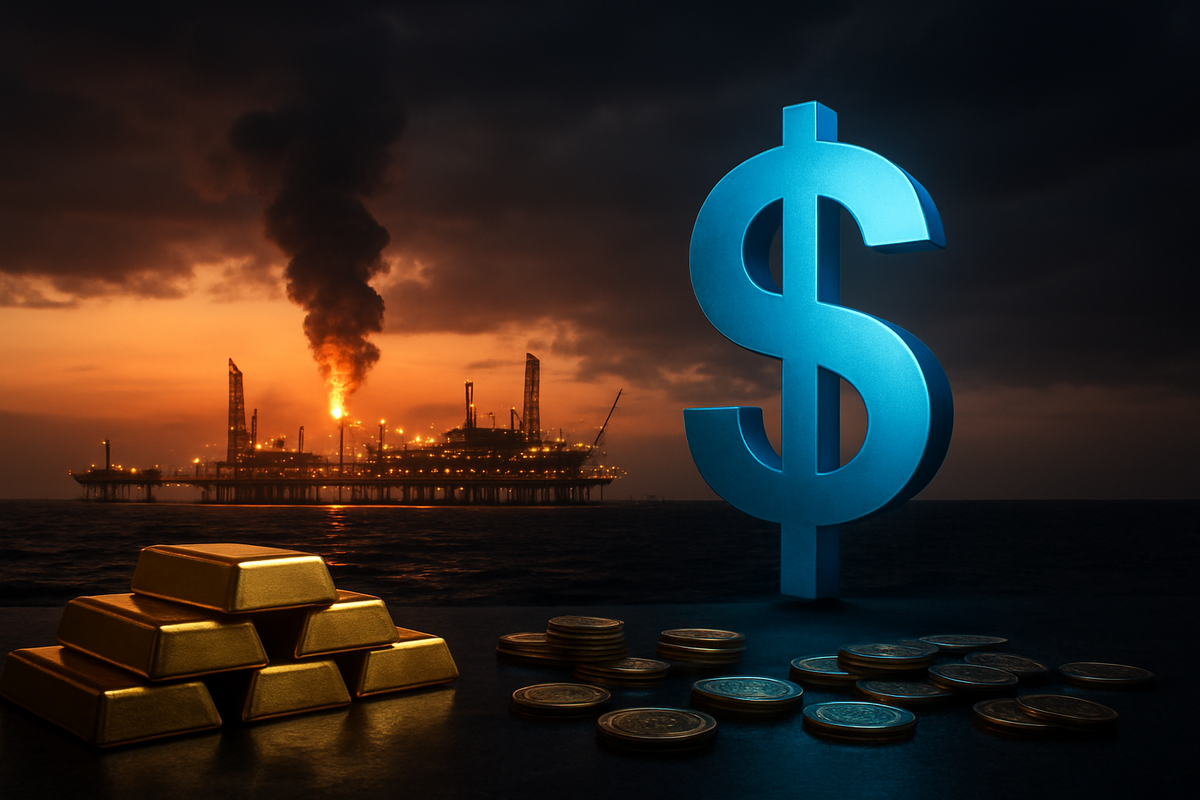
As of April 6, 2026, the global economy is grappling with a geopolitical earthquake that has defied the traditional playbooks of safe-haven investing. The direct military escalation between the United States and Iran, punctuated by the devastating strike on the South Pars gas field, has sent crude oil prices screaming past $110 per barrel. While such a massive spike in global instability would historically send investors flocking to precious metals, a strange phenomenon known as the "oil-inflation-dollar" headwind is currently suppressing the rally.
Despite the drums of war beating louder than they have in decades, gold is currently trading at $4,622 per ounce, and silver at $71.44. While these numbers are high by historical standards, they represent a significant stagnation and even a retreat from earlier 2026 peaks. The immediate implication for the market is a "Golden Paradox": the very crisis that should be driving precious metals higher is instead fueling an inflationary surge that forces the Federal Reserve to maintain high interest rates, strengthening the U.S. Dollar and effectively neutralizing gold’s safe-haven status.
The Strike on South Pars and the Middle East Escalation
The current crisis traces its roots back to mid-March 2026, when long-simmering tensions between Washington and Tehran reached a boiling point. On March 18, 2026, a series of precision airstrikes, reportedly coordinated under the U.S.-led "Operation Epic Fury," targeted the South Pars gas field—the world’s largest natural gas deposit. The strike severely damaged critical processing infrastructure and pipelines, immediately knocking out 12% of Iran's domestic gas production and threatening the export stability of the region.
The retaliation was swift and catastrophic. Following the strike, the Iranian Revolutionary Guard Corps (IRGC) declared a "virtual blockade" of the Strait of Hormuz, deploying advanced naval mines and anti-ship missile batteries. By the final week of March, nearly 20% of the world's daily oil supply and 25% of global liquefied natural gas (LNG) trade were halted. The International Energy Agency (IEA) has reported a daily global energy deficit of over 10 million barrels, a gap that even coordinated releases from strategic reserves have failed to close.
This timeline of escalation has fundamentally reshaped the 2026 energy landscape. Brent crude and WTI both shattered the $110/bbl threshold in the first week of April, with WTI currently hovering near $112.80. The key players in this conflict—the U.S., Iran, and regional powers like Qatar—are now locked in a stalemate that shows no signs of a diplomatic resolution, leaving the global energy artery of the Persian Gulf in a state of paralysis.
Winners and Losers in a Volatile Market
The divergence in the equity markets has been stark, creating a clear divide between the energy sector and the mining industry. ExxonMobil (NYSE: XOM) and Chevron (NYSE: CVX) have emerged as the primary beneficiaries of the "geopolitical premium" on oil. Both companies reached multi-year highs this quarter, with XOM shares surging over 40% year-to-date as of early April. These energy giants are viewed by the market as essential hedges, as their diversified portfolios and shift toward "safe" basins like the Permian have allowed them to capitalize on $110 oil while remaining insulated from the direct physical risks in the Middle East.
Conversely, the precious metals mining sector is facing a "perfect storm." Newmont Corporation (NYSE: NEM) and Barrick Gold Corporation (NYSE: GOLD) have seen their stock prices dive nearly 25% from their January highs. The logic is twofold: while the spot price of gold ($4,622) remains under pressure from a strong dollar, the miners' All-In Sustaining Costs (AISC) have ballooned due to soaring fuel prices. Newmont (NYSE: NEM) recently reported that its operating costs have hit record levels, as the diesel and electricity required for massive open-pit mining are directly tied to the surging cost of oil.
Industrial consumers of silver are also reeling. As silver trades at $71.44, companies in the solar and electronics sectors are experiencing "demand destruction." The high energy costs required for manufacturing, combined with the rising cost of the metal itself, have forced many industrial players to scale back production, further weighing on silver’s performance relative to its traditional correlation with gold.
The Oil-Inflation-Dollar Headwind
The primary reason gold and silver are not trading at even higher multiples during this conflict is the "oil-inflation-dollar" nexus. This economic cycle begins with high energy prices, which have added nearly 1.5% to global headline inflation in just three weeks. This sudden inflationary shock has forced the Federal Reserve to abandon any plans for interest rate cuts in 2026. Instead, the Fed is signaling a "higher-for-longer" or even a "higher-forever" stance to prevent an 1970s-style stagflationary spiral.
Because the Federal Reserve is keeping interest rates high, U.S. Treasury yields have become incredibly attractive. This has transformed the U.S. Dollar (DXY) into the ultimate liquidity haven. In a bizarre twist of market logic, when global investors get scared, they are currently buying the U.S. Dollar rather than gold. Because gold is priced in dollars, the surging greenback makes the metal prohibitively expensive for international buyers, leading to massive institutional liquidations in gold ETFs.
This situation mirrors the historical precedent of the early 1980s, where high inflation eventually led to a dominant dollar that crushed the gold market. The difference today is the sheer speed of the energy shock. Gold’s traditional safe-haven status is essentially being "deferred" as the market prioritizes the yield and liquidity of the dollar over the perceived safety of bullion, which offers no interest or dividends in a high-rate environment.
The Outlook: A Strait of Uncertainty
In the short term, the direction of the markets will be dictated by the physical security of the Strait of Hormuz. If the blockade remains in place, analysts predict oil could test $130/bbl by the end of Q2 2026. Such a scenario would likely force a strategic pivot from the Federal Reserve, potentially triggering an emergency rate hike that would further bolster the dollar and keep gold pinned below the $4,700 mark.
However, the long-term outlook offers a potential reversal. If the U.S.-Iran conflict transitions into a prolonged war of attrition, the "inflationary" aspect of the dollar's strength may eventually erode. Should the global economy enter a deep recession due to sustained $110+ oil, the Federal Reserve might be forced to pivot and cut rates despite inflation. At that moment, the "oil-inflation-dollar" headwind would vanish, potentially unlocking a massive "catch-up" rally for gold and silver as the dollar's dominance finally cracks.
Investors should also watch for a shift in central bank behavior. While retail investors are currently chasing the dollar, central banks in the "Global South" may use this period of suppressed gold prices to aggressively diversify away from the dollar, fearing future sanctions or further geopolitical instability. This underlying central bank demand could provide a hard floor for gold near the $4,400 level.
Summary and Investor Takeaways
The events of April 2026 have rewritten the rules of crisis investing. The strike on the South Pars gas field has not only ignited a regional conflict but has also triggered a complex economic cycle that has temporarily sidelined precious metals. The key takeaway for investors is that in the modern era, geopolitical risk is no longer a guaranteed catalyst for gold if that risk leads directly to higher energy prices and a more aggressive Federal Reserve.
Moving forward, the market will be defined by the "tug-of-war" between energy-driven inflation and the Federal Reserve's resolve. While energy companies like ExxonMobil (NYSE: XOM) offer immediate protection against the current supply shock, precious metals miners like Newmont (NYSE: NEM) remain a riskier bet until the dollar's strength shows signs of peaking.
In the coming months, the most critical data point for the market will not be the casualties in the Middle East, but the U.S. Consumer Price Index (CPI) and the subsequent reaction of the U.S. Treasury yields. Until the "oil-inflation-dollar" cycle is broken, gold and silver will likely remain in the shadow of the greenback, waiting for their turn to once again serve as the world's ultimate store of value.
This content is intended for informational purposes only and is not financial advice.