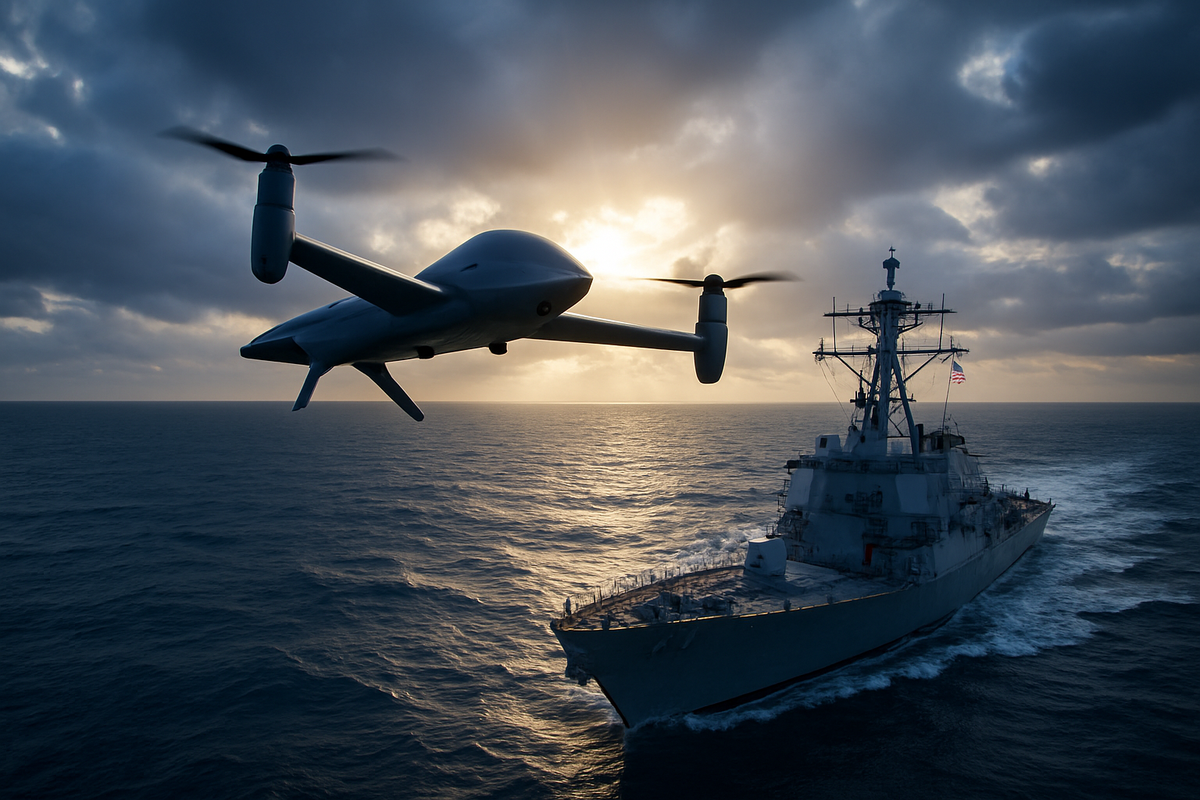
The U.S. Navy has officially signaled a major shift in its maritime surveillance strategy, selecting AeroVironment, Inc. (NASDAQ: AVAV) to provide advanced Intelligence, Surveillance, and Reconnaissance (ISR) services. Under a new Contractor-Owned, Contractor-Operated (COCO) agreement announced on April 1, 2026, AeroVironment will deploy its JUMP 20-X vertical take-off and landing (VTOL) unmanned aircraft system (UAS) to support naval operations across the globe. This partnership marks a significant milestone in the Navy's "ISR-as-a-Service" model, transferring the technical and logistical burdens of drone operations to the private sector while ensuring warfighters have access to real-time, high-definition data.
The selection of the JUMP 20-X platform underscores an intensifying demand for "runway-independent" systems capable of operating from the cramped decks of destroyers and Littoral Combat Ships. By moving away from traditional catapult-launched drones, the Navy is prioritizing flexibility and rapid deployment in increasingly contested maritime environments. For AeroVironment, this contract solidifies its transition from a hardware manufacturer to a high-margin service provider, a move that is expected to reshape its revenue profile through the end of the decade.
A New Era of Maritime Eyes in the Sky
The formal selection of AeroVironment on April 1, 2026, came as part of a competitive Multiple-Award Contract (MAC) framework designed to modernize the Navy’s aging ISR fleet. The JUMP 20-X, a maritime-optimized variant of the proven JUMP 20 platform, was the centerpiece of the bid. Having been officially unveiled at the IDEX 2025 defense exhibition, the "X" variant features enhanced corrosion resistance for salt-water environments and a heavy-fuel engine designed to run on JP-5 and JP-8, simplifying the logistics of refueling aboard naval vessels. Unlike previous generations of maritime drones that required nets or wires for recovery, the JUMP 20-X utilizes AI-powered computer vision to perform autonomous vertical landings on moving ships, even in heavy seas.
The timeline leading to this award was characterized by a series of strategic wins for AeroVironment. In late 2025, the company secured a massive $874.26 million IDIQ contract from the U.S. Army, which signaled to the Department of Defense that the company was capable of scaling its Group 3 UAS production. The Navy’s decision to adopt the COCO model means AeroVironment will provide not just the aircraft, but also the flight crews and maintenance teams. This turnkey approach allows the Navy to scale its ISR capabilities up or down based on regional tensions without the long-term overhead of training and maintaining its own internal UAS units.
Market reaction to the announcement was cautiously optimistic. On the day of the news, shares of AeroVironment (NASDAQ: AVAV) closed at $183.50. While the stock saw intraday gains, it faced headwinds from unrelated market factors, including a securities investigation by Pomerantz LLP and news of a stop-work order on a separate Space Force program. However, defense analysts have remained bullish on the long-term implications. BTIG reiterated a "Buy" rating with a price target of $330 following the announcement, citing the stability of the COCO revenue model as a key driver for future valuation.
Winners and Losers in the Unmanned Arms Race
AeroVironment is the undeniable winner in this latest procurement cycle, but the ripple effects are being felt across the defense industry. By securing a spot in the Navy’s ISR services pool, AVAV has successfully protected its flank against newer, venture-backed startups. The company’s ability to integrate its SPOTR-Edge™ AI technology for autonomous shipboard landings has set a high bar for competitors, proving that "legacy" drone makers can pivot to the software-defined needs of modern warfare.
Conversely, the incumbent provider of naval ISR, Insitu, a subsidiary of The Boeing Company (NYSE: BA), faces a challenging transition. For years, the Boeing-made ScanEagle (designated MQ-27B) was the workhorse of naval ISR. However, the ScanEagle’s reliance on catapult launchers and "Skyhook" recovery systems—which occupy significant deck space—is increasingly seen as a liability compared to the VTOL capabilities of the JUMP 20-X. While Boeing remains a titan in the aerospace sector, its share of the mid-tier UAS market is under pressure as the Navy prioritizes platforms that offer a smaller physical footprint and greater operational versatility.
Other players in the space, such as Textron Inc. (NYSE: TXT) and Northrop Grumman Corporation (NYSE: NOC), are also recalibrating. Textron’s Aerosonde has long competed in this category, but the momentum currently favors VTOL-centric platforms. Meanwhile, private competitors like Shield AI, with its V-BAT system, continue to push the boundaries of what is possible in the autonomous VTOL space. The Navy’s move to include AeroVironment in this contract suggests a preference for diversified suppliers, ensuring that no single company holds a monopoly over the fleet's tactical intelligence.
The Broader Shift Toward "Service" Models and VTOL
The U.S. Navy's selection of the JUMP 20-X fits into a much broader trend within the Department of Defense (DoD): the shift toward "as-a-service" procurement. Historically, the military bought hardware and managed the maintenance and operation itself. However, the rapid pace of technological change in the drone sector means that hardware often becomes obsolete before a traditional acquisition cycle is complete. By hiring AeroVironment to provide ISR as a service, the Navy ensures it always has access to the latest sensors and software updates without having to navigate the sluggish bureaucracy of new equipment purchases.
Furthermore, the emphasis on VTOL technology is a direct response to lessons learned from recent conflicts in Eastern Europe and the Middle East. Fixed-wing drones that require runways or specialized launch equipment are vulnerable to targeted strikes on infrastructure. In a maritime context, a ship’s deck is a finite and valuable piece of real estate. The ability of the JUMP 20-X to take off and land vertically—while still maintaining the long-range endurance of a fixed-wing aircraft—solves a critical tactical problem. This "best of both worlds" approach is likely to become the standard for all future naval UAS requirements.
Regulatory and policy implications are also at play. The DoD has been under increasing pressure to diversify its supply chain away from components sourced from adversarial nations. AeroVironment has positioned itself as a "Blue UAS" leader, ensuring that its supply chain is fully compliant with the National Defense Authorization Act (NDAA). This compliance gives it a significant edge over smaller competitors who may still be struggling to purge their hardware of restricted components.
Charting the Path Forward
In the short term, AeroVironment must now execute on the individual task orders that will flow from this MAC. The logistical challenge of deploying contractor crews to Navy vessels worldwide should not be underestimated. The company will likely need to ramp up hiring and training for its flight operations division to meet the potential demand. If AeroVironment can demonstrate high reliability and data quality in these initial deployments, it will be well-positioned to capture a larger slice of the estimated $874 million pool allocated for these services.
Looking further ahead, the "JUMP 20-X" success could serve as a springboard for international sales. Allied navies in the Indo-Pacific and Europe are watching the U.S. Navy’s move toward VTOL ISR with great interest. As these nations look to modernize their own fleets to counter regional threats, AeroVironment’s status as a vetted U.S. Navy partner will be a powerful marketing tool. Strategic pivots toward more advanced AI and electronic warfare (EW) payloads are also likely, as the Navy looks to use these drones not just for observation, but for active disruption of enemy communications.
Market Outlook and Final Thoughts
The selection of AeroVironment to provide ISR services via the JUMP 20-X platform is a defining moment for the company and the broader unmanned systems industry. It validates the "ISR-as-a-Service" business model and confirms that VTOL technology is the new baseline for maritime operations. For investors, the takeaway is clear: AeroVironment is no longer just a "small drone" company; it is a critical service provider with deep roots in the most vital areas of defense spending.
As we move through the remainder of 2026, market participants should keep a close eye on the volume of task orders issued under this Navy contract. Success here will lead to high-margin, recurring revenue that could significantly boost AVAV's earnings per share. While competition from private firms like Shield AI remains fierce, AeroVironment’s established relationship with both the Army and the Navy provides a formidable "moat." The next few months will be critical as the first JUMP 20-X units begin their deployments, marking the start of a new chapter in naval aviation.
This content is intended for informational purposes only and is not financial advice.