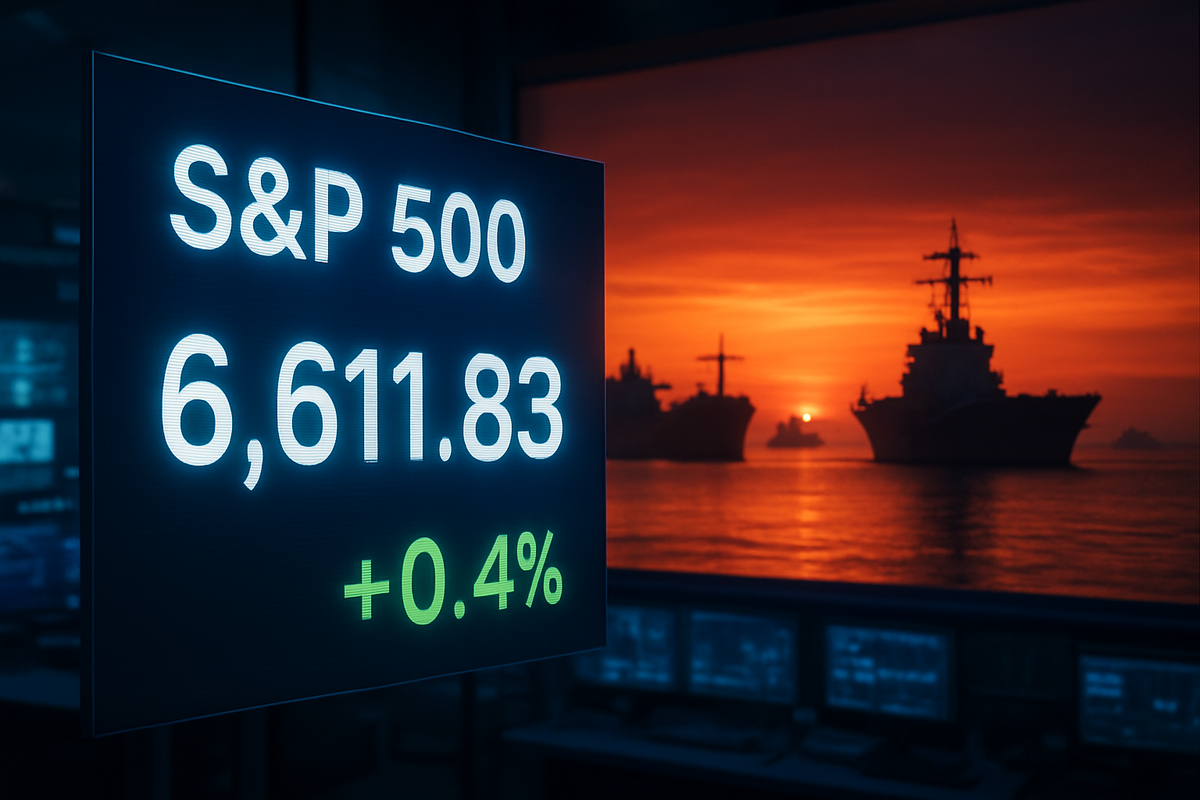
The U.S. stock market staged a modest advance on Monday, as investors grappled with a high-stakes geopolitical standoff in the Middle East. The S&P 500 rose 0.4% to finish at 6,611.83, a cautious gain that reflected a "wait-and-see" approach on Wall Street. Despite the positive finish, trading remained subdued throughout the session, characterized by low volume and high intraday volatility as the financial world turned its eyes toward Washington and Tehran.
The primary driver of the market’s nervous energy is the Tuesday deadline set by President Donald Trump regarding the ongoing conflict with Iran and the blockade of the Strait of Hormuz. With the deadline less than 24 hours away, the immediate implications for global energy markets and trade routes have left investors on edge. While the small uptick on Monday suggests some hope for a diplomatic "off-ramp," the overarching sentiment remains one of deep hesitation, as the potential for a major military escalation looms over the global economy.
The S&P 500's climb to 6,611.83 on Monday followed a period of intense selling pressure that has defined much of early 2026. The index is currently navigating a complex recovery after dropping nearly 7.5% since late February, when "Operation Epic Fury" first began to disrupt regional stability. Monday's 0.4% gain was less a sign of renewed bullishness and more a technical consolidation after last week’s wild swings. Traders reported that while there were no major sell-offs, there was also an absence of "conviction buying," with many institutional players sitting on the sidelines until the outcome of the Tuesday deadline becomes clear.
The current crisis traces its roots back to the start of the year, following a series of maritime skirmishes in the Persian Gulf that led to the effective closure of the Strait of Hormuz—a vital chokepoint through which approximately 21% of the world’s petroleum liquids pass. President Trump’s administration has maintained a "maximum pressure" stance, culminating in the current ultimatum demanding that Iran immediately cease all interference with international shipping and dismantle its newly deployed coastal missile batteries. The deadline, set for Tuesday at 12:00 PM ET, has been described by the White House as the final opportunity for a non-kinetic resolution.
Key stakeholders, including the Department of Defense and major oil-producing nations, have spent the weekend in high-level consultations. Initial market reactions during the Monday session saw the CBOE Volatility Index (VIX) remain elevated above 30, a level typically associated with extreme market stress. While the broader market indices managed to eke out gains, the underlying tension was palpable in the Treasury markets, where investors sought the safety of the 10-year note, keeping yields suppressed despite the inflationary pressures of rising oil prices.
In the wake of the escalating tensions, the energy and defense sectors have emerged as the primary beneficiaries of the "war footing" environment. Shares of Exxon Mobil (NYSE: XOM) and Chevron (NYSE: CVX) have both seen significant gains year-to-date, with both companies rising again on Monday as Brent Crude hovered near $120 per barrel. These integrated oil majors are seen as hedges against a prolonged blockade, as their global diversified portfolios and U.S.-based production assets become increasingly valuable in a supply-constrained world. Furthermore, non-Middle Eastern energy plays like Cheniere Energy (NYSE: LNG) are benefiting from the scramble to replace Qatari natural gas exports that are currently trapped behind the blockade.
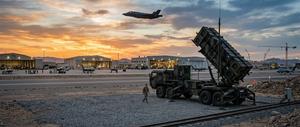
The defense industry has also seen a surge in interest as the U.S. military prepares for potential tactical strikes or naval escort operations. Lockheed Martin (NYSE: LMT) and RTX Corp (NYSE: RTX) have both outperformed the broader market by more than 20% since the start of the conflict, buoyed by the replenishment of missile defense systems and the deployment of advanced aircraft to the region. Northrop Grumman (NYSE: NOC) has also seen its stock price bolstered by its role in providing the stealth and surveillance technology necessary for monitoring the Iranian coastline.
Conversely, the travel and technology sectors are bearing the brunt of the geopolitical risk. Airlines, including Delta Air Lines (NYSE: DAL), United Airlines (NASDAQ: UAL), and American Airlines (NASDAQ: AAL), have faced heavy selling pressure as jet fuel costs skyrocket and international flight paths are rerouted away from the Middle East. Meanwhile, technology giants such as Microsoft (NASDAQ: MSFT) and NVIDIA (NASDAQ: NVDA) are facing a dual threat: the potential for stagflation caused by energy shocks and the risk of supply chain disruptions in a broader global conflict. These "growth" stocks typically underperform when energy-driven inflation forces the Federal Reserve to maintain higher interest rates for longer.
The wider significance of this event cannot be overstated, as it fits into a broader trend of deglobalization and the fragmentation of traditional energy markets. The 2026 conflict is being viewed by many analysts as a "regime-shift" moment, where the reliable flow of cheap energy through the Persian Gulf is no longer a given. This mirrors the oil shocks of the 1970s and early 1990s but is compounded by the modern world's reliance on high-tech supply chains and "just-in-time" delivery models. If the Strait of Hormuz remains closed for an extended period, the ripple effects will likely trigger a global recession, fundamentally altering the competitive landscape for multinational corporations.
Regulatory and policy implications are also mounting. The Trump administration’s aggressive stance is forcing a re-evaluation of energy security policies in Europe and Asia, potentially accelerating the pivot toward domestic production and alternative energy sources. Historically, markets have shown a "72-hour rule" during geopolitical shocks—initial panic followed by a stabilization once the "scope of uncertainty" is defined. However, the current situation is unique due to the sheer volume of global oil at risk. Comparisons are being drawn to the 1990 Gulf War, where a swift military outcome eventually led to a massive market rally, but the path to that outcome remains fraught with peril.
For competitors and partners of the primary players, the situation creates a volatile landscape of winners and losers based on geographic exposure. Companies with heavy reliance on Middle Eastern logistics are seeing their operational costs spiral, while those with "energy-secure" supply chains are gaining a competitive edge. This shift is likely to lead to a long-term re-rating of stocks based on their "geopolitical resilience," a metric that is becoming just as important to investors as traditional earnings growth.
What comes next depends entirely on the outcome of the Tuesday deadline. In the short term, there are three primary scenarios: a diplomatic breakthrough that leads to an immediate relief rally, a tactical military strike that increases volatility but provides a definitive path forward, or a prolonged stalemate that could see the S&P 500 re-test its 2025 lows. If the deadline passes without a resolution, analysts expect the VIX to spike toward 40, as algorithms and humans alike prepare for the "unknown unknowns" of a maritime war.
Strategic pivots will be required for almost every sector. Market opportunities may emerge in the form of "distressed" tech stocks that have been oversold due to macro fears, but the immediate challenge remains managing the inflationary impact of $110+ oil. If the conflict escalates, we may see the Federal Reserve forced into a difficult position—trying to support a flagging economy while fighting energy-induced inflation. This "stagflationary" scenario is the primary fear for long-term investors.
As the sun sets on Monday, April 6, 2026, the key takeaway is that the market is currently a hostage to geopolitics. The 0.4% gain in the S&P 500 is a fragile victory, easily erased by a single social media post or a failed diplomatic cable. Moving forward, the market’s trajectory will be determined by whether the current administration can secure the Strait of Hormuz without a protracted conflict that drains global liquidity.
Investors should remain cautious and prioritize liquidity in their portfolios. The coming months will likely be characterized by high volatility and a continued divergence between "hard assets" like energy and defense and "soft assets" like consumer discretionary and high-multiple tech. Watching the price of Brent Crude and the daily updates from the Persian Gulf will be more important for portfolio performance than any quarterly earnings report in the immediate future.
This content is intended for informational purposes only and is not financial advice.