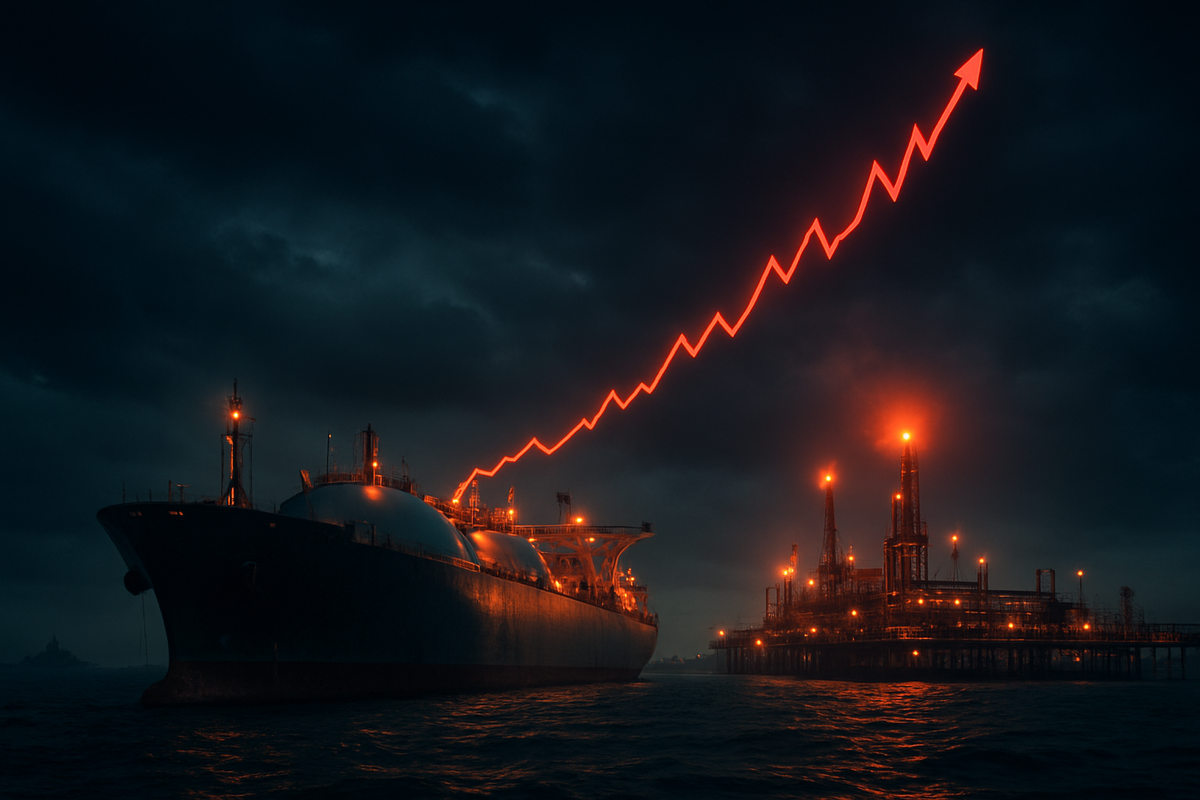
The global energy landscape has been thrust into a state of acute volatility, reminiscent of the 2022 energy crisis, as the World Bank’s latest Commodity Markets Outlook reveals a staggering 59.4% surge in European natural gas prices for the month of March 2026. This dramatic spike has served as the primary engine for a 41.6% rise in the global energy price index, marking one of the most significant monthly disruptions in the history of modern energy trading.
The immediate implications are profound, threatening to derail the fragile post-inflationary recovery of the global economy. As energy costs permeate through supply chains, the specter of "stagflation"—low growth coupled with high inflation—has returned to the forefront of policy discussions in Brussels, Washington, and beyond. Market participants are now grappling with a "new normal" of supply fragility, where geopolitical flashpoints can instantly vaporize years of infrastructure planning and storage security.
The Siege of Hormuz and the Qatar Shock
The roots of this March surge trace back to a rapid escalation of geopolitical tensions in West Asia. Throughout February and early March 2026, a series of naval skirmishes in the Persian Gulf culminated in what analysts are calling the "Siege of Hormuz." This effective blockade of the Strait of Hormuz—a maritime artery responsible for the transit of roughly 20% of global liquefied natural gas (LNG)—sent shockwaves through the Dutch TTF and other European gas benchmarks. Unlike the 2022 crisis, which centered on Russian pipeline reliance, the 2026 crisis strikes at the heart of the global LNG sea-bridge that Europe spent billions to construct.
Compounding the maritime blockade was a devastating infrastructure failure at the Ras Laffan Industrial City in Qatar. Following a series of targeted drone strikes attributed to regional proxies, several liquefaction trains were forced offline. The World Bank report highlights that these strikes have effectively removed 17% of Qatar’s LNG export capacity from the market for the foreseeable future. This "Qatar Shock" occurred just as European storage facilities were reaching their lowest seasonal levels, forcing European utilities into a frantic bidding war with Asian buyers for the few remaining spot-market cargoes.
The timeline leading to this moment was brief but brutal. On March 4th, 2026, initial reports of the Ras Laffan damage surfaced, causing a 15% jump in a single trading session. By mid-month, as the Hormuz blockade became a semi-permanent reality, prices decoupled from historical fundamentals. Major energy players and national governments have responded with emergency conservation measures, but the sheer scale of the 59.4% monthly increase has left many industrial sectors facing mandatory curtailments.
Corporate Fallout: Winners and Losers in the Energy Transition
The sudden realignment of energy prices has created a stark divide between the winners and losers of the 2026 energy shock. Companies with diversified global portfolios and significant US-based assets are finding themselves in an enviable, albeit chaotic, position. Cheniere Energy, Inc. (NYSE: LNG), the leading US exporter of liquefied natural gas, has seen its stock price reach record highs as its Gulf Coast terminals become the primary lifeline for European energy security. Similarly, ExxonMobil Corporation (NYSE: XOM) and ConocoPhillips (NYSE: COP), which hold substantial interests in both US shale and global LNG ventures, are poised to benefit from the upward price pressure on unhedged production.
In Europe, the reaction is more nuanced. Traditional giants like Equinor ASA (NYSE: EQNR) have seen valuations climb as Norwegian piped gas remains the most reliable alternative to the missing Middle Eastern LNG. However, companies like Shell PLC (NYSE: SHEL) and TotalEnergies SE (NYSE: TTE) face a complex balancing act; while high prices boost their upstream margins, their heavy investments in Qatari infrastructure and global LNG trading routes leave them exposed to the physical loss of volume and the political pressure to subsidize domestic European consumers.
Conversely, the "losers" of this event are the energy-intensive industrial giants. BASF SE (OTC: BASFY), the German chemical powerhouse, has already signaled that its Verbund sites in Europe may face production freezes if gas prices do not retreat by the third quarter. The cost of feedstock and power is rapidly becoming unsustainable for European manufacturers, leading to fears of an "industrial exodus" to North America or other regions with lower energy costs. This disparity is likely to accelerate a shift in capital investment away from the European continent toward more energy-secure jurisdictions.
A Mirror to 2022: Broader Industry and Policy Shifts
This March spike is not merely a localized event; it represents a fundamental shift in how the energy market views security. The World Bank’s findings suggest that the 41.6% rise in the global energy index is a systemic warning that the world’s transition to LNG—once viewed as a safe "bridge fuel"—has introduced new vulnerabilities. Historically, the 2022 energy crisis forced Europe to abandon its reliance on Russian pipelines. The 2026 crisis is forcing a similar reassessment of maritime LNG routes and Middle Eastern stability.
The ripple effects are already being felt in the regulatory sphere. We are seeing an immediate push in the European Union to accelerate the "RePowerEU 2.0" initiative, which prioritizes domestic nuclear expansion and massive offshore wind projects to reduce reliance on any single imported energy source. Furthermore, the event has triggered a renewned focus on maritime security, with global powers discussing the formation of permanent naval escorts for energy tankers in the Gulf, a move that could significantly increase the geopolitical stakes and insurance costs for energy shipping.
The historical precedent of the 1970s oil shocks and the 2022 gas crisis suggests that such price spikes lead to permanent shifts in demand. This "demand destruction" is already visible in the European heavy industry sector, where the move toward hydrogen and electrification is no longer a choice but a survival strategy. The World Bank report underscores that the energy index's rise is likely to be stickier than previous spikes due to the physical destruction of infrastructure, which cannot be quickly remedied by a simple diplomatic ceasefire.
The Horizon: Scenarios for 2026 and Beyond
In the short term, the energy market is expected to remain in a state of "extreme backwardation," where current prices are significantly higher than future contracts, reflecting the immediate desperation for supply. If the "Siege of Hormuz" continues into the summer cooling season, analysts predict that natural gas prices could breach the all-time highs seen during the peak of the 2022 crisis. Strategic pivots are already underway, with European utilities signing long-term 20-year contracts with US suppliers to bypass the volatility of the spot market.
Long-term possibilities include a radical acceleration of the "Atlantic Basin" energy alliance, where North American gas and renewable technology become the bedrock of Western energy security. However, this also presents the challenge of a divided global market, with Asian economies potentially leaning more heavily on Russian energy redirected toward the East. The market opportunity for "green hydrogen" and long-duration battery storage has never been more apparent, as the volatility of natural gas prices makes the high capital expenditure of these technologies look increasingly attractive.
The most likely scenario is a bifurcated market: a period of intense, high-cost volatility followed by a permanent reduction in European gas demand as the continent aggressively de-industrializes or electrifies. The World Bank warns that if infrastructure in Qatar is not restored by the end of 2026, the global energy deficit could become a structural feature of the late 2020s, keeping the energy price index elevated for years to come.
Wrap-up: Key Takeaways for Investors
The World Bank’s report serves as a stark reminder that energy security is the ultimate driver of global economic stability. The 59.4% surge in European gas prices in March 2026 is a "black swan" event that has transformed from a geopolitical risk into a physical supply reality. The key takeaways are clear: the transition to LNG has replaced pipeline dependency with maritime vulnerability, and the Middle East remains the world's most critical—and fragile—energy hub.
Moving forward, the market will be characterized by extreme sensitivity to geopolitical news and a premium on domestic energy production. Investors should watch for the results of the upcoming G7 energy summit, where the potential for a coordinated "buyer’s cartel" or new strategic reserves will be discussed. Additionally, the ability of companies like Cheniere Energy and Equinor to ramp up supply will be the primary metric for market stabilization.
In the coming months, the focus will shift from "price" to "availability." For investors, this means looking toward companies with geographical advantages and infrastructure resilience. The age of cheap, abundant energy has truly ended, and the 2026 "March Spike" may well be remembered as the moment the global energy market entered its most volatile chapter yet.
This content is intended for informational purposes only and is not financial advice.