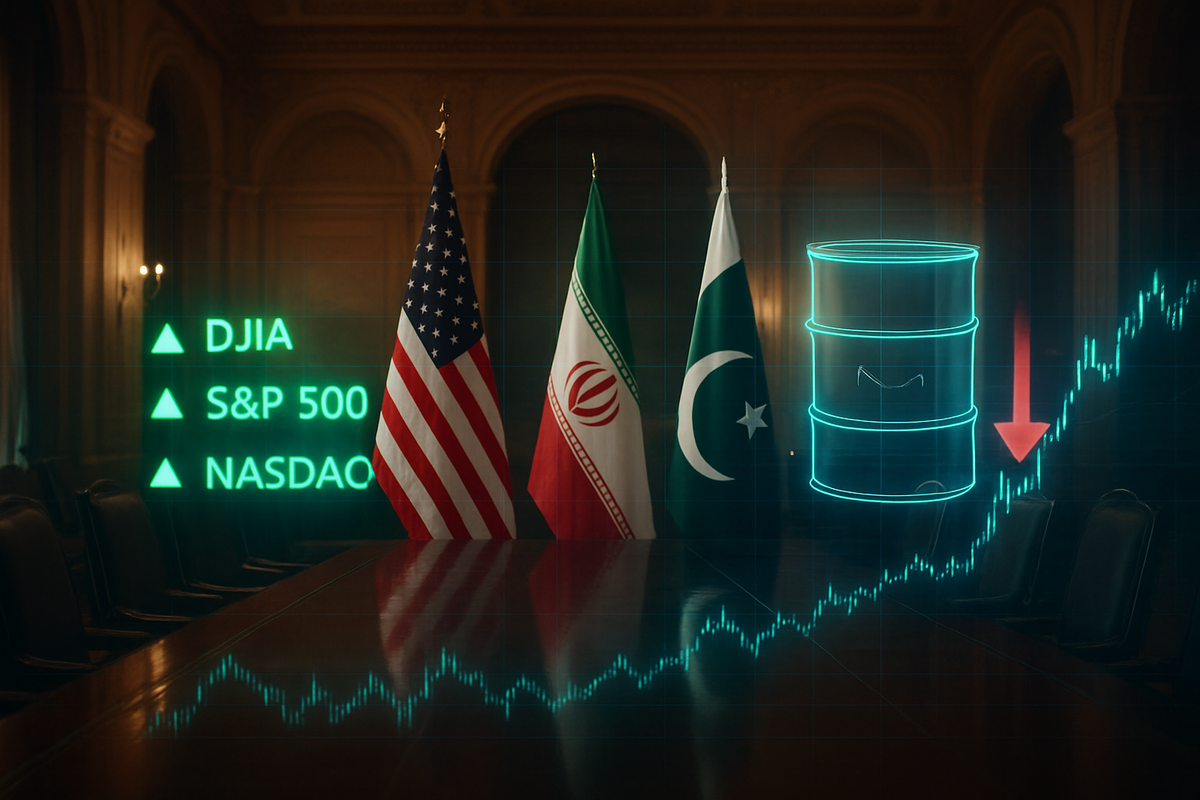
Global financial markets received a much-needed jolt of optimism early Tuesday, April 14, 2026, as news broke that Pakistan has successfully brokered a second round of high-stakes negotiations between the United States and Iran. Following a weekend of diplomatic stalemate that briefly sent oil prices skyrocketing, stock futures for the Nasdaq, Dow Jones Industrial Average, and S&P 500 turned positive during pre-market trading. The renewed hope for a de-escalation of the seven-week-old conflict has led to a cooling of crude prices, offering relief to a global economy that has been teetering on the edge of a localized energy crisis.
The shift in sentiment comes as a direct response to an invitation from Islamabad for a follow-up summit, aimed at resolving the "nuclear dust" impasse that halted progress just 48 hours ago. Traders are closely watching the developments, as any concrete step toward a permanent ceasefire could undo the massive risk premiums currently baked into the energy and defense sectors. As of early Tuesday morning, Nasdaq futures led the charge with a 0.93% gain, while the S&P 500 rose 0.40%, signaling that investors are once again willing to bet on a diplomatic exit strategy.
The Islamabad Marathon and the Path to De-escalation
The current diplomatic flurry is the culmination of nearly two months of open hostilities. The conflict began on February 28, 2026, with "Operation Epic Fury," a series of coordinated U.S. and Israeli strikes against Iranian nuclear and military infrastructure. Following the reported death of Iran’s Supreme Leader during these strikes, the conflict escalated into a direct state-on-state war, leading to a blockade of the Strait of Hormuz—a chokepoint responsible for 20% of the world’s oil and liquefied natural gas.
The first attempt at peace, dubbed the "Islamabad Marathon," took place over April 11–12 at the Serena Hotel in Pakistan. Led by U.S. Vice President JD Vance and Senior Adviser Jared Kushner, the American delegation faced off against Iranian Foreign Minister Abbas Araghchi and Parliament Speaker Mohammad Bagher Qalibaf. Despite a grueling 21-hour session, talks initially collapsed on Sunday when Iran refused to cease all nuclear fuel enrichment, prompting a temporary U.S. naval blockade of Iranian ports on April 13.
However, the tide turned early this morning, April 14, when Pakistani Prime Minister Shehbaz Sharif and Army Chief Asim Munir confirmed that both Tehran and Washington had agreed to a "framework for resumption." This second round of negotiations is expected to address the specific terms of a two-week truce that is set to expire shortly. The involvement of Pakistan as a neutral intermediary has been crucial, as it remains one of the few nations with active military and diplomatic channels to both the Trump administration and the Iranian leadership.
Market Winners and Losers: Defense Soars While Airlines Struggle
The geopolitical tension of 2026 has created a stark divide in the equities market. Defense giants have been the primary beneficiaries of the "Operation Epic Fury" era. Lockheed Martin (NYSE: LMT) has seen its stock price jump 25% year-to-date, reaching all-time highs as the U.S. military ramped up procurement of precision munitions. Similarly, RTX Corporation (NYSE: RTX) and Northrop Grumman (NYSE: NOC) have experienced significant surges in valuation due to their central roles in regional missile defense systems. These stocks saw a slight "peace-talk pull-back" Tuesday morning as investors rotated capital into more growth-oriented sectors.
In the energy sector, ExxonMobil (NYSE: XOM) and Chevron (NYSE: CVX) have thrived on the back of $100+ per barrel oil. While the prospect of peace eased Brent crude prices down to $97.50 and WTI to $96.83 on Tuesday, these companies remain in a strong position due to the high-price environment of the last quarter. Occidental Petroleum (NYSE: OXY) also remains a key player to watch, as its domestic production serves as a hedge against Middle Eastern supply disruptions.
Conversely, the travel and logistics sectors have been hit hard by the conflict. United Airlines (NASDAQ: UAL) and American Airlines (NASDAQ: AAL) have seen their share prices drop by more than 15% since February, plagued by soaring jet fuel costs. On the tech front, Palantir Technologies (NASDAQ: PLTR) has outperformed the broader market as its data analytics platforms are increasingly utilized for battlefield management. Meanwhile, Robinhood Markets (NASDAQ: HOOD) saw a spike in activity on Tuesday morning, as retail investors rushed back into the market to capture the "peace bounce" in tech stocks like Apple (NASDAQ: AAPL) and Alphabet (NASDAQ: GOOGL).
The Broader Impact: Oil at the Center of Global Policy
The significance of these talks extends far beyond the immediate stock tickers. The U.S.-Iran war of 2026 has fundamentally shifted global energy policy, forcing a re-evaluation of the reliance on the Strait of Hormuz. With national gas prices in the U.S. surpassing $4.00 per gallon in early April, the political pressure on the White House to secure a deal is immense. The current negotiations represent more than just a ceasefire; they are an attempt to prevent a global inflationary spiral that could mimic the stagflation of the 1970s.
Historically, this event mirrors the volatility seen during the 2015 JCPOA negotiations, but with much higher stakes due to the active kinetic conflict. The "Pakistan Channel" has emerged as a vital new component of 21st-century diplomacy, signaling a shift in how regional powers mediate between superpowers. If a deal is reached, it could set a precedent for "monitored neutrality," where third-party nations provide the ground for verification of nuclear de-escalation, a move that would have long-term regulatory implications for the energy and shipping industries.
What Lies Ahead: A Two-Week Window for Stability
As the second round of talks prepares to convene, the short-term outlook remains "cautiously bullish." The market is operating within a two-week window—the duration of the current temporary truce. If the delegations can agree on a roadmap for "nuclear dust" removal and the lifting of the Hormuz blockade, we could see a sustained rally in the Nasdaq and S&P 500, potentially reclaiming the highs lost in early March.
However, the risk of a strategic pivot remains. Should the second round of talks fail, market analysts at major firms like JPMorgan warn that oil could test the $150 per barrel mark, which would likely trigger a broader market correction. Investors should be prepared for high intraday volatility; the "buy the dip" mentality that drove Tuesday’s futures higher is contingent on a diplomatic breakthrough that is far from guaranteed.
Conclusion: Watching the "Islamabad Indicators"
The U.S.-Iran peace talks represent the most significant geopolitical pivot for the markets in 2026. While the rise in stock futures and the easing of oil prices offer a glimmer of hope, the road to a lasting resolution is fraught with technical and ideological hurdles. The key takeaway for investors is that the "geopolitical risk premium" is currently the primary driver of market direction, overshadowing traditional earnings reports or interest rate data.
Moving forward, the market will likely track the "Islamabad Indicators"—any leak or official statement regarding the progress of the nuclear fuel enrichment talks. Investors should keep a close eye on the energy and defense sectors for signs of profit-taking, while monitoring the transportation and tech sectors for a potential long-term recovery. In the coming months, the success or failure of these Pakistan-brokered talks will determine whether 2026 is remembered as a year of global recovery or a year of prolonged economic strife.
This content is intended for informational purposes only and is not financial advice.