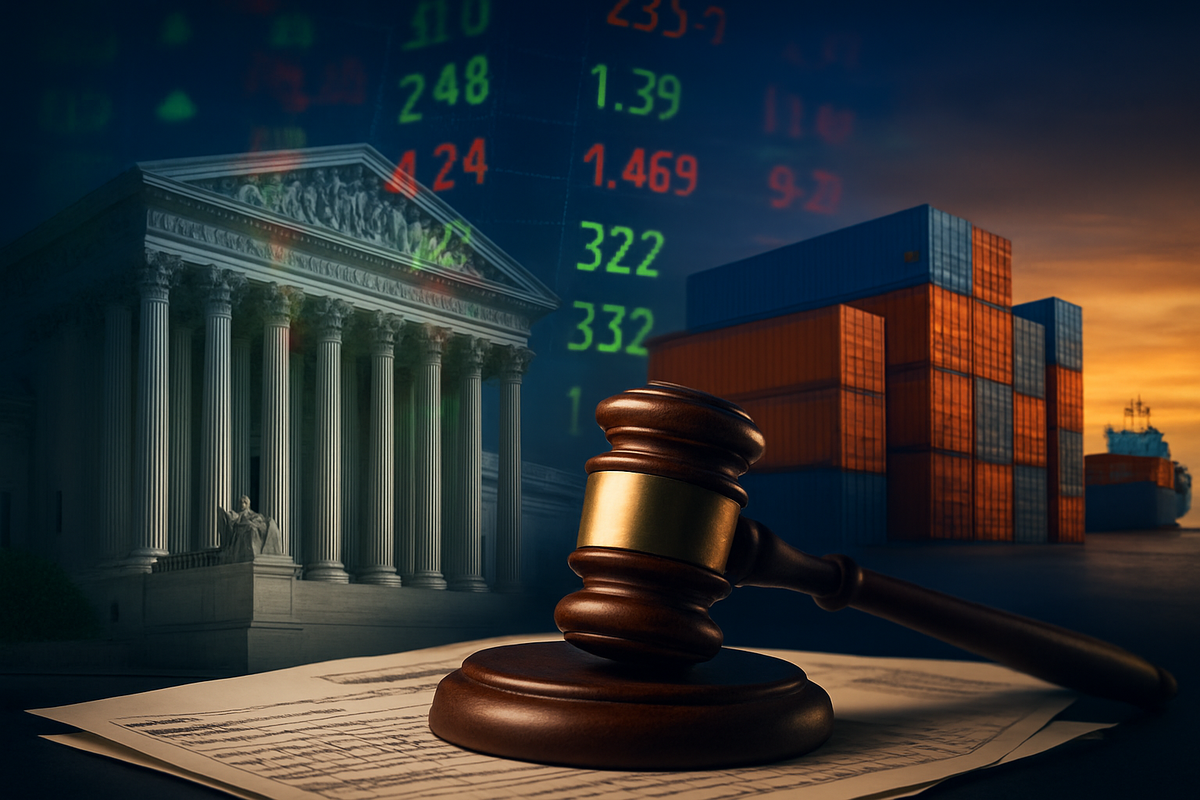
In a landmark decision that has sent shockwaves through global financial markets, the Supreme Court of the United States ruled in late February 2026 to invalidate a significant portion of President Trump’s sweeping tariff regime. The 6-3 ruling in Learning Resources, Inc. v. Trump has effectively dismantled the legal foundation for the administration’s most aggressive trade barriers, which were enacted during the "Trade War 2.0" of 2025. As of March 30, 2026, the market is still reeling from the implications, navigating a landscape of massive corporate refunds, supply chain recalibrations, and a defiant executive branch that has already pivoted to alternative legal authorities to maintain its protectionist agenda.
The immediate fallout of the decision has been a mixture of relief for major importers and renewed anxiety over trade policy stability. While the ruling struck down the 10% universal baseline tariff and punitive duties linked to border security, it left the controversial Section 232 and Section 301 tariffs largely intact. This legal "split" has created a bifurcated market environment where some industries are celebrating a multi-billion dollar windfall from expected tax refunds, while others remain under the thumb of "national security" trade restrictions. The administration’s rapid-fire response—invoking Section 122 of the Trade Act of 1974 just days after the ruling—has ensured that the "tariff era" is far from over, keeping investors on edge.
The Legal Earthquake: SCOTUS Strikes Down Presidential 'Power of the Purse'
The Supreme Court’s decision on February 20, 2026, was the culmination of a year-long legal battle led by a coalition of retailers and manufacturers. Writing for the majority, Chief Justice John Roberts argued that the International Emergency Economic Powers Act (IEEPA), which the administration used to justify its 2025 tariffs, does not grant the President the constitutional authority to levy taxes or duties. The Court asserted that such powers are reserved exclusively for Congress under the Taxing and Spending Clause. This ruling effectively nullified the "Liberation Day" tariffs—a 10% flat tax on nearly all imports—and the 25% "Border Security" tariffs imposed on goods from Mexico, Canada, and China.
The timeline leading to this moment was a whirlwind of executive orders and judicial challenges. Throughout 2025, the administration sought to replace large portions of the federal income tax with tariff revenue, pushing the effective U.S. tariff rate to its highest level in over a century. By the time the case reached the Supreme Court, the U.S. economy was showing signs of significant "tariff fatigue," with domestic prices for consumer electronics and apparel surging. The Court’s decision was greeted by an immediate, albeit volatile, rally in the S&P 500, as investors initially bet on a return to more traditional trade norms.
However, the "victory" for free trade was short-lived. Within 96 hours of the ruling, the White House invoked Section 122 of the Trade Act of 1974, which allows for temporary global surcharges to address trade deficits. This "bridge" tariff of 15% was designed to circumvent the SCOTUS ruling while the administration launched new investigations under the still-valid Section 232 and Section 301 frameworks. This aggressive pivot has tempered the market’s enthusiasm, as the threat of a prolonged legal battle over the new surcharges now looms over the second quarter of 2026.
Corporate Winners and Losers: A Shifting Landscape
The invalidation of IEEPA-based tariffs has created clear winners in the tech and retail sectors. Apple Inc. (NASDAQ: AAPL) stands as a primary beneficiary, having reportedly spent upwards of $900 million per quarter on tariff-related costs throughout 2025. The removal of duties on Mac and iPhone components imported from diverse supply hubs has provided a much-needed boost to the company’s hardware margins. Similarly, retail giants like Walmart Inc. (NYSE: WMT) and Target Corporation (NYSE: TGT) have seen a reduction in the "import tax" that had been squeezing their bottom lines and forcing price hikes for consumers.
Conversely, domestic industries that had flourished under the protective umbrella of the 2025 tariffs are now facing renewed competition. While the core steel tariffs under Section 232 remain in place, protecting companies like United States Steel Corporation (NYSE: X), the removal of "derivative" tariffs on finished steel parts and aluminum foil has opened the door for cheaper foreign competition. Domestic manufacturers who benefited from the 10% universal baseline tariff now find themselves vulnerable as the cost of imported competing goods drops, despite the administration’s attempts to use Section 122 as a stopgap.
The automotive sector remains caught in the crossfire. Ford Motor Company (NYSE: F) and General Motors Company (NYSE: GM) have seen some relief in the cost of parts imported from Mexico and Canada, which were previously taxed under the invalidated "Border Security" measures. However, both companies continue to struggle with high domestic input costs for raw materials due to the surviving Section 232 duties. Furthermore, the new 15% Section 122 surcharge has prevented the industry from realizing the full potential of the SCOTUS-mandated cost reductions, keeping production costs historically high.
Broader Market Implications and Global Repercussions
The wider significance of the Learning Resources decision cannot be overstated. It marks a historic reassertion of Congressional authority over trade policy, a power that had been steadily ceded to the executive branch since the mid-20th century. This shift fits into a broader industry trend of "legal de-risking," where multinational corporations are increasingly looking to the judiciary to provide a check on unpredictable trade maneuvers. The ruling has also triggered a massive administrative challenge: the Court of International Trade (CIT) is currently overseeing the refund process for an estimated $160 billion to $200 billion in "illegally collected" duties, a liquidity injection that could significantly impact corporate earnings in the coming quarters.
The ripple effects are global. U.S. trading partners, particularly those in the USMCA and the European Union, have cautiously welcomed the ruling while remaining wary of the administration’s pivot to Section 122. The historical precedent set here—similar to the challenges faced by the Nixon administration during the 1971 "Nixon Shock"—suggests that while the executive can find "emergency" workarounds, the legal ceiling for unilateral trade action is now much lower. For competitors in China and Southeast Asia, the ruling offers a window of opportunity to regain market share in the U.S., provided they can navigate the newly proposed Section 301 investigations into "structural excess capacity."
The Road Ahead: Navigating Post-Tariff Uncertainty
In the short term, the market faces a "litigation blizzard." A coalition of 24 states and several major retail trade groups have already filed suit against the new 15% Section 122 tariffs, arguing that "balance-of-payments" authority is being used as a pretext for the same protectionist goals the Supreme Court just restricted. If the courts apply the logic from the Learning Resources case—specifically the "non-delegation doctrine"—even the long-standing Section 232 and Section 301 authorities could eventually be at risk. This creates a high-stakes environment for strategic planning; companies must decide whether to repatriate supply chains or bet on a further rollback of trade barriers.
Market opportunities will likely emerge in "downstream" manufacturing—industries that use steel, aluminum, and electronics as inputs. As the $200 billion in refunds begins to flow back into corporate balance sheets, we may see a surge in capital expenditure and R&D, particularly in the tech and green energy sectors. However, the potential for a "scenario-based" market remains high. If the administration successfully defends Section 122, the U.S. will remain a high-tariff environment; if not, we could see a rapid return to pre-2016 trade dynamics, fundamentally altering the competitive landscape for domestic producers.
Conclusion and Outlook: A Market in Transition
The Supreme Court’s invalidation of the 2025 tariff regime is a watershed moment for the U.S. economy, yet it has not provided the "clean break" many investors hoped for. The key takeaway is that while the President’s legal authority to impose broad-based tariffs has been curtailed, the political will to maintain a protectionist stance remains robust. The pivot to Section 122 and the continuation of national security duties mean that trade policy will remain a primary driver of market volatility for the foreseeable future.
Moving forward, the market will likely be defined by the "refund rally" versus the "surcharge slump." Investors should keep a close eye on the Court of International Trade’s progress in returning tariff duties to companies like Apple and Walmart, as well as the initial rulings on the legality of the new Section 122 surcharges. In the coming months, the focus will shift from the headline-grabbing SCOTUS decision to the granular details of administrative law and the resilience of global supply chains in an era of permanent trade friction.
This content is intended for informational purposes only and is not financial advice.