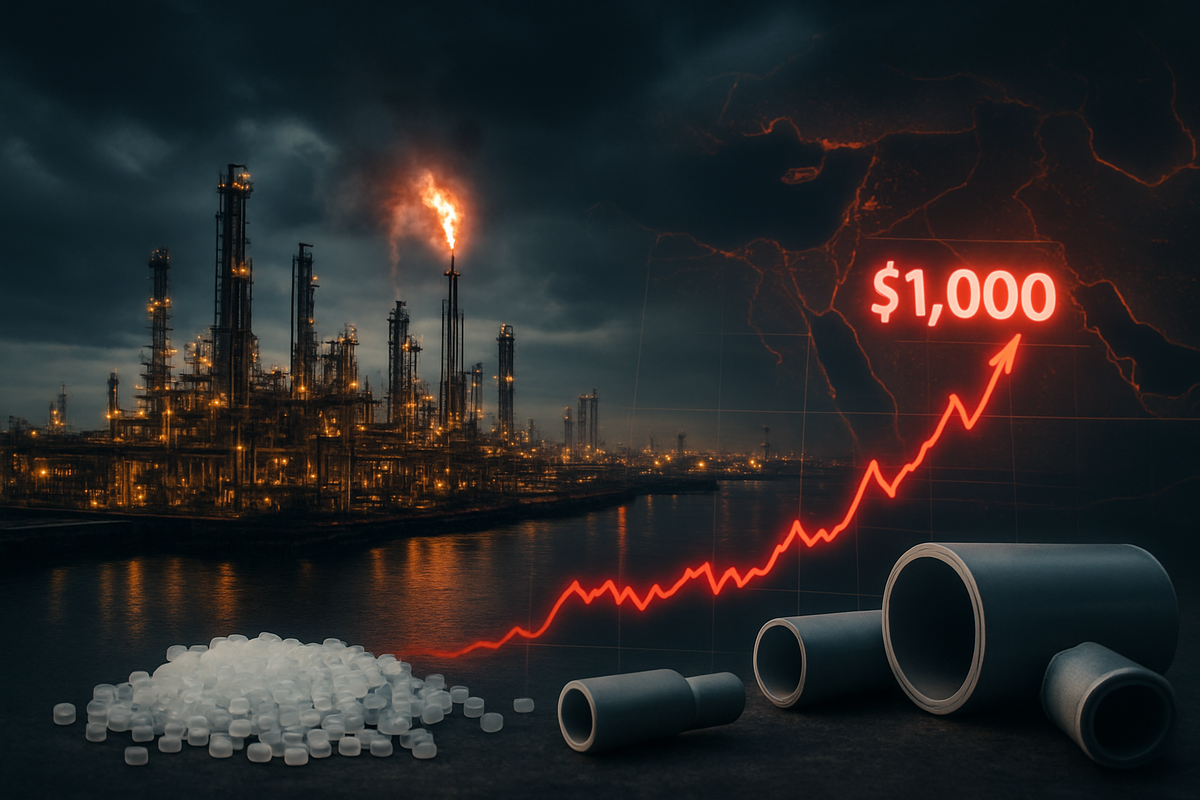
The global petrochemical industry is reeling this week as naphtha prices in Singapore breached the psychological $1,000 per metric ton mark, a level not seen in years. This explosive price action, triggered by a sudden and severe escalation of hostilities in the Middle East, has sent shockwaves through the plastics value chain, forcing immediate production cuts and price hikes for essential polymers like polypropylene and PVC.
The spike represents a 60% increase from levels seen just one month ago, effectively paralyzing manufacturers across Asia and Europe who rely on naphtha as their primary feedstock. As the "mother of all feedstocks" surges, the downstream impact is already manifesting in soaring costs for consumer packaging, construction materials, and automotive components, signaling a new era of inflation for the global manufacturing sector.
The Perfect Storm: A Timeline of the $1,000 Spike
The ascent to $1,000/mt began in earnest on February 28, 2026, following the outbreak of a major military conflict involving regional powers and Western allies. The immediate catalyst was the effective blockade of the Strait of Hormuz, a critical maritime artery through which approximately 30% of the world’s naphtha and 20% of its crude oil flows. Within days, the market shifted from a state of structural oversupply to one of acute, panic-driven scarcity.
Strategic energy infrastructure has also come under direct fire. Drone and missile strikes have targeted key facilities, including Saudi Arabia’s Ras Tanura refinery, the Ruwais complex in Abu Dhabi, and Qatar’s Pearl GTL plant. These disruptions have halted millions of barrels of production, leaving Asian crackers—the massive industrial plants that turn naphtha into plastic building blocks—scrambling for alternative supply. By March 25, 2026, spot prices in Singapore officially hit the four-digit mark, while Northeast Asian benchmarks (C&F Japan) were assessed even higher, between $1,010 and $1,050/mt.
Industry reactions have been swift and defensive. In Japan and South Korea, major refiners and petrochemical producers have been forced to navigate a market where the cost of raw materials now exceeds the value of the finished chemicals they produce. This "negative spread" has triggered a wave of "economic run cuts," with many facilities operating at just 60% capacity to avoid catastrophic financial losses. The logistics of the trade have also collapsed; war-risk insurance premiums have added up to $8/mt to cargo costs, while bunker fuel prices for shipping have jumped over 30%.
Winners and Losers: A Tale of Two Feedstocks
The $1,000 naphtha price has created a stark divide in the global market, favoring companies with access to North American natural gas liquids over those dependent on oil-based naphtha. Dow (NYSE: DOW) has emerged as a significant relative winner. Because Dow’s U.S. Gulf Coast assets are primarily fed by ethane—a byproduct of natural gas—they remain insulated from the oil-linked price surge affecting their Asian rivals. This has allowed Dow to maintain high margins while global polymer prices rise, creating a competitive "moat" that is currently wider than at any point in the last decade.
Conversely, Asian giants like LG Chem (KRX: 051910) and Mitsubishi Chemical (TYO: 4188) are facing severe margin compression. LG Chem has reportedly cut operating rates at its Yeosu and Daesan steam crackers to minimum levels. Similarly, Mitsubishi Chemical reduced output at its Ibaraki cracker to avoid a total shutdown. These companies are effectively being priced out of the market by the soaring cost of naphtha, which is the lifeblood of the East Asian petrochemical complex.
In the polymer space, Reliance Industries (NSE: RELIANCE) is walking a fine line. While its petrochemical margins are being squeezed by the high cost of feedstocks like ethylene, which has doubled to $1,351/mt in Northeast Asia, its massive refining segment is capturing record-high "crack spreads" on gasoline and diesel. Additionally, Reliance’s strategic ability to source discounted feedstocks through existing long-term agreements has provided some cushion that smaller regional players lack. Meanwhile, LyondellBasell (NYSE: LYB) was forced to declare force majeure on several polymer lines in Europe, citing the unsustainable surge in energy and feedstock costs that made fulfillment of existing contracts economically impossible.
Broader Industry Trends and Historical Precedents
The current crisis underscores a long-term trend of "feedstock fragility" in the global supply chain. This event mirrors the supply shocks of the 1970s oil crisis but with the added complexity of a deeply integrated global plastics market. The current arbitrage between U.S. ethane-based polymer production and Asian naphtha-based production has widened to over $1,200/mt, effectively splitting the world into a "two-speed economy." Western producers are reaping windfall profits while Asian manufacturers face an existential threat.
The impact on the Polyvinyl Chloride (PVC) market has been particularly devastating for the global construction sector. In India, a major hub for PVC consumption, domestic prices rose by a staggering 78% in March alone. This has forced Formosa Plastics (TPE: 1301) to declare force majeure on multiple ethylene downstream products effective April 1, 2026. The ripple effect is being felt in infrastructure projects globally, as the cost of PVC pipes and fittings—essential for water and sewage systems—has jumped by nearly 100% in some regions.
Regulatory bodies are also taking note. With the cost of finished plastic products rising by 20% to 100%, there are growing calls for government intervention to secure essential supply chains. However, unlike previous energy crises, the focus is now on the "chemical security" of nations. Some countries are considering strategic naphtha reserves, similar to strategic petroleum reserves, to buffer against future geopolitical volatility in the Middle East.
The Road Ahead: Strategic Pivots and Scenarios
In the short term, the market is bracing for "demand destruction." As the prices for polypropylene (used in everything from food packaging to car bumpers) and PVC continue to climb, manufacturers may begin to look for alternative materials or scale back production of non-essential goods. Analysts expect high prices to persist through at least the third quarter of 2026, as any resolution to the Middle East conflict will take months to translate into reopened shipping lanes and repaired infrastructure.
Long-term, this crisis will likely accelerate the transition toward "flex-feed" crackers and circular economy investments. BASF (ETR: BAS) provides a glimpse into this future; the company formally inaugurated its Zhanjiang Verbund site in China on March 26, 2026. This state-of-the-art facility features a flex-feed cracker capable of switching between naphtha, butane, and other gases, giving it a strategic advantage in a volatile price environment. We can expect more companies to follow this "local-for-local" production model to mitigate the risks associated with long-distance feedstock imports.
A Fragile Recovery and What to Watch
The breach of $1,000 naphtha marks a turning point for the global economy. The key takeaway for the market is that the era of cheap, reliable petrochemical feedstocks is over—at least until the geopolitical landscape stabilizes. The immediate future will be characterized by extreme volatility and a widening gap between the "haves" (ethane-based producers) and the "have-nots" (naphtha-based producers).
Moving forward, investors should keep a close eye on the operating rates of Asian steam crackers. If rates continue to fall below 60%, a total market collapse for certain specialized polymers could occur. Additionally, the ability of companies to pass on these costs to consumers without destroying demand will be the ultimate test of corporate resilience in 2026. For now, the petrochemical world remains in a state of high-alert, waiting for the first signs of a de-escalation that could bring the Singapore naphtha benchmarks back down to earth.
This content is intended for informational purposes only and is not financial advice