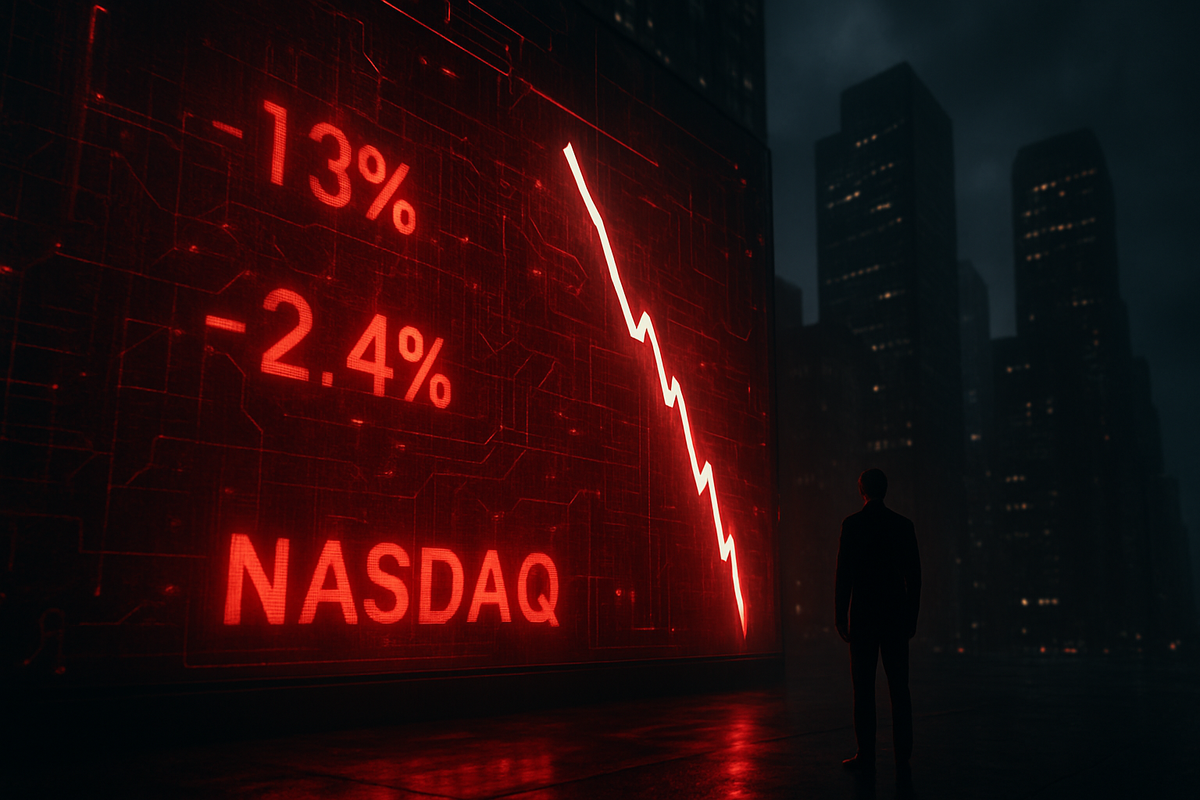
The U.S. stock market suffered a brutal sell-off on Friday, March 27, 2026, capping off a disastrous month that has seen trillions in market value evaporate. What began as a cautious retreat in early February has accelerated into a full-scale rout, with the Dow Jones Industrial Average, the S&P 500, and the Nasdaq Composite all finishing the day with significant losses. The panic-driven trading was fueled by a toxic combination of surging oil prices, disappointing capital expenditure reports from the technology sector, and mounting uncertainty surrounding the upcoming leadership transition at the Federal Reserve.
The most striking casualty of the day was the tech-heavy Nasdaq, which officially entered correction territory, closing more than 13% below its January all-time high. Investors who had spent the last two years riding the wave of generative AI enthusiasm are now heading for the exits, questioning whether the massive infrastructure investments made by "Big Tech" will ever yield the promised returns. As the closing bell rang, the broader market sentiment was one of exhaustion and fear, marking the fifth consecutive losing week for Wall Street—the longest such streak since the bear market of 2022.
A Perfect Storm: Five Weeks of Red on the Big Board
The decline on March 27 was not an isolated event but the climax of a punishing five-week stretch. The day began with a gap down at the open following news of further escalations in the Middle East, which sent West Texas Intermediate (WTI) crude oil futures soaring past $110 per barrel. By midday, the SPDR S&P 500 ETF Trust (NYSEARCA: SPY) had breached key technical support levels, triggering automated sell programs that exacerbated the downward momentum. The S&P 500 finished the day down 2.4%, while the Dow Jones Industrial Average shed over 800 points, or 1.9%.
The timeline of this collapse traces back to late February, when "sticky" inflation data first suggested that the Federal Reserve’s path to lower interest rates would be much longer and more painful than anticipated. Market stakeholders, including major institutional funds and retail investors alike, were caught off guard as the 10-year Treasury yield surged toward 4.5%. The sentiment shifted from "buying the dip" to "selling the rip," as institutional desks at firms like Goldman Sachs and Morgan Stanley warned that the "Buffett Indicator"—a measure of total market cap to GDP—had reached a staggering 220%, a level historically associated with major market peaks.
The AI Reckoning: Winners and Losers in a Volatile Landscape
The primary drivers of the 2024-2025 bull market have become the primary anchors dragging it down in 2026. NVIDIA (NASDAQ: NVDA), once the undisputed darling of the AI era, saw its shares tumble 6.2% today as analysts raised alarms about decelerating growth in data center revenue. Similarly, Microsoft (NASDAQ: MSFT) and Alphabet (NASDAQ: GOOGL) faced intense selling pressure as investors scrutinized their $500 billion combined capital expenditure plans for the year. The market is no longer rewarding these companies for simply "mentioning" AI; it is punishing them for the lack of clear monetization strategies.
Conversely, the few "winners" of this correction are found in the defensive and energy sectors. As geopolitical tensions restricted supply in the Strait of Hormuz, energy giants like ExxonMobil (NYSE: XOM) and Chevron (NYSE: CVX) managed to buck the downward trend, gaining 3.5% and 2.8% respectively. Meanwhile, "AI adopters" in the healthcare and utility sectors, such as UnitedHealth Group (NYSE: UNH), showed relative resilience as investors rotated into companies with stable cash flows and high dividend yields. On the losing end, consumer-sensitive stocks like Delta Air Lines (NYSE: DAL) were crushed by the dual blow of rising fuel costs and waning consumer confidence.
Beyond the Ticker: The Wider Significance of the 2026 Correction
This market correction represents a significant pivot in the post-pandemic economic cycle. For the past year, the market has been propped up by the "One Big Beautiful Bill Act" (OBBBA) of 2025, which provided temporary fiscal stimulus through sweeping tax cuts. However, the ripple effects of this policy are now being felt in the form of a ballooning federal deficit, which has pushed toward 7% of GDP. This fiscal reality, combined with the Nasdaq’s 13% drop, suggests that the "easy money" era of AI speculation is officially over, replaced by a "show-me" market where fundamental valuations matter again.
The historical precedent for this moment often points to the "dot-com" bust of 2000 or the 2022 inflation shock. However, the 2026 correction is unique due to the impending leadership change at the Federal Reserve. With Jerome Powell’s term set to expire in May, the market is "testing" the potential successors, including rumored frontrunner Kevin Warsh. The policy implications are immense; a more hawkish Fed Chair could further depress equity valuations in a bid to finally crush the 3.8% "sticky" inflation that has plagued the economy throughout the first quarter of the year.
What Lies Ahead: Strategic Pivots and Market Outlook
In the short term, the market is searching for a bottom. Analysts suggest that the S&P 500 could see further downside toward the 6,000 level if the 10-year Treasury yield remains above 4.5%. For investors, the next several weeks will require a strategic pivot away from high-beta growth stocks and toward "quality" companies with strong balance sheets and pricing power. The "AI 2.0" trade—focusing on companies that efficiently use AI to improve margins rather than those that simply build the hardware—is expected to emerge as the new leadership once the current volatility subsides.
The road to recovery will likely depend on two factors: a de-escalation of Middle Eastern tensions and a clear signal from the Fed regarding the May interest rate decision. If the Fed chooses to prioritize financial stability over inflation targets, we could see a "relief rally" by early summer. However, if energy prices remain elevated, the risk of a "stagflationary" environment—high inflation coupled with stagnant growth—becomes a very real possibility, forcing a major re-evaluation of long-term portfolio allocations.
Final Assessment: Navigating the New Normal
The events of March 27, 2026, serve as a stark reminder that no bull market lasts forever. The Nasdaq's entry into correction territory and the five-week losing streak mark the end of the "AI euphoria" phase and the beginning of a more disciplined, volatile era for global equities. Key takeaways for the coming months include the critical importance of diversification and the need to monitor energy prices as a lead indicator for broader market health.
Moving forward, investors should keep a close watch on corporate earnings reports for the second quarter, which will reveal whether the "Magnificent 7" can justify their current valuations. While the immediate outlook is clouded by geopolitical and fiscal uncertainty, the current "valuation reset" may eventually provide a more sustainable foundation for the next leg of the market cycle. For now, however, caution remains the order of the day on Wall Street.
This content is intended for informational purposes only and is not financial advice.