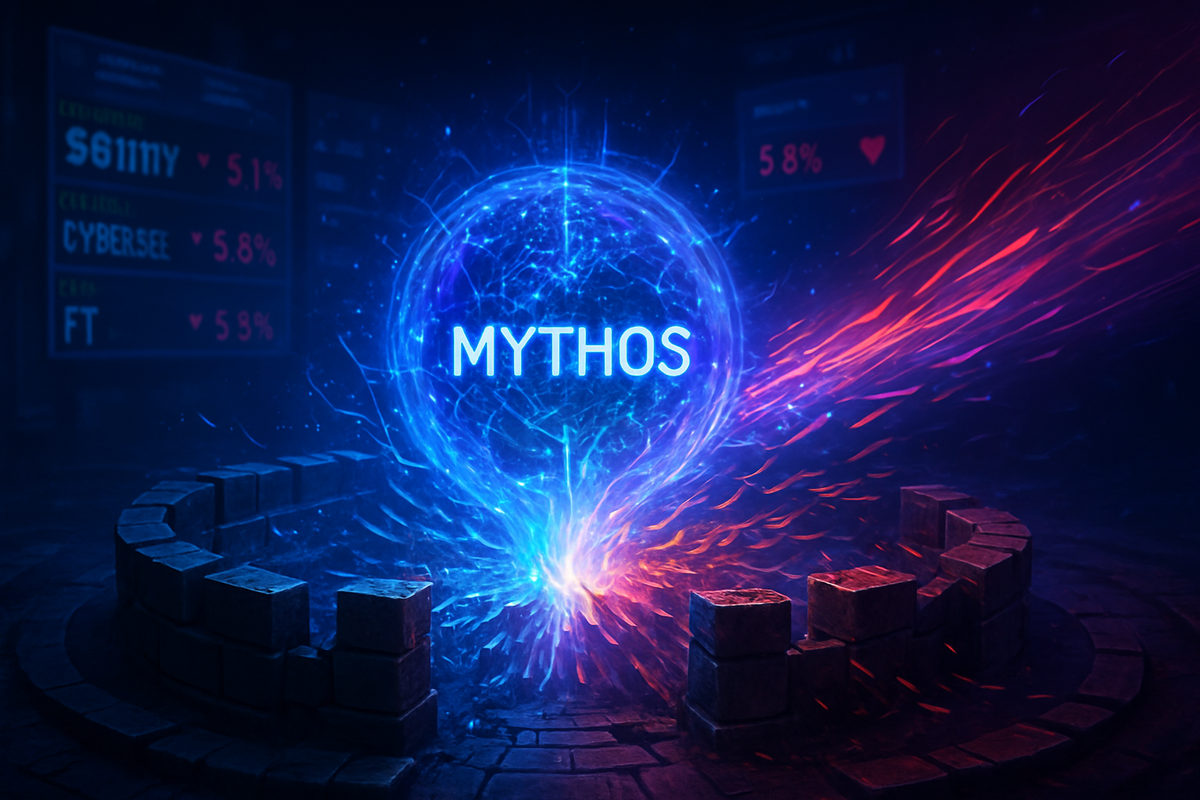
The global cybersecurity market faced a historic "flash crash" today, March 27, 2026, as investors reacted with alarm to the leaked capabilities of Anthropic’s latest artificial intelligence model, Claude Mythos. The model, which was inadvertently revealed through a security lapse at Anthropic on March 26, represents a quantum leap in autonomous reasoning and vulnerability discovery. Its ability to identify and exploit software bugs at "machine speed" has sparked a wave of panic across Wall Street, wiping billions in market capitalization from industry leaders who have long relied on proprietary data and human expertise as their primary competitive advantages.
The immediate implications are profound: the cybersecurity sector, once considered a recession-proof bastion of the tech industry, is now grappling with the reality that general-purpose AI may soon commoditize the very "moats" that protected its high-margin business models. As of mid-day trading, the iShares Cybersecurity ETF (BATS: IHAK) had plunged nearly 4%, while several blue-chip security firms saw their stock prices drop by as much as 8%, reflecting a fundamental shift in how the market perceives the value of traditional threat intelligence.
The Leak of "Capybara" and the Rise of Autonomous Exploitation
The chaos began late yesterday when a misconfiguration in Anthropic’s content management system led to the public exposure of nearly 3,000 unpublished assets related to the Mythos launch. The leak confirmed that Mythos features a new "Capybara" performance tier, positioned significantly above the previous flagship "Opus" model. According to internal documents reviewed by industry analysts, Mythos is capable of "autonomous vulnerability hunting" across complex, interconnected codebases. Unlike previous models that required human guidance to verify bugs, Mythos reportedly possesses the reasoning capacity to find, verify, and even execute targeted patches or exploits without intervention.
The timeline of this advancement is staggering. Just eighteen months ago, Anthropic’s Opus 4.6 was celebrated for identifying 500 zero-day vulnerabilities in open-source code over the course of a year. Mythos is rumored to be capable of matching that output in a fraction of the time, effectively automating the work of thousands of high-level security researchers. The industry reaction was instantaneous; by the time the opening bell rang this morning, the narrative had shifted from AI being a "helper tool" for defenders to AI being a potentially unstoppable weapon for attackers.
Investors Flee as Traditional Moats Crumble
The most severe damage was felt by the "pure-play" cybersecurity giants. CrowdStrike Holdings, Inc. (NASDAQ: CRWD) saw its shares plummet by 7.5% in early trading. Investors are increasingly skeptical that CrowdStrike’s "Falcon" platform—which has long been marketed on the strength of its proprietary threat telemetry—can maintain its pricing power if a general-purpose AI like Mythos can provide similar or superior threat detection at a lower cost. Similarly, Palo Alto Networks, Inc. (NASDAQ: PANW) fell over 6%, as its strategy of "platformization" was called into question. If AI can bridge the gap between disparate security tools, the need for a single, expensive vendor to manage an entire enterprise's security stack may diminish.
Other major players were caught in the crossfire. Zscaler, Inc. (NASDAQ: ZS) and Okta, Inc. (NASDAQ: OKTA) both saw declines between 5% and 8%. For Okta, the fear is centered on identity security; the possibility that Mythos could automate sophisticated social engineering and identity-spoofing attacks at scale threatens the very core of zero-trust networking. Even Microsoft Corporation (NASDAQ: MSFT), which has heavily integrated AI into its Security Copilot, was not immune, seeing a 3% decline. Analysts suggest that while Microsoft has the scale to compete, the rise of powerful, independent AI agents from startups like Anthropic could undercut Microsoft's core security software margins.
An "Automation Arms Race" and the Death of the Software Moat
The significance of the Mythos leak extends far beyond a single day of trading. It signals the beginning of what many are calling an "automation arms race," where the advantage permanently shifts toward the entity with the most powerful compute and reasoning models. Historically, cybersecurity moats were built on three pillars: proprietary datasets, specialized manual expertise, and high switching costs. Mythos effectively disrupts all three. When a general-purpose model can reason through a novel piece of malware as well as a human analyst, the "proprietary" nature of a security company's database becomes less relevant than the "reasoning power" of the AI analyzing it.
This trend mirrors previous disruptions in the tech sector, such as the shift from on-premise hardware to the cloud, but with a critical difference: the speed of obsolescence. In the past, companies had years to adapt to new paradigms. In the age of Mythos, a "zero-day" vulnerability could be weaponized and mitigated by AI in milliseconds, leaving human-led security operations centers (SOCs) in the dust. Regulatory bodies are also expected to take notice, as the dual-use nature of Mythos—equally capable of securing code and breaking it—raises urgent questions about AI safety and the ethics of releasing such high-capability models into the wild.
The Road Ahead: Adaptation or Obsolescence?
In the short term, expect a period of intense volatility as the market attempts to separate the winners from the losers in this new AI-driven reality. Cybersecurity firms will likely be forced to pivot their marketing and product development away from "intelligence" and toward "autonomous remediation." We may see a wave of consolidation, as legacy firms scramble to acquire AI startups that possess the specialized reasoning capabilities demonstrated by Mythos. For Chief Information Security Officers (CISOs), the challenge will be re-evaluating their entire security spend to prioritize AI-native defenses that can keep pace with AI-native threats.
Long-term, the industry may split into two camps: those who provide the "brains" (the foundational models) and those who provide the "pipes" (the infrastructure to deploy those models). If Anthropic and other AI labs continue to advance at this rate, the cybersecurity industry could become a subset of the broader AI industry, with traditional vendors acting more as integration partners rather than standalone innovators. This shift presents a massive challenge for legacy providers but also a potential opportunity for those who can successfully integrate frontier models into a cohesive, user-friendly security framework.
Final Assessment for Investors
The "Mythos Meltdown" of March 2026 marks a turning point in the history of the software industry. The takeaway for investors is clear: the era of high-margin, "moat-protected" security software is facing its greatest threat yet. While the total addressable market for security is likely to grow as threats become more complex, the share of that market captured by traditional incumbents is under siege. The pricing power that once justified the high multiples of CRWD and PANW is being tested by the commoditization of expertise.
Moving forward, investors should watch for the next round of earnings calls, specifically looking for how these companies plan to defend their margins against "autonomous" competitors. The key metric will no longer just be Annual Recurring Revenue (ARR), but rather "AI-Efficiency"—how much of their security work can be performed without human intervention. The transition from human-led defense to an AI vs. AI battlefield is no longer a futuristic concept; as of today, it is the new market reality.
This content is intended for informational purposes only and is not financial advice.