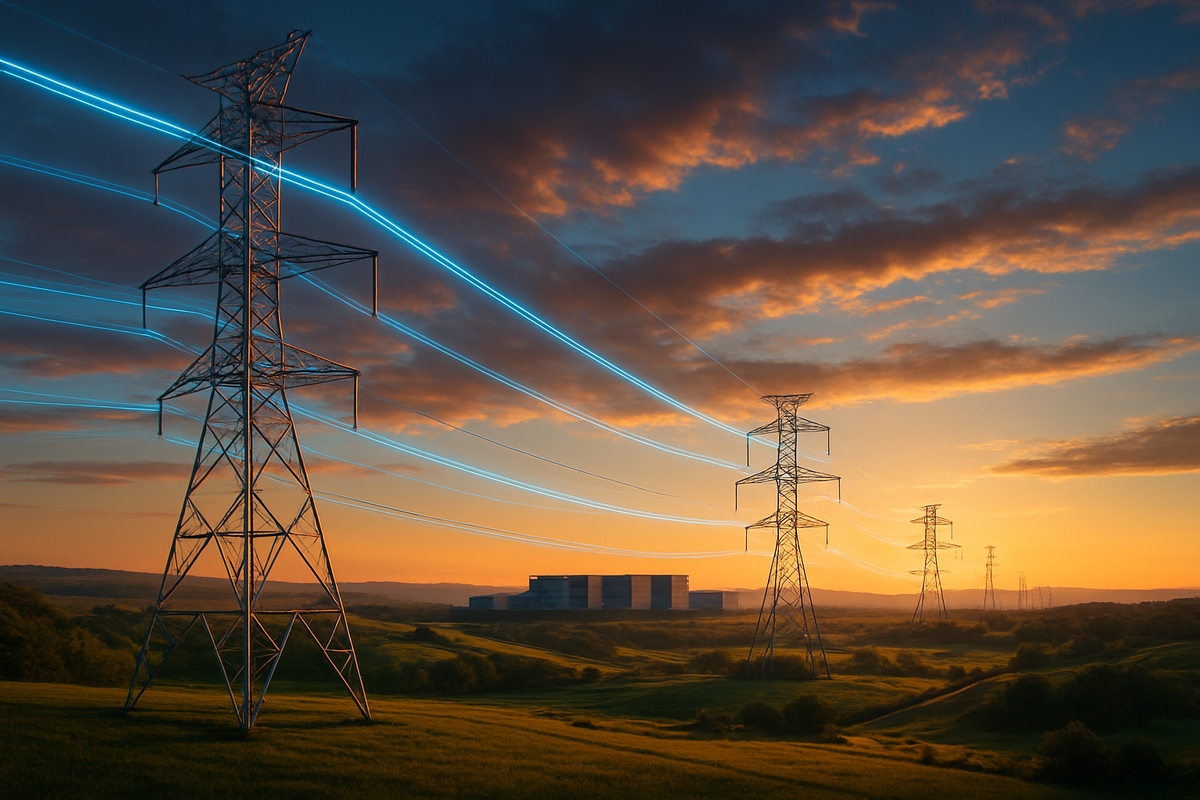
In a landmark move that signals a new era for the American utility sector, American Electric Power (Nasdaq: AEP) has announced a massive $4.2 billion investment in electric transmission infrastructure for its Ohio unit. Announced on March 20, 2026, the project is a centerpiece of a broader $33.3 billion "Stargate" energy and data initiative aimed at transforming the decommissioned Portsmouth Gaseous Diffusion Plant in Piketon, Ohio, into one of the world’s largest artificial intelligence data center hubs.
The immediate implications of this deal are twofold: it provides the critical high-voltage infrastructure necessary to support an unprecedented 10-gigawatt (GW) load growth, while simultaneously shielding residential and small business customers from the standard rate hikes typically associated with such massive capital expenditures. By utilizing a novel private-funding model, AEP Ohio is positioning itself as a leader in the "reindustrialization" of the American Midwest, proving that the energy demands of the AI boom can be met without compromising the financial stability of the local community.
Driving the 765-kV Revolution
The $4.2 billion investment focuses on the construction of several 765-kilovolt (kV) transmission lines—a signature technology of American Electric Power (Nasdaq: AEP) that can move six times as much energy as standard 345-kV lines. This infrastructure is essential to support the planned PORTS Technology Campus, a 10-gigawatt data center site being developed in partnership with SB Energy, a subsidiary of SoftBank Group (OTC: SFTBY), and Oracle (NYSE: ORCL). The timeline for the project is aggressive: construction is slated to begin in late 2026, with the first phase of power delivery expected by 2029.
This announcement follows years of mounting pressure on the Ohio power grid, driven by the rapid expansion of hyperscale data centers in the "Silicon Heartland." The negotiations leading up to this moment were marked by a pivotal July 2025 ruling by the Public Utilities Commission of Ohio (PUCO), which established a "Data Center Tariff." This regulatory framework was designed specifically to prevent "stranded assets"—infrastructure built for a single large customer that might later be abandoned—by requiring large energy users to pay for at least 85% of their contracted capacity regardless of use.
Key stakeholders, including the U.S. Department of Energy (DOE) and local Appalachian development groups, have hailed the project as a vital step in repurposing legacy industrial sites. Initial market reactions have been overwhelmingly positive, with utility analysts noting that AEP’s decision to have SB Energy fund the $4.2 billion transmission cost upfront is a masterstroke in balance-sheet management. This arrangement allows AEP to expand its regulated asset base without taking on the debt typically required for a project of this magnitude.
Winners, Losers, and the Shifting Utility Landscape
The primary winner in this scenario is American Electric Power (Nasdaq: AEP), which secures a long-term, regulated revenue stream for operating and maintaining the new lines without the immediate risk of rate-case friction with the public. Furthermore, GE Vernova (NYSE: GEV) has emerged as a major beneficiary, having secured a $10 billion contract to supply 170 high-efficiency gas turbines for the 9.2 GW of natural gas generation that will power the Piketon campus. Specialized construction firms like Quanta Services (NYSE: PWR) are also expected to see a significant backlog boost, as they are the primary partners for the complex 765-kV line installations.
On the other hand, the new regulatory environment in Ohio presents a complex challenge for traditional hyperscale operators like Microsoft (Nasdaq: MSFT), Alphabet (Nasdaq: GOOGL), and Meta (Nasdaq: META). While the new infrastructure ensures they have the power they need, the PUCO’s "take-or-pay" requirements and the precedent of upfront funding mean that the era of "cheap" grid expansion at the expense of residential ratepayers is effectively over. These tech giants must now weigh the benefit of Ohio’s robust infrastructure against the higher capital commitments required to secure it.
For investors, the most significant shift is in the profile of utility cash flows. By moving toward a model where large-scale commercial users pay for their own grid entry, AEP (Nasdaq: AEP) is reducing its "regulatory lag"—the time between spending money and recovering it through rates. This makes the utility's earnings more predictable and less susceptible to the political whims of state regulators, a highly attractive prospect for income-focused investors in a volatile market.
A Blueprint for the National Grid Renaissance
The Piketon project is a vivid illustration of the "Grid Renaissance" currently sweeping the United States. As the demand for AI processing power collides with the aging American electrical grid, utilities are being forced to innovate not just in engineering, but in finance and regulation. This event fits into a broader industry trend where the private sector—specifically tech and private equity—is increasingly stepping in to fund public utility infrastructure to ensure speed-to-market.
This shift has profound ripple effects on competitors. Neighboring utilities, such as FirstEnergy (NYSE: FE) and Duke Energy (NYSE: DUK), are likely to face pressure to adopt similar "direct-funding" models as they compete to attract data center investments in their respective territories. From a policy perspective, the Ohio "Data Center Tariff" of 2025 is already being looked at as a national blueprint. States that fail to implement similar protections for residential ratepayers may find themselves facing fierce public backlash against the tech industry's insatiable energy appetite.
Historically, large infrastructure projects of this scale were funded through decades of incremental rate increases. The AEP-SB Energy partnership breaks this mold, echoing the early 20th-century model where industrial titans funded their own dedicated power plants, but with a modern twist: the infrastructure remains part of a regulated, interconnected grid. This hybrid approach allows for the rapid scaling of high-tech industries while maintaining the public service mandate of the utility.
Looking Ahead: Permitting and Strategic Pivots
In the short term, the focus will shift to the Ohio Power Siting Board (OPSB) as it begins the permitting process for the specific transmission routes. Investors should expect a series of public hearings throughout late 2026, which will test local support for the project. While the "no-rate-increase" promise provides a strong political shield, environmental concerns regarding the 9.2 GW of natural gas generation required to bridge the gap until renewable sources can scale will likely be a point of contention.
Looking further ahead, the success of the Piketon project could lead to a strategic pivot for AEP (Nasdaq: AEP), potentially spinning off more "direct-funded" infrastructure units or forming similar joint ventures in other states like Texas and Virginia. The market opportunity is vast; as more industries—from EV manufacturing to green hydrogen—require massive grid upgrades, the "AEP Ohio Model" could become the standard for how America builds for the future. Challenges remain, however, particularly in the global supply chain for high-voltage transformers and specialized labor, which could lead to project delays if not managed carefully.
Summary of Market Implications
The $4.2 billion investment in Ohio represents more than just new wires and towers; it is a fundamental shift in how the American power grid is financed and utilized. By decoupling massive industrial load growth from residential rate increases, American Electric Power (Nasdaq: AEP) has provided a solution to one of the most pressing political and economic problems of the AI age. The project ensures that Ohio remains a competitive hub for global technology firms while protecting the financial well-being of its citizens.
As the market moves forward, investors should watch for the official start of construction in late 2026 and any subsequent PUCO filings that might refine the operational agreements between AEP and SB Energy. The long-term impact of this project will likely be measured in its ability to attract a "cluster" of high-tech companies to the Appalachian region, potentially sparking a wider economic revival. For the utility sector, the message is clear: the future belongs to those who can bridge the gap between legacy infrastructure and the high-voltage demands of the next industrial revolution.
This content is intended for informational purposes only and is not financial advice