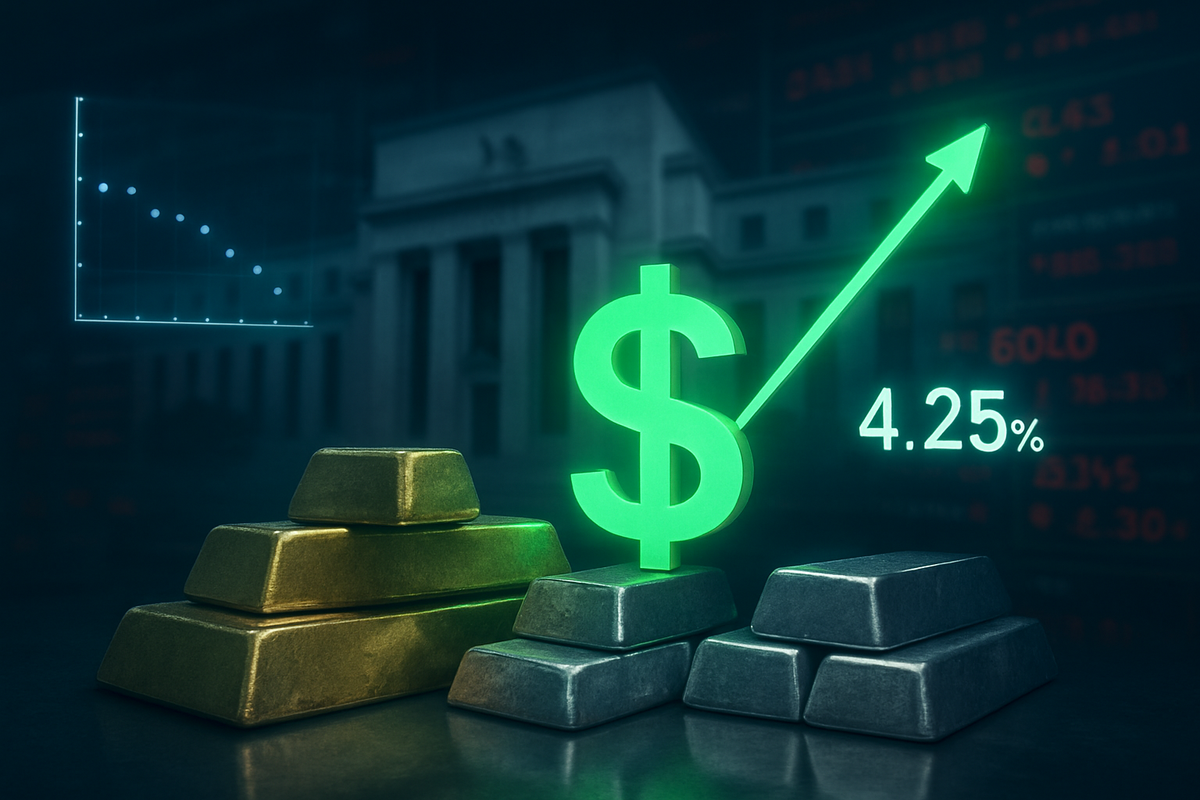
The high-flying precious metals market suffered a bruising reality check this week as the Federal Reserve delivered a stern "hawkish hold," dampening expectations for a pivot to easier monetary policy. Following the conclusion of the Federal Open Market Committee (FOMC) meeting on Wednesday, March 18, 2026, the central bank opted to maintain the federal funds rate at its current range of 3.50% to 3.75%, while simultaneously releasing a "dot plot" that signaled just one solitary rate cut for the remainder of the year.
The immediate aftermath has been nothing short of a rout for bullion bulls. As of the market session on March 20, 2026, spot gold prices have been forced into a steep retreat, sliding toward $4,657 an ounce—a sharp reversal from the record highs seen earlier this year. Silver has faced even more aggressive selling pressure, tumbling toward the $73 mark. The dual pressure of a surging U.S. Dollar Index (DXY) and 10-year Treasury yields climbing to 4.25% has stripped away the luster from non-yielding assets, leaving investors to recalibrate their portfolios for a "higher-for-longer" environment that many had hoped was nearing its end.
A "Hawkish Hold" Stuns the Markets
The Federal Reserve’s decision on March 18 was not entirely unexpected in terms of the rate itself, but the accompanying economic projections caught Wall Street off guard. For months, market participants had priced in at least three rate cuts for 2026, betting that cooling inflation and moderating GDP growth would give policymakers the green light to ease. Instead, the updated Summary of Economic Projections (SEP) revealed a committee deeply concerned about "cost-push" inflation stemming from persistent geopolitical volatility and a structural shift in global energy costs.
The timeline leading up to this moment has been defined by a resilient U.S. economy that refused to buckle under the weight of 3.5% interest rates. In early 2026, consumer spending remained surprisingly robust, and the labor market, while softening, did not show the signs of distress that would typically trigger a Fed rescue. Federal Reserve Chair Jerome Powell, in his post-meeting press conference, emphasized that while the central bank believes rates are in restrictive territory, the "final mile" of returning inflation to the 2% target is proving to be the most difficult.
Key stakeholders, including institutional bond holders and major commodity desks, reacted swiftly to the "dot plot" revision. The shift in the median projection for year-end 2026 to 3.4%—up from 2.9% in December 2025—sent a clear message: the Fed is in no rush. This stance has revitalized the U.S. Dollar, which had been under pressure from "de-dollarization" narratives throughout late 2025. With the 10-year Treasury yield hitting 4.25%, the opportunity cost of holding gold and silver has spiked, leading to a massive liquidation of long positions in the futures markets.
The initial market reaction saw the SPDR Gold Shares (NYSEARCA:GLD) and the iShares Silver Trust (NYSEARCA:SLV) gap lower at the Thursday open, with heavy volume suggesting that retail and institutional investors alike were trimming exposure. The suddenness of the move reflects a broader realization that the "Great Bullion Pivot" of 2025, which saw gold emerge as a primary reserve asset for central banks, may have moved too far ahead of the actual monetary policy trajectory.
Mining Giants and Financial Institutions: The New Winners and Losers
The fallout from the Fed's decision has created a stark divide among public companies. Gold mining behemoths like Newmont Corporation (NYSE: NEM) and Barrick Gold Corporation (NYSE: GOLD) have seen their stock prices underperform the broader market as the falling spot price of gold threatens to squeeze profit margins that were expanded during the late 2025 rally. For these producers, the combination of high operational costs—driven by energy and labor—and a declining end-product price creates a challenging near-term earnings outlook.
In the silver space, the impact is equally pronounced. Companies such as Pan American Silver Corp. (NYSE: PAAS) and First Majestic Silver Corp. (NYSE: AG) are grappling with the dual nature of silver as both a monetary and industrial metal. While industrial demand for silver in AI-driven data centers and the solar industry remains structurally sound, the "monetary drag" from a hawkish Fed is currently the dominant price driver. Wheaton Precious Metals Corp. (NYSE: WPM), which operates under a streaming model, is slightly more insulated but still remains sensitive to the underlying price volatility of the metals it streams.
Conversely, the banking sector has found a silver lining in the Fed’s hawkishness. Financial giants like JPMorgan Chase & Co. (NYSE: JPM) often benefit from a "higher-for-longer" rate environment, which allows them to maintain wider net interest margins (NIM). As long as the economy avoids a hard landing, banks can enjoy the carry on their massive reserve balances at the Fed. Furthermore, the resurgence of the U.S. dollar provides a tailwind for domestic-focused large-cap companies that are shielded from the currency translation losses that plague multinationals.
The broader casualty list includes interest-rate-sensitive sectors beyond just precious metals. Real Estate Investment Trusts (REITs) and high-growth technology firms, which rely on low discount rates for their future cash flows, have also felt the pinch of the 10-year yield's ascent to 4.25%. For investors, the "hawkish hold" has served as a reminder that in 2026, the Federal Reserve remains the ultimate arbiter of market sentiment, capable of derailing even the most powerful commodity bull runs with a single dot on a chart.
A Structural Shift in Global Finance
The current sell-off in gold and silver must be viewed through the lens of a broader industrial and geopolitical trend. While the Fed's hawkishness is a short-term headwind, 2026 has been a year of "The Great Bullion Pivot." For the first time in decades, gold has begun to rival U.S. Treasuries as a preferred reserve asset for central banks globally. This structural demand has created a higher floor for prices than in previous cycles, which explains why gold is still trading near $4,657 despite the hawkish rhetoric, rather than collapsing back to 2024 levels.
This event also highlights the growing disconnect between the Fed’s domestic mandate and the global "de-dollarization" movement. While the Fed is focused on Core PCE inflation—currently running near 2.7% to 3.0%—sovereign buyers are more concerned with the U.S. national debt, which has surpassed $38 trillion. This creates a volatile tug-of-war: the Fed pushes rates up to defend the dollar’s purchasing power, while global participants accumulate gold as a hedge against the very fiscal instability that high rates can exacerbate.
Historically, this period draws comparisons to the early 1980s, when then-Fed Chair Paul Volcker maintained high rates to break the back of inflation. However, the 2026 context is different due to the sheer size of the debt-to-GDP ratio. The ripple effect on competitors and partners is also unique; as the U.S. maintains higher rates, it forces other central banks, such as the European Central Bank and the Bank of Japan, to reconsider their own easing paths to prevent their currencies from devaluing too rapidly against a resurgent greenback.
From a regulatory standpoint, the Fed’s stance may invite increased scrutiny of the "shadow banking" sector and the commodity futures markets. With such violent swings in gold and silver, regulators are keeping a close eye on margin requirements and the potential for systemic liquidity shocks. The resilience of the $4,600 level for gold will be a critical psychological and technical marker for the market in the weeks ahead.
The Road Ahead: Potential Scenarios and Strategic Pivots
Looking forward, the remainder of 2026 will be defined by how "sticky" inflation remains. If energy prices continue to hover near $100 per barrel due to supply chain disruptions in the Middle East, the Fed may be forced to keep the 3.50%–3.75% range even longer than the market currently anticipates. In the short term, the market will be hyper-focused on the next round of Personal Consumption Expenditures (PCE) data. Any sign that inflation is accelerating could see the "one cut" projection vanish entirely, potentially pushing gold toward the $4,500 support level.
For precious metals miners and investors, a strategic pivot may be necessary. We could see a wave of consolidation in the mining industry as smaller players, burdened by high debt and falling metal prices, become targets for larger, more liquid competitors. Furthermore, institutional investors may shift from physical bullion or ETFs like GLD toward "value-oriented" gold producers that can prove their ability to generate free cash flow even at $4,600 an ounce.
The long-term outlook, however, still carries a bullish undertone for those who believe the Fed will eventually be forced to choose between fighting inflation and preventing a fiscal crisis. If the 4.25% yield on the 10-year Treasury begins to significantly increase the government’s interest expense, a "forced pivot" or some form of yield curve control could become a reality by 2027. Such a scenario would likely serve as the ultimate catalyst for gold and silver to reclaim their recent losses and move toward the $5,000 and $100 marks, respectively.
Navigating the "Vigilant Neutrality" Era
The events of late March 2026 mark the end of the "easy money" fantasy that some investors clung to at the start of the year. The Federal Reserve’s "hawkish hold" has successfully reasserted the central bank’s dominance over the narrative, reminding the market that the fight against inflation is far from over. For gold and silver, the current correction is a painful but perhaps necessary reset after a period of exuberant speculation.
Moving forward, the primary takeaway is that "vigilant neutrality" is the new mandate. Investors should watch for a stabilization in the U.S. Dollar Index; a sustained break above 106.00 could signal further pain for commodities. Conversely, any softening in labor market data could lead the Fed to pull forward that single anticipated rate cut, providing a much-needed relief rally for precious metals.
The lasting impact of this FOMC meeting will be a more disciplined approach to asset allocation. The era of blind commodity rallies is giving way to a period where macroeconomic fundamentals—real rates, fiscal health, and geopolitical risk—must be weighed with precision. While the gold and silver markets are currently "crushed," the underlying structural drivers of 2026 remain in play, waiting for the first sign of a Fed blink.
This content is intended for informational purposes only and is not financial advice.