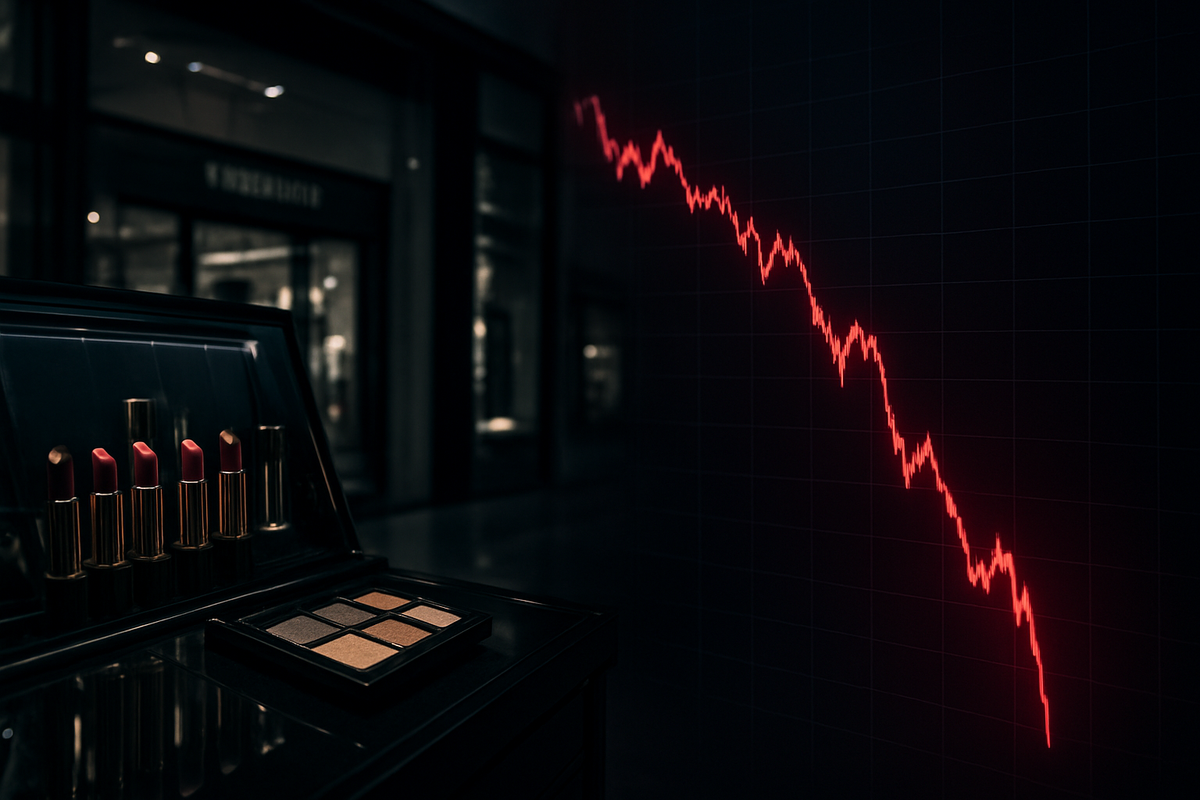
The beauty industry’s post-pandemic golden era appears to have met a sobering reality. Shares of Ulta Beauty (NASDAQ: ULTA) plummeted more than 14% during Monday’s trading session, securing its position as the worst performer in the S&P 500 for the day. The massive sell-off followed a series of cautious disclosures regarding the company’s fiscal outlook and a stark warning from leadership about a significant "normalization" in the beauty category.
This double-digit decline represents the largest single-day drop for the retail giant in nearly two years. As investors scrambled to reassess the valuation of the specialty beauty sector, the ripple effects were felt across the consumer discretionary landscape, raising urgent questions about the resilience of high-end cosmetic spending in a climate of rising energy costs and geopolitical instability.
Margin Compression and Moderating Growth: The Catalyst for the Crash
The catalyst for the current carnage was a combination of Ulta’s fourth-quarter 2025 earnings report and its freshly issued guidance for the 2026 fiscal year. While the company technically beat revenue estimates for the holiday quarter—reporting $3.90 billion against an expected $3.82 billion—the underlying health of the business showed signs of strain. Operating margins, a key metric for retail profitability, experienced a sharp contraction, falling from 14.8% to 12.2% year-over-year.
Management’s outlook for the coming year further soured the mood on Wall Street. Ulta Beauty projected net sales growth of just 6% to 7% for fiscal 2026, a notable deceleration from the nearly 10% growth recorded in the previous year. Comparable store sales guidance was similarly tempered to a range of 2.5% to 3.5%. The company cited a surge in Selling, General, and Administrative (SG&A) expenses, which jumped 23% due to higher incentive compensation and heavy investments in the "Ulta Beauty Unleashed" digital initiative.
In her first major test since taking the helm in January 2025, CEO Kecia Steelman provided a candid assessment of the headwinds facing the firm. Steelman pointed to a "normalized" environment where the frantic growth of previous years is being replaced by more disciplined consumer behavior. She also explicitly linked the slowdown to macroeconomic anxieties, specifically highlighting how escalating tensions in the Middle East and the resulting surge in Brent crude oil prices—now hovering near $100 per barrel—are forcing households to reconsider their discretionary budgets.
Winners and Losers in the Beauty Re-Rating
While Ulta bore the brunt of the market's ire, the entire beauty sector was cast under a shadow of doubt. The Estée Lauder Companies (NYSE: EL) saw its stock remain under heavy pressure, trading near $87.88 after losing nearly 8% in the preceding days. Similarly, Coty Inc. (NYSE: COTY) lingered near its 52-week lows, reflecting broader skepticism about the "prestige" beauty segment's ability to maintain premium pricing power.
However, the sell-off has highlighted a growing divide between traditional beauty retailers and agile, value-oriented players. E.l.f. Beauty (NYSE: ELF), despite dropping initially, managed to stabilize with a modest 1.3% gain on Monday. Analysts suggest that E.l.f.’s lower price points and strong resonance with Gen Z consumers may allow it to capture market share even as the overall category growth slows. Conversely, big-box retailers like Walmart (NYSE: WMT) and Target (NYSE: TGT) are increasingly viewed as "winners" in this environment, as their expanded beauty aisles offer convenience and competitive pricing that challenge Ulta’s specialty-store dominance.
The shift in market share is also benefiting Amazon (NASDAQ: AMZN), which continues to aggressively expand its premium beauty offerings. As consumers seek to maximize value, the platform's convenience and deep inventory are drawing foot traffic away from physical storefronts, putting further pressure on Ulta's brick-and-mortar footprint and its partnership with Target.
A Wider Market Signal: Discretionary Spending Under Siege
The 14% plunge in Ulta stock is more than just a retail story; it is a macro signal for the broader S&P 500. The index fell 0.6% on Monday to close at 6,632.19, its lowest point of the year. Ulta’s struggle serves as a bellwether for the consumer discretionary sector, which is increasingly sensitive to the "energy shock" triggered by supply chain disruptions in the Strait of Hormuz. When high-margin products like luxury makeup and skincare begin to see volume declines, it often precedes a wider cooling of the economy.
Historically, the beauty industry has been considered "recession-proof"—a phenomenon known as the "lipstick effect" where consumers buy small luxuries even when they can't afford big-ticket items. However, the current environment is unique. The sheer level of saturation in the beauty market, combined with the aggressive expansion of Sephora (owned by LVMH (OTC: LVMUY)) and direct-to-consumer brands, has created a hyper-competitive landscape where margins are increasingly difficult to defend.
Regulatory and policy watchers are also taking note. With energy prices spiking, there is renewed pressure on central banks to maintain restrictive interest rates to combat inflation, further squeezing the "lipstick" budget. The precedent set by today’s drop suggests that the "easy growth" era driven by social media trends and post-lockdown spending has officially concluded, forcing a pivot toward operational efficiency over raw expansion.
The Road Ahead: International Expansion and Digital Pivots
Looking forward, Ulta Beauty’s path to recovery likely lies outside of its saturated domestic market. The company is currently doubling down on its international expansion, particularly into Mexico and the United Kingdom via its acquisition of Space NK. These markets offer fresh growth runways, but they also come with significant execution risks and initial capital requirements that will likely weigh on earnings in the short term.
Strategically, the company must also prove that its "Ulta Beauty Unleashed" digital strategy can drive loyalty without relying on the heavy discounting that erodes margins. If the company can successfully integrate its physical and digital ecosystems while managing its inventory levels, it may be able to stabilize its stock price later in the year. However, a failure to gain traction in its international ventures or a further spike in global energy costs could lead to another round of guidance cuts.
Market analysts will be watching closely for the results of the spring "21 Days of Beauty" event, which will serve as a critical barometer for consumer appetite. If the event fails to spark significant traffic, the narrative of a structural slowdown will only gain more momentum among institutional investors.
Wrapping Up: A Turning Point for Retail Investors
Today’s 14% collapse in Ulta Beauty shares marks a definitive turning point for the retail sector in 2026. The combination of internal margin struggles and external macroeconomic pressures has shattered the perception of invincibility that previously surrounded the beauty industry. While the company remains a powerhouse in the sector, the era of double-digit comparable growth and expanding margins appears to be in the rearview mirror.
For investors, the key takeaway is the importance of margin resilience. In a "normalized" economy, top-line growth is no longer sufficient if it comes at the expense of profitability. The broader market remains in a state of high alert, as the energy crisis and geopolitical tensions continue to dictate the terms of consumer engagement.
In the coming months, watch for the volatility in Brent crude prices and the performance of value-oriented beauty brands. If energy prices remain near $100 per barrel, expect further rotation out of high-end discretionary stocks and into defensive sectors. Ulta’s ability to navigate this "new normal" will be the ultimate test for Kecia Steelman’s leadership and the company’s long-term value proposition.
This content is intended for informational purposes only and is not financial advice