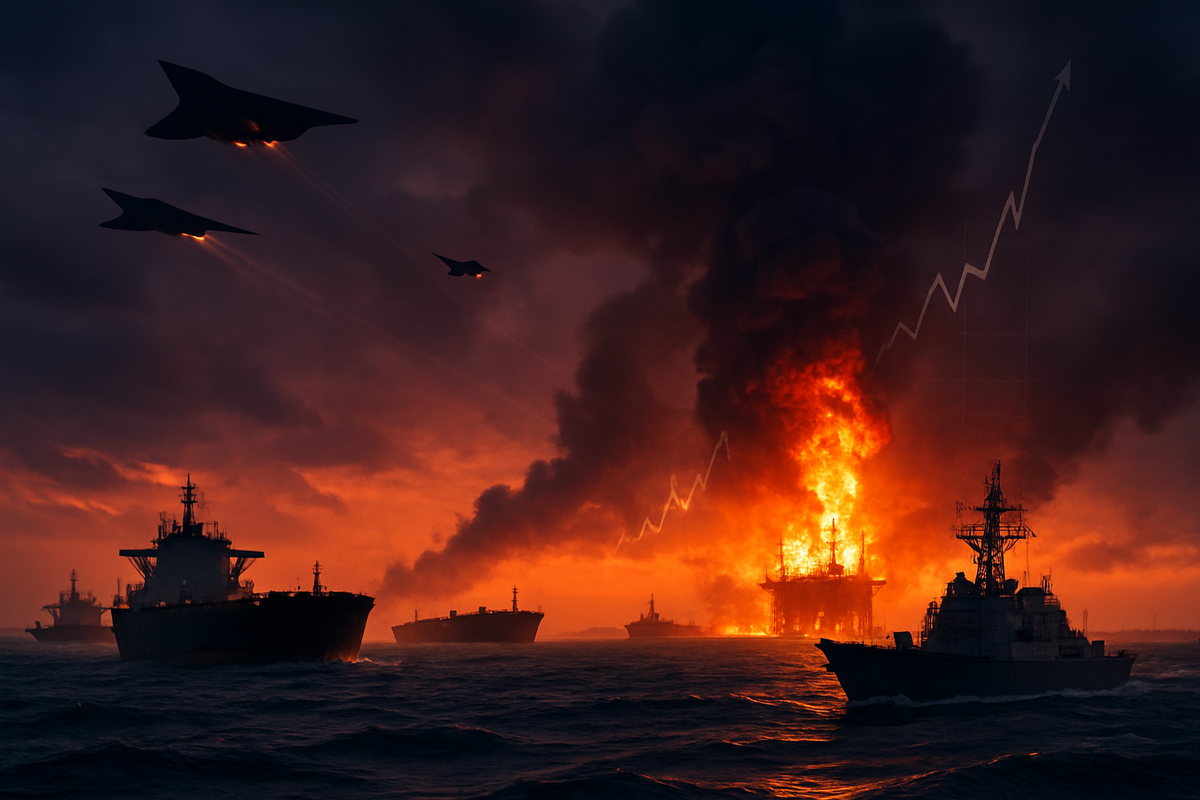
WASHINGTON D.C. — The global energy landscape has been plunged into a state of high-intensity volatility following a dramatic escalation in military conflict between the United States and Iran. As of March 16, 2026, Brent crude prices have surged past the critical $105 per barrel threshold, a direct consequence of "Operation Epic Fury," a joint U.S.-Israeli military campaign that has effectively paralyzed the world’s most vital maritime energy artery. With the Strait of Hormuz now a contested "no-go" zone for commercial shipping, the specter of 1970s-style stagflation has returned to the American economic forecast, forcing the Federal Reserve into a policy deadlock.
The immediate implications of the conflict are being felt at every level of the global supply chain. The International Energy Agency (IEA) has labeled the current situation the "largest supply disruption in history," as an estimated 20% of the world’s oil and liquefied natural gas (LNG) remains trapped behind a de facto blockade in the Persian Gulf. For the American consumer, the geopolitical shock has manifested at the pump, with national gasoline averages climbing past $4.00 per gallon for the first time in years, further eroding purchasing power in an already cooling economy.
A Timeline of Escalation: From Airstrikes to Blockades
The current crisis traces back to February 28, 2026, when the United States and Israel launched a series of coordinated precision strikes against Iranian military infrastructure and command centers. Tensions reached a breaking point on March 14, when U.S. forces targeted and significantly damaged Kharg Island, Iran's primary oil export terminal. This move was intended to sever the financial lifeline of the Iranian Revolutionary Guard Corps, but it prompted a swift and aggressive retaliatory response from Tehran.
Following the strikes, the new Iranian leadership under Mojtaba Khamenei declared the Strait of Hormuz closed to all vessels affiliated with the U.S. and its allies. Since early March, at least 21 merchant vessels have been targeted by drone swarms and shore-based missile batteries, leading major shipping conglomerates to suspend all transits through the waterway. Currently, over 150 oil tankers are anchored in the Gulf of Oman, unable to move while the U.S. Navy and its "Operation Epic Fury" coalition attempt to clear mines and neutralize asymmetrical threats.
The market reaction was instantaneous. Brent crude, which began the year in the $70 range, spiked to a peak of $126 per barrel during the initial "fear premium" phase before settling near $105.98 today. To mitigate the shock, IEA member nations authorized the release of 400 million barrels from Strategic Petroleum Reserves (SPR) on March 11, but analysts warn that even this unprecedented intervention provides only a temporary buffer against a prolonged closure of the Strait.
Market Winners and Losers in the New Geopolitical Reality
The surge in energy prices has created a stark divide in the equity markets, with energy majors and defense contractors seeing massive inflows while transportation and consumer-facing sectors struggle.
The Winners: Energy giants with diversified production outside the Middle East have seen their stock prices reach multi-year highs. ExxonMobil (NYSE: XOM) has emerged as a primary beneficiary, with shares trading near $120 as investors bet on the company's significant assets in the Permian Basin and Guyana. Similarly, Chevron (NYSE: CVX) hit all-time highs in mid-March, buoyed by its low breakeven costs and recent acquisitions that have bolstered its non-OPEC production capacity. Occidental Petroleum (NYSE: OXY) has also seen a significant rally, up 36% year-to-date, as high oil prices accelerate the company's ability to deleverage and return capital to shareholders.
In the defense sector, Lockheed Martin (NYSE: LMT) and Northrop Grumman (NYSE: NOC) have seen their share prices soar to record levels. Lockheed Martin, the lead contractor for many of the systems deployed in the current conflict, reported a backlog of $194 billion, while Northrop Grumman's stock jumped 10.9% following reports that its stealth platforms were integral to the initial strikes on Iranian facilities.
The Losers: Conversely, the aviation and logistics sectors are reeling from soaring input costs. United Airlines (NASDAQ: UAL) saw its shares tumble 21% in a single week as jet fuel prices climbed to $3.95 per gallon. Delta Air Lines (NYSE: DAL) has faced similar pressure, with analysts at TD Cowen slashing price targets due to expected margin erosion in the first half of 2026. FedEx (NYSE: FDX) is also under scrutiny; while the company uses fuel surcharges to offset costs, the broader slowdown in global trade and service suspensions in the Middle East are expected to result in a year-over-year earnings decline.
The Return of Stagflation: A Policy Nightmare
The US-Iran conflict is not just a regional military event; it is a macro-economic pivot point. The U.S. economy in Q1 2026 is showing classic signs of stagflation—a rare and dangerous combination of stagnant economic growth and high inflation. As of mid-March, U.S. GDP growth has slowed to a tepid 1.4%, while Headline CPI (Consumer Price Index) has spiked to 3.8% due to the energy shock.
This "Stagflation Vise" leaves the Federal Reserve in a precarious position. Typically, a cooling economy would prompt interest rate cuts to stimulate growth. However, with Core PCE (Personal Consumption Expenditures) remaining persistent at 3.0% and energy costs driving headline inflation higher, any rate cut risks de-anchoring inflation expectations further. The "Misery Index"—the sum of the unemployment rate (now at 4.5%) and the inflation rate—has reached its highest level since the early 2020s, drawing uncomfortable comparisons to the oil shocks of 1973 and 1979.
The broader significance of this event lies in the potential for a permanent shift in energy trade. Iran has reportedly begun offering oil in yuan-denominated contracts to circumvent U.S. sanctions, attempting to drive a wedge between the U.S. and major Asian importers like China and India. This challenge to the "petrodollar" system could have long-term regulatory and policy implications for the global financial order.
Looking Ahead: Strategic Pivots and Scenarios
In the short term, the market will remain fixated on the "tanker war" in the Strait of Hormuz. If the U.S. Navy can successfully establish "blue water" corridors for shipping, oil prices may stabilize in the $90 range. However, if Iran successfully deploys more advanced sea mines or targets Saudi oil processing facilities, a spike toward $150 per barrel is not out of the question.
Long-term, this conflict will likely accelerate the strategic pivot toward Western Hemisphere energy independence. Companies with significant North American footprints will continue to see a premium as the Middle East is once again viewed as an inherently unstable source of supply. Furthermore, the crisis may serve as a paradoxical catalyst for a renewed push into nuclear energy and renewables, as energy security becomes synonymous with national security.
Investors should also watch for a potential "secondary shock" if the conflict expands to include other regional players or if domestic political pressure in the U.S. forces an even more aggressive military stance to bring fuel prices down before the 2026 midterm elections.
Summary and Investor Outlook
The escalation of the US-Iran conflict in March 2026 has fundamentally altered the global economic calculus. With Brent crude holding above $105 and the Strait of Hormuz effectively closed, the immediate outlook is one of heightened risk and volatility. The key takeaways for the market moving forward include:
- Energy and Defense Dominance: Sectors tied to commodity production and military spending are the primary hedges against the current geopolitical risk.
- Stagflation Risks: The U.S. economy faces a challenging "no-man's land" where the Federal Reserve has few good options to combat both slowing growth and rising costs.
- Supply Chain Resilience: Transportation and logistics firms will face continued margin pressure until shipping lanes are secured or fuel prices retreat.
For the coming months, investors should closely monitor the Federal Reserve's Q2 meeting and any diplomatic movements regarding a potential ceasefire. While the "war premium" is currently priced in, the lasting impact of this conflict on global inflation and trade routes will likely be felt well into 2027.
This content is intended for informational purposes only and is not financial advice.