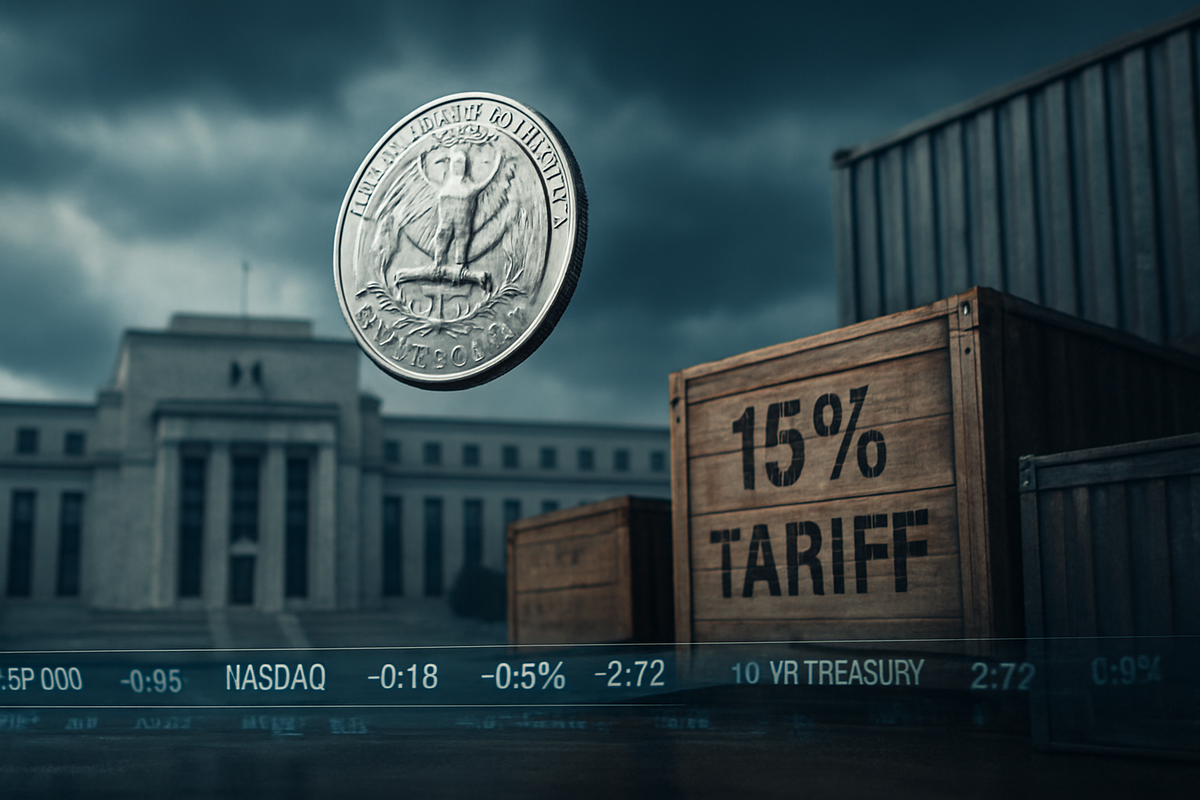
WASHINGTON D.C. — In a stark recalibration of monetary policy expectations, Federal Reserve Governor Christopher Waller characterized a potential March interest rate cut as a "coin flip" during a high-stakes address at the National Association for Business Economics (NABE) conference on February 23, 2026. The comments represent a significant pivot toward caution, effectively cooling investor fervor for immediate relief just as a constitutional crisis over trade policy injects fresh volatility into the American economy.
The shift in rhetoric from one of the Federal Reserve’s most influential voices has sent shockwaves through Wall Street, catching traders off guard after a January FOMC meeting where Waller had surprisingly emerged as a dove. His current hesitation is rooted in a "hot" January jobs report that challenged the narrative of a cooling economy, coupled with a chaotic trade landscape following a landmark Supreme Court ruling that struck down broad executive tariff powers, only to see them replaced by emergency temporary levies.
The January Surprise and the 150-Day Tariff Clock
Governor Waller’s pivot is primarily a reaction to a surge in labor market data that defied the "hiring recession" trends of 2025. The January 2026 jobs report revealed an unexpected addition of 130,000 positions—nearly double the consensus estimate—forcing Fed officials to question if the previous year's stagnation was truly over or merely a statistical anomaly. Waller explicitly stated that the Fed needs to determine if the January data is "signal or noise" before committing to a 25-basis-point cut at the March 17–18 FOMC meeting. He emphasized that the February employment data, scheduled for release on March 6, will be the ultimate tie-breaker in his personal "coin flip" decision.
The backdrop for this monetary uncertainty is a deepening trade crisis. On February 20, 2026, the Supreme Court ruled in Learning Resources, Inc. v. Trump that the administration’s use of the International Emergency Economic Powers Act (IEEPA) to impose broad "reciprocal" tariffs was unconstitutional, asserting that the power to levy such taxes rests solely with Congress. In a rapid-fire response, the administration invoked Section 122 of the Trade Act of 1974, imposing a 15% global temporary tariff for 150 days to manage a perceived balance-of-payments emergency. Waller acknowledged that while the Fed often "looks through" the temporary inflationary spikes caused by tariffs, the resultant "considerable uncertainty" is actively dampening business investment and clouding the central bank’s economic projections.
Banks Benefit from Yield Surge as Retail and Tech Face Headwinds
The sudden hawkish tilt has created a bifurcated landscape of winners and losers across the equities market. Large-cap financial institutions, including JPMorgan Chase & Co. (NYSE: JPM), Goldman Sachs Group Inc. (NYSE: GS), and Wells Fargo & Co. (NYSE: WFC), saw their stock prices stabilize or rise as Treasury yields surged. A "higher-for-longer" interest rate environment typically bolsters net interest margins for major lenders, and analysts at these firms have already begun pushing their forecasts for the first rate cut of 2026 into the summer months.
Conversely, the retail sector is reeling from the dual blow of sustained high borrowing costs and the new 15% global tariff. Small-to-mid-cap retailers like The Gap, Inc. (NYSE: GPS) and Urban Outfitters, Inc. (NASDAQ: URBN) are particularly vulnerable, as they lack the scale to negotiate long-term shipping contracts or absorb the sudden increase in landed costs. Meanwhile, Costco Wholesale Corporation (NASDAQ: COST) has taken a lead role in legal challenges against the new Section 122 tariffs, arguing that the administration is bypassing the spirit of the recent Supreme Court ruling. High-growth technology stocks, sensitive to discount rates, also faced selling pressure; NVIDIA Corporation (NASDAQ: NVDA) and Microsoft Corporation (NASDAQ: MSFT) saw modest pullbacks as the prospect of cheap capital in the first half of 2026 began to evaporate.
Policy Turbulence and the Ghost of 2025
This event marks a critical juncture in the Fed's attempt to navigate the "post-recession" landscape of 2026. Throughout 2025, the U.S. economy grappled with near-zero job growth, leading many—including Waller in January—to advocate for aggressive easing. However, the current situation mirrors historical "head fakes" where inflation or employment data briefly reignites, leading to policy errors. The Fed is wary of the 1970s-style mistake of cutting rates too early only to see inflation become entrenched, particularly with a 15% global tariff potentially acting as a pro-inflationary catalyst.
The regulatory implications of the SCOTUS ruling cannot be overstated. By reclaiming tariff authority for Congress, the Court has disrupted the executive branch's ability to use trade as a flexible tool of foreign and economic policy. This has left the Fed in the unenviable position of having to predict the movements of a Congress that is famously slow to act, even as the administration uses "emergency" stop-gap measures like Section 122. The "tariff-driven uncertainty" Waller mentioned is not just about the cost of goods, but about the very framework of American trade law.
Strategic Pivots and the March 6 Milestone
In the short term, the market is now entirely fixated on the March 6 employment report. If the February numbers show that the January gains were "eviscerated," as Waller put it, a March rate cut remains on the table. However, if the labor market holds steady, the market must prepare for a significant strategic pivot where the "easing cycle" is delayed until the third quarter of 2026. Corporations are already beginning to adapt; Walmart Inc. (NYSE: WMT) and Amazon.com, Inc. (NASDAQ: AMZN) are reportedly stockpiling inventory ahead of the expiration of the 150-day tariff window, anticipating that the trade war could escalate if Congress fails to pass a permanent tariff framework.
The long-term challenge for the Fed will be managing the "higher-for-longer" narrative without tipping a fragile economy back into the stagnation of 2025. Market participants should prepare for extreme volatility in the 10-year Treasury yield and a strengthening U.S. Dollar, which could further pressure multinational earnings as currency headwinds combine with trade barriers.
Conclusion: A Delicate Balancing Act
Governor Waller’s "coin flip" comments have successfully reset market expectations, shifting the probability of a March rate cut from a near-certainty to a long shot. This cautious approach reflects the Fed’s commitment to data-dependency in an era where traditional economic signals are being distorted by unprecedented legal and political shifts. The central bank is essentially buying time, waiting to see if the early 2026 growth spurt is a true recovery or a temporary flare-up fueled by pre-tariff front-loading.
For investors, the coming months will require a defensive posture. The primary focus should remain on the health of the consumer and the ability of firms to navigate a world of 15% temporary tariffs and persistent 5% interest rates. As the "coin flip" remains in mid-air, the only certainty is that the road to economic normalization in 2026 will be significantly more turbulent than many had hoped just weeks ago.
This content is intended for informational purposes only and is not financial advice.