In a weekend move that has sent shockwaves through global markets, President Donald Trump announced a new 15% global import surcharge, invoking the long-dormant Section 122 of the Trade Act of 1974. The announcement follows a stinging defeat at the Supreme Court on Friday, February 20, 2026, which invalidated the administration's previous tariff framework. By early Monday morning, February 23, 2026, the Dow Jones Industrial Average had plummeted 1.4%, or roughly 691 points, as investors grappled with the implications of a universal tariff regime that effectively replaces previous country-specific duties with an across-the-board surcharge.
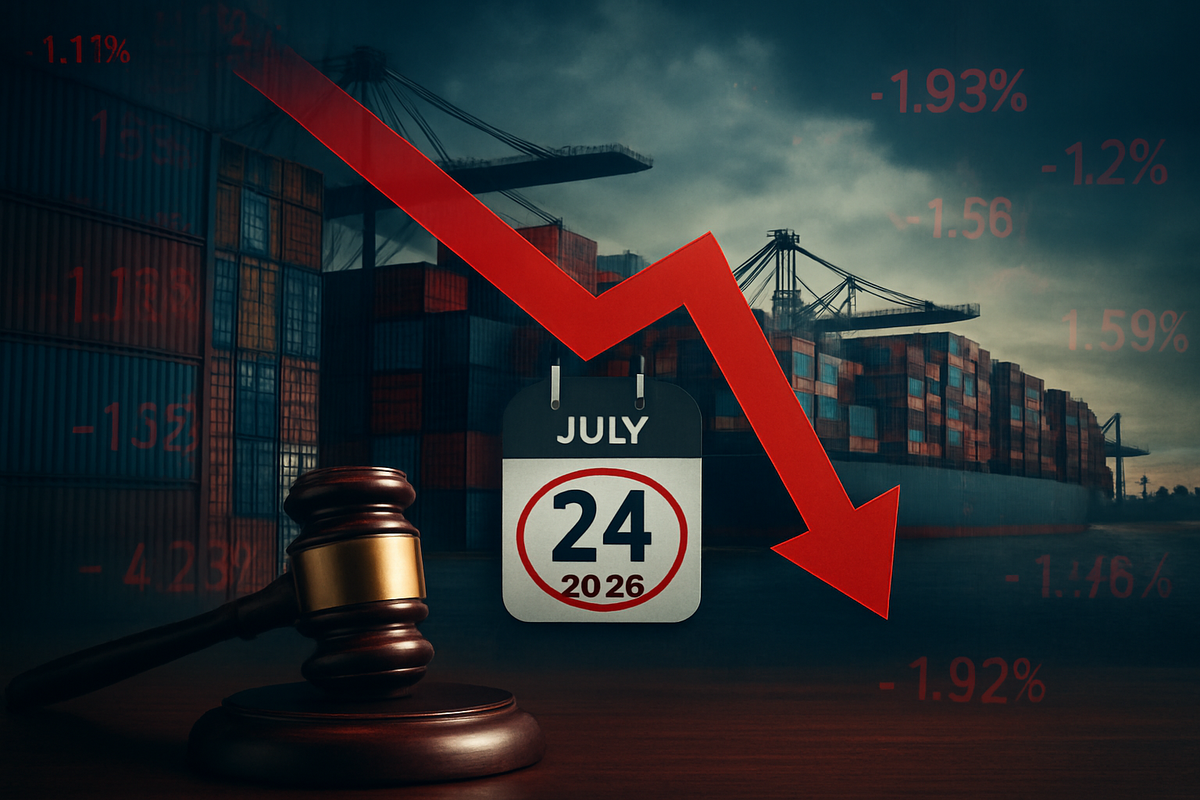
This strategic pivot marks a dramatic shift in the administration’s trade war, transitioning from broad executive "emergency" powers to a specific, time-limited statutory authority designed to address balance-of-payments deficits. While the 15% rate is the statutory maximum allowed under Section 122, the law mandates a strict 150-day window for such measures. This creates a high-stakes "tariff cliff" on July 24, 2026, forcing a divided Congress to either codify the administration's protectionist agenda or allow the surcharges to expire in the heat of a midterm election year.
A Legal Whiplash: From SCOTUS Defeat to a 150-Day Surcharge
The path to this moment began on Friday when the Supreme Court ruled 6-3 in Learning Resources, Inc. v. Trump that the International Emergency Economic Powers Act (IEEPA) does not grant the President unilateral authority to levy taxes or tariffs. The decision immediately voided the "Reciprocal Tariffs" and "Fentanyl-related" duties that had been the cornerstone of U.S. trade policy since early 2025. Markets initially rallied on the news, hoping for a return to pre-2025 trade norms. However, that optimism was short-lived. By Saturday, February 21, the President countered the judicial branch by invoking Section 122, a provision originally enacted to curb executive overreach after the "Nixon Shock" of 1971 but never before utilized in its current form.
The administration’s argument for the new 15% surcharge rests on the claim of a "large and serious" balance-of-payments deficit—a legal threshold that critics argue is antiquated in an era of floating exchange rates. Unlike the previous IEEPA-based tariffs, which targeted specific nations like China, Canada, and Mexico with varying rates (some as high as 100%), the Section 122 surcharge is, by law, non-discriminatory and applies to nearly all imported goods. This "blunt instrument" approach has created a logistical nightmare for importers who had spent months tailoring supply chains to avoid specific country-of-origin penalties.
Initial market reactions on Monday morning reflected deep-seated uncertainty. Beyond the 1.4% drop in the Dow, the S&P 500 and Nasdaq fell by 1.0% and 1.1%, respectively. The "tariff shock" was compounded by statements from Treasury officials suggesting that the 150-day window would be used to launch more permanent investigations under Section 301. Key stakeholders, including the U.S. Chamber of Commerce and various retail federations, have already signaled intent to challenge the "balance-of-payments" justification in court, setting the stage for a summer of intense legal and legislative maneuvering.
Corporate Fallout: Winners in Green Energy, Losers in Big Tech and Retail
The shift to a universal 15% surcharge has created a new class of corporate winners and losers, often determined by how the new rate compares to the now-defunct IEEPA duties. Among the hardest hit are tech hardware giants and high-volume retailers. Apple Inc. (Nasdaq: AAPL) saw its shares slide as analysts estimated the universal surcharge could cost the company upwards of $30 billion annually if it chooses not to pass the full cost to consumers. Similarly, Nvidia Corp. (Nasdaq: NVDA) faced pressure as the global surcharge threatens to inflate the cost of its sophisticated AI chip manufacturing components sourced from overseas.
Big-box retailers like Walmart Inc. (NYSE: WMT), Target Corp. (NYSE: TGT), and Costco Wholesale Corp. (Nasdaq: COST) are reeling from the loss of "duty-free" status on many consumer staples that were not previously targeted under country-specific tariffs. Home Depot Inc. (NYSE: HD) and Lowe’s Companies Inc. (NYSE: LOW) also saw significant selling pressure, as the 15% surcharge applies to a vast array of imported building materials and appliances. For these companies, the "universal" nature of Section 122 means there are few "safe havens" left in the global supply chain, forcing a likely spike in consumer prices across the board.
Conversely, some sectors are viewing the 15% surcharge as a strategic victory. First Solar Inc. (Nasdaq: FSLR) and other domestic renewable energy manufacturers saw a boost, as the 15% tariff on imported Asian solar panels makes U.S.-made modules more price-competitive. In the heavy industry sector, Nucor Corp. (NYSE: NUE) and United States Steel Corp. (NYSE: X) remained resilient; their core protections under Section 232 (National Security) were unaffected by the SCOTUS ruling, and the new global surcharge adds an additional layer of protection against foreign competitors. Interestingly, traditional automakers like General Motors Co. (NYSE: GM) and Ford Motor Co. (NYSE: F) saw a mixed reaction, as the 15% surcharge is actually lower than some of the 25% or higher "reciprocal" duties previously applied to specific imported parts.
Historical Echoes and the Erosion of Executive Trade Power
The invocation of Section 122 is a callback to the "Nixon Shock" of 1971, when President Richard Nixon imposed a 10% surcharge to force a global currency realignment. However, the 1974 Trade Act was specifically designed to limit such powers, replacing the open-ended authority Nixon used with the current 150-day "emergency" window. This historical context suggests that the Trump administration is using Section 122 not as a permanent policy, but as a "legislative bridge" or a bargaining chip to force Congress back to the negotiating table.
This event fits into a broader trend of "judicial reassertion" in Washington. For decades, Congress has delegated trade and tariff authority to the executive branch, but the Learning Resources ruling signals that the Supreme Court is no longer willing to allow the President to use "emergency" statutes like IEEPA to circumvent the House and Senate’s power to tax. The ripple effects will be felt by every U.S. trading partner, as the move effectively treats allies and adversaries with the same 15% brush, potentially alienating key partners in Europe and Asia who had hoped for a reprieve following the SCOTUS decision.
The policy implications are profound. If the administration successfully defends the use of Section 122, it could redefine "balance-of-payments" for the modern era, essentially allowing any president to cite a trade deficit as a national emergency. However, the immediate precedent set by the Supreme Court suggests that any "Plan B" that looks like a tax will face rigorous scrutiny. This sets up a "regulatory purgatory" for global trade, where businesses must plan for a 15% cost increase that might only last five months—or could be the first step in a permanent legislative overhaul.
The July Deadline: A Summer of Strategic Pivots
As the 150-day clock begins to tick toward the July 24, 2026, deadline, the market will be hyper-focused on Capitol Hill. For corporations, the immediate requirement is a "strategic pivot" toward short-term inventory management. Companies like Amazon.com Inc. (Nasdaq: AMZN) and major importers are expected to front-load shipments before the next potential policy shift, creating a temporary surge in logistics demand followed by a likely cooling as the "tariff cliff" approaches.
The most likely scenario is one of legislative gridlock. Senate Finance Committee Chair Ron Wyden (D-OR) has already called the Section 122 invocation "legally suspect," while House Ways and Means Chair Jason Smith (R-MO) has signaled support. Without a bipartisan consensus, the tariffs will expire automatically in July. This creates a "game of chicken" between the White House and Congress: will the administration use the 150 days to negotiate a new, permanent trade bill, or will it allow the tariffs to lapse, potentially leading to a chaotic "de-tariffing" that could be just as disruptive as their imposition?
Market opportunities may emerge for domestic-focused companies and "reshoring" consultants as firms scramble to move production stateside to avoid the persistent threat of executive trade actions. However, the short-term challenge remains the "uncertainty premium." Investors should prepare for heightened volatility in the consumer discretionary and technology sectors as the market attempts to price in the possibility of a permanent 15% global baseline for all trade entering the United States.
Moving Forward: What Investors Should Watch
The events of this February weekend have rewritten the rules of the 2026 trade landscape. The primary takeaway is that while the Supreme Court has limited the way the executive branch can impose tariffs, it has not dampened the administration’s intent to use every available statutory tool to protect domestic industry. Moving forward, the market will likely remain in a "wait-and-see" mode, with a heavy emphasis on the June and July legislative sessions.
Investors should closely monitor two key indicators: the progress of new Section 301 investigations, which could replace the 15% surcharge with more targeted permanent duties, and the rhetoric from Congressional leadership regarding a potential "Trade Authority Act" that might codify these powers. The 1.4% drop in the Dow is a clear signal that the market hates a vacuum, and the transition from IEEPA to Section 122 has created a legal and economic vacuum that won't be filled until mid-summer.
In the coming months, the focus will shift from the courtroom back to the trading floor and the halls of Congress. Whether this 150-day surcharge is a "last stand" for unilateral trade policy or the beginning of a new, legislatively-backed era of protectionism remains to be seen. For now, the global trade machine is running on a borrowed timeline, with July 24 marked in red on every major economic calendar.
This content is intended for informational purposes only and is not financial advice.