A wave of selling washed over the technology sector on February 23, 2026, as investors grappled with the disruptive potential of Anthropic’s latest breakthrough in artificial intelligence. The release of "Claude Code Security," an autonomous remediation tool capable of scanning, reasoning through, and patching complex software vulnerabilities, has sent a shockwave through the cybersecurity and software-as-a-service (SaaS) industries. Market participants are increasingly wary that the era of multi-billion dollar "moats" built on traditional threat detection may be coming to an end, replaced by AI agents that can fix bugs before they are ever exploited.
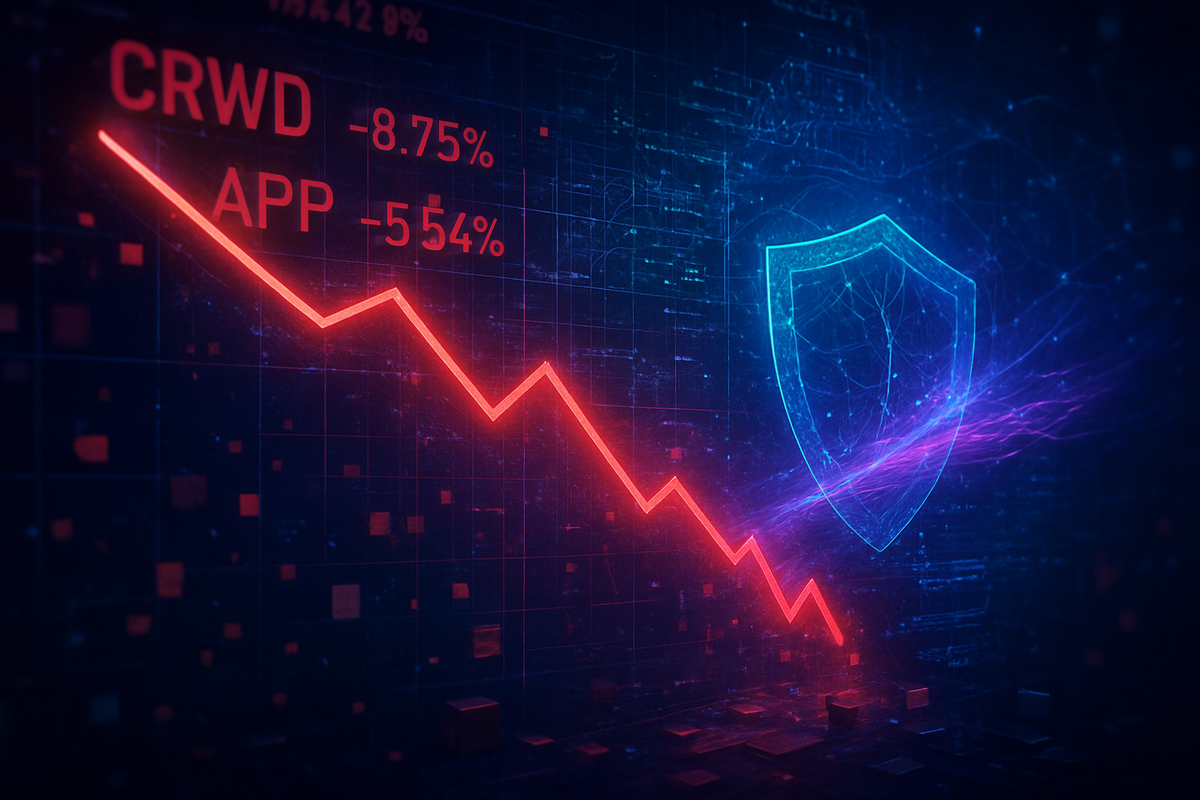
The fallout was immediate and severe for industry leaders. Shares of CrowdStrike (NASDAQ: CRWD) plunged 11.4% during Monday’s trading session, marking one of its worst single-day performances since its 2024 outage recovery. Similarly, AppLovin (NASDAQ: APP) saw a 9.7% decline as the "AI loser" narrative expanded beyond security into the broader software and ad-tech landscape. For many on Wall Street, the event signals a fundamental shift in the software value chain: if AI can autonomously secure and optimize code at the source, the premium currently paid for third-party monitoring platforms may be at risk of evaporating.
The Dawn of Autonomous Remediation
The catalyst for the market rout was the official unveiling of Claude Code Security on February 20, 2026. Integrated into the broader Claude Code ecosystem, the tool is powered by Anthropic’s latest flagship model, Claude Opus 4.6. Unlike traditional Static Application Security Testing (SAST) tools that rely on pattern recognition to find known vulnerabilities, Claude Code Security utilizes advanced "reasoning loops" to understand the intent and flow of a codebase. This allows it to identify "business logic" errors—flaws that are unique to a specific application’s design and have historically required human experts to find.
The capabilities presented by Anthropic were staggering. The company revealed that its "Frontier Red Team" used the new tool to identify and patch over 500 previously unknown zero-day vulnerabilities in production-level open-source software. Most of these bugs had existed for years, undetected by existing security protocols. By automating the "discovery-to-patch" pipeline, Anthropic has effectively commoditized high-level security engineering, a move that directly threatens the business models of firms that profit from the complexity of managing software vulnerabilities.
The market's reaction on February 23 was the culmination of a weekend spent by analysts recalculating the long-term earnings potential of the "Big Three" security firms. While detection and response remain critical, the narrative has shifted to "preventative automation." If an AI agent can ensure that code is born secure, the need for massive, agent-based endpoint protection suites—the bread and butter of firms like CrowdStrike—could see a significant decline in the coming decade.
Winners and Losers in the AI-Native Era
The immediate market bloodbath has bifurcated the technology sector into those perceived as "AI-native" and those labeled as "legacy" incumbents. CrowdStrike (NASDAQ: CRWD) has become the poster child for this struggle; despite its market-dominating Falcon platform, investors are concerned that its high-margin subscription model cannot survive a world where security is a feature of the development environment rather than a separate layer of the stack. Similarly, JFrog (NASDAQ: FROG) saw its shares crater nearly 25% due to its heavy reliance on managing the software supply chain, a process Anthropic’s tool aims to automate.
AppLovin (NASDAQ: APP) also found itself in the crosshairs, albeit for slightly different reasons. As a leader in AI-driven mobile ad-tech, AppLovin has enjoyed a massive run-up in valuation over the past two years. However, the Anthropic announcement served as a reminder that the proprietary algorithms powering AppLovin’s "AXON" engine are no longer safe from competition. If frontier AI models from Anthropic or Alphabet (NASDAQ: GOOGL) can offer similar or superior optimization capabilities as an out-of-the-box service, AppLovin's pricing power could be severely undermined.
On the other side of the ledger, the clear "winners" appear to be the hyper-scalers and the AI labs themselves. Microsoft (NASDAQ: MSFT), which has its own GitHub Copilot security features, remained relatively resilient, as its diversified business model and early lead in integrated AI developer tools provide a defensive cushion. Smaller, nimble AI-native security startups like Pangea—which CrowdStrike ironically attempted to acquire in late 2025 to bolster its own AI credentials—are being eyed by venture capital as the true successors to the current security giants.
A Fundamental Shift in the Security Paradigm
This event is not merely a technical update; it represents a historical turning point in the software industry. For decades, the relationship between developers and security teams was adversarial, with developers building quickly and security teams frantically trying to find and fix errors after the fact. Anthropic’s breakthrough moves the security function "left" on the timeline, integrating it directly into the moment of creation. This is being referred to by industry insiders as "vibe coding" with built-in immunity—a trend where natural language commands are translated into secure, production-ready code.
The broader implications for the market are profound. We are seeing a shift from "Detection and Response" to "Autonomous Resilience." This mirrors the transition in the early 2010s from on-premise software to the cloud. Just as hardware companies like Dell and HP struggled to maintain relevance when computing became a utility, software companies that rely on manual complexity may struggle as AI simplifies the stack. Regulatory bodies are also taking note; if AI can fix its own security flaws, the liability for software failures may shift from the developers to the AI providers themselves, a change that could trigger a new wave of policy debates in Washington.
Historically, this sell-off draws parallels to the 2023 "Chegg Moment," when the education tech company Chegg (NYSE: CHGG) admitted that ChatGPT was decimating its business model. The difference here is the scale. While Chegg was a niche player, the companies currently under fire—like Cloudflare (NYSE: NET) and Zscaler (NASDAQ: ZS)—are the backbone of the modern enterprise internet. The fear is that we are witnessing the first stage of a broad-based devaluation of SaaS moats.
The Road Ahead: Adaptation or Obsolescence?
In the short term, expect a flurry of defensive maneuvers from the impacted firms. We are likely to see a "M&A frenzy" as legacy security and software companies use their remaining cash reserves to acquire smaller AI-agent startups. CrowdStrike has already begun this pivot with its recent acquisitions of Pangea and Onum, but the market is clearly demanding more than just incremental updates. These firms will need to prove they can integrate agentic AI into their platforms as a core competency, rather than just a marketing layer.
Long-term, the survival of these companies depends on their ability to manage the "data moat." While Anthropic has the model intelligence, firms like CrowdStrike and AppLovin have decades of proprietary telemetry data. The strategic pivot will involve training specialized, "small language models" on this proprietary data to outperform generic models like Claude Opus. However, the window of opportunity is closing; if Anthropic continues to release tools that can reason through any codebase without specialized training, the data moat may prove less formidable than once thought.
Investor Outlook and Final Thoughts
The events of February 23, 2026, serve as a stark reminder that in the age of generative AI, no company is truly "un-disruptable." The 11.4% drop in CrowdStrike and the 9.7% decline in AppLovin are symptoms of a market that is finally repricing the risk of AI displacement. The era of selling "detection" is ending; the era of "automated perfection" has begun.
For investors, the coming months will be a period of intense scrutiny. Watch for executive commentary during upcoming earnings calls regarding "agentic integration" and R&D spending. The companies that can successfully transition from being "watchdogs" to "architects" of secure, AI-generated software will be the ones that survive this transition. However, as the "Anthropic Effect" has shown, the speed of innovation is currently outstripping the speed of corporate adaptation, and the market is no longer willing to wait for the laggards to catch up.
This content is intended for informational purposes only and is not financial advice.