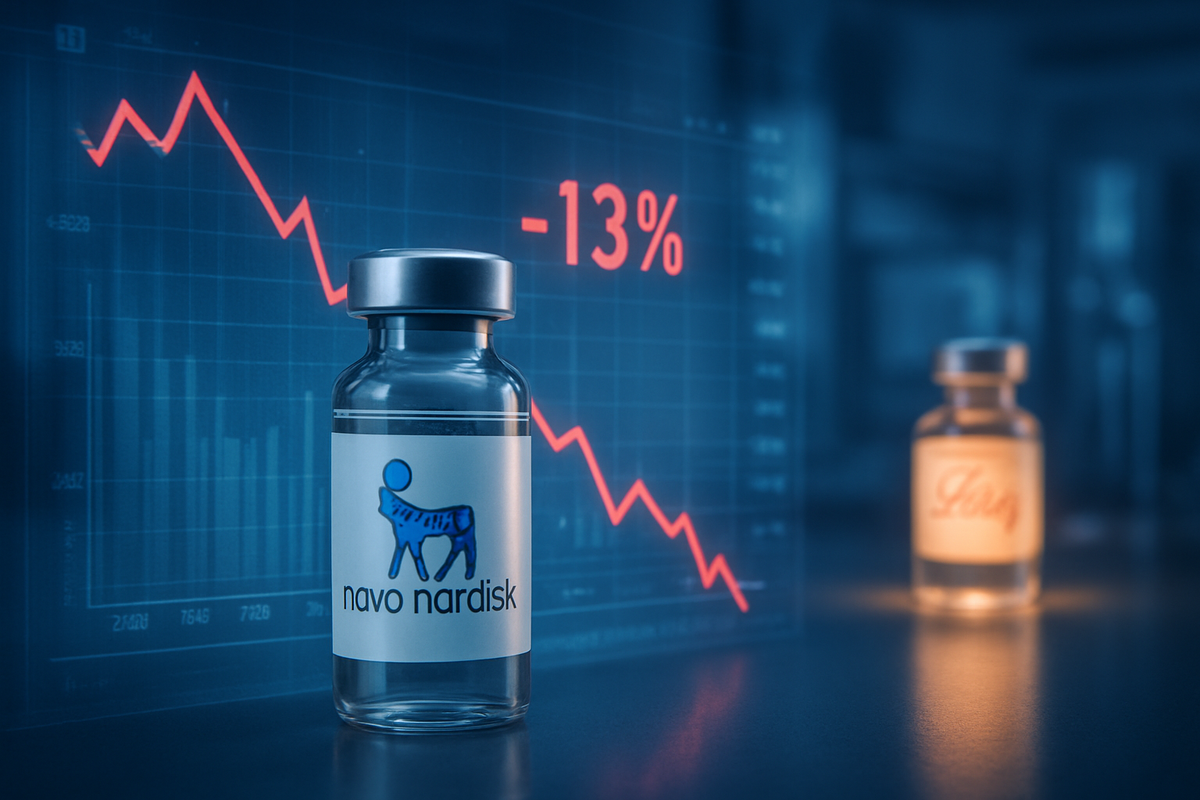
COPENHAGEN — Shares of the Danish pharmaceutical giant Novo Nordisk (NYSE: NVO) plummeted more than 13% in premarket trading on Monday, February 23, 2026, following the release of highly anticipated Phase 3 trial results for its next-generation obesity treatment, CagriSema. The data from the REDEFINE 4 study revealed that the drug, once hailed as a potential "Lilly-killer," failed to demonstrate superiority or even non-inferiority to its primary rival, Eli Lilly’s (NYSE: LLY) blockbuster weight-loss injection, Zepbound.
The market reaction was swift and severe, wiping nearly $100 billion off Novo Nordisk’s market capitalization within hours. Investors, who had priced in a significant clinical victory for the company’s combination therapy of semaglutide and cagrilintide, were left reeling as the results suggested that Eli Lilly’s dual-agonist platform remains the gold standard for efficacy in the multi-billion dollar anti-obesity market.
A Statistical Setback in the "Weight Loss Wars"
The REDEFINE 4 trial was an 84-week, head-to-head study designed specifically to prove that CagriSema could outperform Eli Lilly’s Tirzepatide (marketed as Zepbound). According to the headline data released early Monday, patients on CagriSema achieved a mean weight loss of 23.0% over the study period. While impressive in a vacuum, it fell statistically short of the 25.5% weight loss recorded by patients on the 15 mg dose of Tirzepatide.
Furthermore, when accounting for treatment dropouts and real-world adherence—a metric known as the "treatment-regimen estimand"—the gap widened further, with CagriSema showing 20.2% weight loss compared to 23.6% for Tirzepatide. The failure to meet the primary endpoint of non-inferiority is a major blow to Novo Nordisk's strategy to reclaim the leadership mantle it lost to Lilly in late 2024. This setback follows a year of mounting pressure on Novo, which had already seen its stock cool after issuing conservative 2026 guidance earlier this month citing "unprecedented pricing pressure" in the U.S. market.
Industry analysts at Morgan Stanley described the REDEFINE 4 results as a "worst-case scenario" for Novo Nordisk. For years, the company has staked its future on the idea that combining semaglutide (the active ingredient in Wegovy) with a long-acting amylin analogue (cagrilintide) would provide a synergistic effect superior to any single-molecule approach. Today’s data suggests that Eli Lilly’s strategy of targeting both GLP-1 and GIP receptors—and soon, glucagon receptors with its upcoming "triple agonist" Retatrutide—is a more potent biological pathway for weight reduction.
Winners and Losers: A Shifting Competitive Landscape
While Novo Nordisk faced its worst single-day performance in nearly a decade, Eli Lilly (NYSE: LLY) saw its shares climb 4% in early trading. The REDEFINE 4 results effectively cement Lilly’s dominance in the high-potency segment of the obesity market. Analysts now suggest that Zepbound has a clear runway to capture the majority of new patient starts through 2027, as it currently lacks a direct clinical superior in the injectable space.
The "next-wave" competitors also saw significant interest following Novo’s stumble. Amgen (NASDAQ: AMGN) is increasingly viewed as a formidable challenger with its drug MariTide. Unlike the weekly injections from Novo and Lilly, MariTide has shown the potential for monthly or even quarterly dosing in Phase 2 trials. With Novo’s next-gen offering faltering on efficacy, Amgen’s focus on patient convenience could allow it to dominate the "maintenance market" for patients who have already reached their goal weight.
Viking Therapeutics (NASDAQ: VKTX) also emerged as a strategic winner in the eyes of investors. Following the news, Viking’s stock surged 9% on speculation that it has become the most attractive acquisition target in the sector. Viking’s candidate, VK2735, has demonstrated rapid weight loss in early trials that some believe could eventually eclipse the 25% threshold, making it the only remaining "pure-play" asset capable of rivaling Lilly on raw potency.
Broader Industry Trends and Regulatory Headwinds
The clinical failure of CagriSema comes at a precarious time for the pharmaceutical industry. The U.S. government’s "Most Favored Nation" pricing policy, which went into effect in early 2025, has drastically reduced the net price of GLP-1 medications for Medicare beneficiaries. With lower margins per patient, pharmaceutical companies are under immense pressure to justify premium valuations through superior clinical results—a bar that Novo Nordisk failed to clear today.
Historically, the "obesity gold rush" was seen as a tide that would lift all boats. However, the February 2026 market correction suggests that the industry is entering a "Phase 2" characterized by clinical differentiation and price wars. The era of "any GLP-1 is a winner" is over. We are now seeing a divergence where efficacy, dosing frequency, and oral delivery methods are the primary drivers of shareholder value.
Furthermore, the results highlight a growing divide in therapeutic philosophy. Novo Nordisk’s focus on the GLP-1/Amylin combination was intended to preserve lean muscle mass more effectively than Lilly’s dual-agonist. However, today’s data release lacked sufficient detail on body composition to support that claim, leaving investors focused purely on the headline weight loss percentage—a metric where Novo currently trails.
The Road Ahead: Strategic Pivots and Future Trials
In the short term, Novo Nordisk is expected to pivot its marketing and R&D efforts toward its oral weight-loss programs. The company’s oral semaglutide tablet remains a high-priority asset, as it offers a needle-free alternative that many patients prefer. However, the disappointing results from the injectable CagriSema cast a shadow over the future of the oral combination version, which is currently in mid-stage development.
Management is now pinning its remaining hopes on the REDEFINE 11 trial, expected to report in 2027. This study is exploring more aggressive dosing schedules and longer treatment durations for CagriSema, with the hope that a more prolonged exposure to the drug will eventually yield the 25%+ weight loss figures that investors demand. Until then, Novo Nordisk faces a "lost year" of clinical uncertainty and competitive erosion.
Strategic adaptations may also include a more aggressive acquisition strategy. With nearly $30 billion in cash reserves, Novo Nordisk may look to acquire mid-cap biotech firms with novel mechanisms of action, such as gene therapies for metabolic health or myostatin inhibitors designed to prevent muscle loss during rapid weight reduction.
Investor Outlook and Summary
The events of February 23, 2026, represent a critical turning point in the weight-loss market. The takeaway for investors is clear: the leadership position in obesity is no longer a given for Novo Nordisk. Eli Lilly has claimed the title of the efficacy leader, while Amgen and Viking Therapeutics are rapidly closing the gap on convenience and potency.
Moving forward, the market will be hyper-focused on Amgen’s Phase 3 MARITIME results due in late 2027 and any updates on Viking’s Phase 3 enrollment. For Novo Nordisk, the coming months will be a period of consolidation and damage control. Investors should watch for the company's Q1 2026 earnings call, where management will be expected to provide a more detailed roadmap for how it intends to compete in an environment where its flagship "next-gen" drug is no longer the favorite.
The "Obesity Duopoly" has officially been broken, replaced by a complex, multi-player race where clinical perfection is the only path to premium valuation.
This content is intended for informational purposes only and is not financial advice.