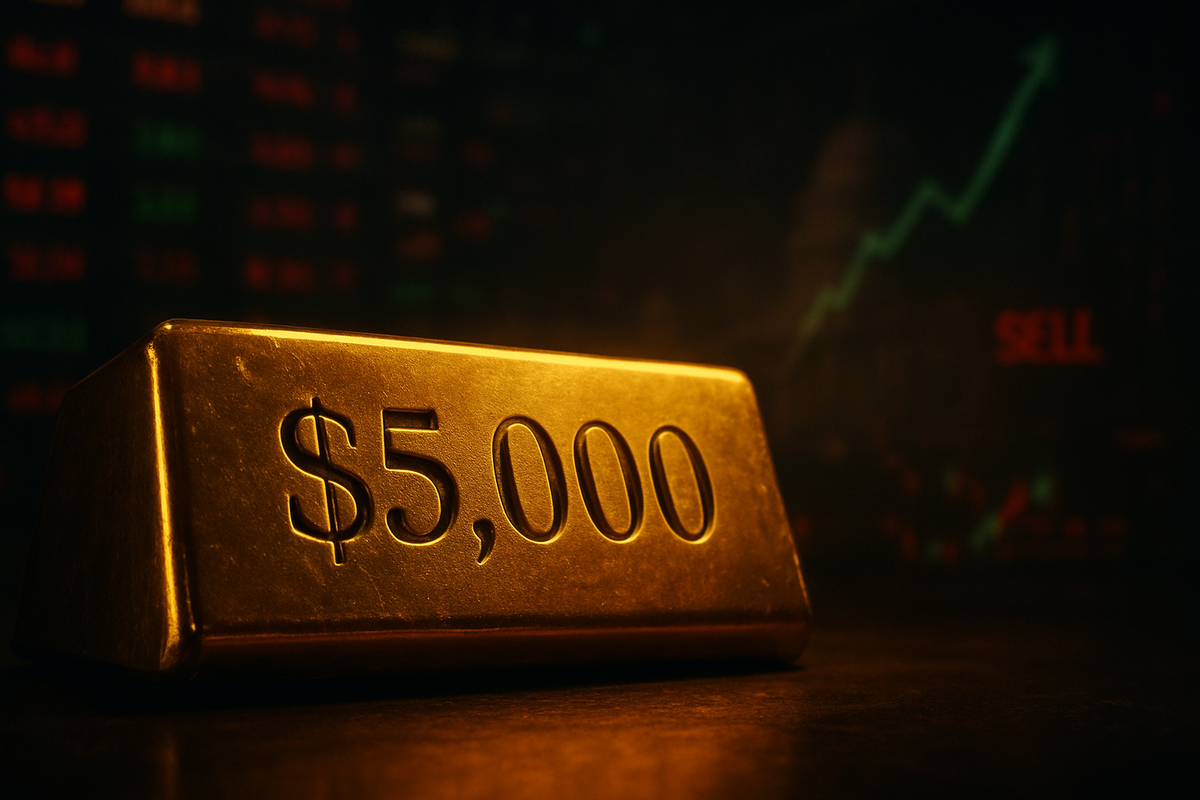
NEW YORK — In a move that has sent shockwaves through global financial centers, gold prices officially breached the historic $5,000 per ounce mark during early trading on February 23, 2026. The surge represents a tectonic shift in the commodity markets, as the yellow metal—once viewed primarily as a hedge against localized crises—has been re-rated by institutional investors and sovereign states as the ultimate "strategic anchor" in a fragmenting global economy.
The breach of this psychological and technical barrier follows a volatile 14-month climb, driven by a "perfect storm" of aggressive U.S. tariff escalations and a pervasive "Sell America" sentiment among international reserve managers. As the U.S. Dollar Index (DXY) shows signs of structural vulnerability, the global flight to hard assets has reached a fever pitch, fundamentally altering the calculus for portfolios from Wall Street to Shanghai.
The road to $5,000: Tariffs, turmoil, and a timeline of the ascent
The path to today’s record high began in earnest in early 2025, following the implementation of a universal baseline tariff on all U.S. imports. By late 2025, these duties had evolved into a sophisticated "Trade War 2.0," pushing the average effective import tax to a staggering 15%, levels not seen since the 1930s. The resulting "tariff-induced inflation" created a permanent floor for precious metals, as multinational corporations passed on billions in logistics and compliance costs to consumers.
A critical turning point occurred in mid-2025 when a series of high-profile legal battles over the independence of the Federal Reserve began to erode market confidence in the predictability of U.S. monetary policy. This institutional "de-risking" saw a massive rotation out of Treasuries and into physical bullion. The timeline reached a climax in January 2026, when a brief but violent "flash crash" saw gold dip 12% on profit-taking, only to be met by a wall of institutional buying that catapulted the price past $4,800 within weeks.
Central banks have been the primary architects of this rally. Throughout 2025, global central banks purchased a record-breaking 1,150 metric tonnes of gold, according to preliminary industry data. Nations such as Poland, India, and China have shifted from "tactical buyers" to "aggressive hoarders," with over 95% of reserve managers now indicating plans to further increase gold holdings. This coordinated move away from dollar-denominated assets has effectively "dried up" the physical market, leaving shorts scrambling as the $5,000 level was finally taken out.
Winners and losers in the era of 'Super-Margins'
The ascent to $5,000 has created a stark divide in the corporate world, producing "Super-Margins" for producers while squeezing industrial consumers. Leading the charge are the major miners, specifically Newmont Corporation (NYSE: NEM) and Barrick Gold (NYSE: GOLD). With All-In Sustaining Costs (AISC) largely contained between $1,500 and $1,700 per ounce, these firms are now generating upwards of $3,300 in profit for every ounce pulled from the ground. Agnico Eagle Mines (NYSE: AEM) has also emerged as a favorite for income-seeking investors, as it funnels record-breaking free cash flow into aggressive dividend hikes.
Royalty and streaming firms like Franco-Nevada (NYSE: FNV) and Wheaton Precious Metals (NYSE: WPM) are perhaps the cleanest winners of this trend. Operating on asset-light models with fixed-cost contracts negotiated when gold was below $2,000, these companies capture 100% of the price upside without exposure to the rising labor and energy costs currently plaguing the broader industrial sector.
Conversely, the "losers" list is growing. Luxury conglomerates like LVMH (OTC: LVMUY) and Richemont (OTC: CFRUY) are facing a dual threat: the soaring cost of raw materials for their jewelry divisions and a cooling demand for high-end goods as global trade friction limits consumer spending. Even the tech sector is feeling the burn; Apple (NASDAQ: AAPL) and other hardware giants are reportedly accelerating research into copper-palladium alloys to replace gold in high-end circuitry and AI servers. Furthermore, the dental industry, led by companies like Dentsply Sirona (NASDAQ: XRAY), is seeing a shift toward cheaper alternative materials as the cost of gold-based restorative procedures becomes prohibitive for the average patient.
A structural shift: De-dollarization and the 1970s parallel
Financial historians are already drawing parallels between the current 2026 surge and the stagflation era of the late 1970s. However, the current environment is arguably more complex. While the 1970s were defined by oil shocks and a pivot from the gold standard, the 2026 move is driven by a "crisis of confidence" in the fiat system itself. With U.S. Debt-to-GDP now exceeding 120%, the traditional "safe haven" of the U.S. Treasury has been partially supplanted by the "neutral" safe haven of gold.
The significance of the 'Sell America' trade cannot be overstated. It represents a fundamental realignment where trade is no longer viewed as a growth engine but as a tool of geopolitical pressure. As regional trade blocs in Europe and Asia sign expansive deals that bypass the U.S. entirely, the demand for a non-sovereign reserve currency has skyrocketed. This is no longer a speculative bubble; it is a structural revaluation of the global monetary hierarchy.
Regulatory implications are also emerging. The surge has prompted calls in Washington for new oversight of "strategic metal reserves," while some members of the BRICS+ alliance have begun discussing a gold-backed digital settlement unit. These developments suggest that the $5,000 mark is not just a price point, but a signal that the era of unipolar financial dominance is rapidly evolving into a multipolar reality.
The $10,000 trajectory: What lies ahead?
The immediate question for markets is whether $5,000 represents a peak or a new base. Short-term volatility is expected as some traders lock in once-in-a-generation profits. However, many analysts, including those at Bank of America, are already modeling a trajectory toward $10,000 per ounce by 2030. For this to occur, the U.S. Dollar Index (DXY) would likely need to settle into a long-term range below 90, a scenario that seems increasingly plausible if the Federal Reserve is forced into aggressive rate cuts to stimulate a tariff-burdened economy.
Strategic pivots will be required for companies across the spectrum. We are likely to see a surge in M&A activity within the mining sector as mid-tier producers become attractive targets for "mega-miners" looking to replenish their reserves. On the consumer side, expect a "thrift shift" in electronics and medical devices, where engineering out the use of precious metals becomes a primary competitive advantage.
Investors should prepare for a "regime-shift risk." The correlation between stocks and bonds has turned positive and volatile, leaving gold as one of the few assets providing true diversification. The next few months will be critical as the market tests the $5,000 floor; if it holds, the psychological shift will be permanent, and the "Sell America" trade could transition from a tactical move to a generational trend.
Closing the gold chapter and opening a new one
The breach of $5,000 per ounce marks the definitive end of the "low-inflation, globalized" era that defined the early 21st century. It is a stark reminder that in a world of geopolitical fragmentation and fiscal expansion, hard assets remain the ultimate arbiter of value. The key takeaway for the market is that gold has reclaimed its throne as a "strategic currency," independent of any single nation's policy whims or debt levels.
Moving forward, the market will likely be characterized by heightened sensitivity to trade data and central bank rhetoric. Investors should keep a close eye on the Invesco DB US Dollar Index Bullish Fund (NYSE: UUP); if the dollar continues to slide alongside rising gold, the case for a $10,000 gold price becomes almost unavoidable.
As we look toward the remainder of 2026, the $5,000 mark will be remembered as the moment the global financial system acknowledged a new reality. Gold is no longer just "insurance"—it is the scoreboard for a world in transition.
This content is intended for informational purposes only and is not financial advice.