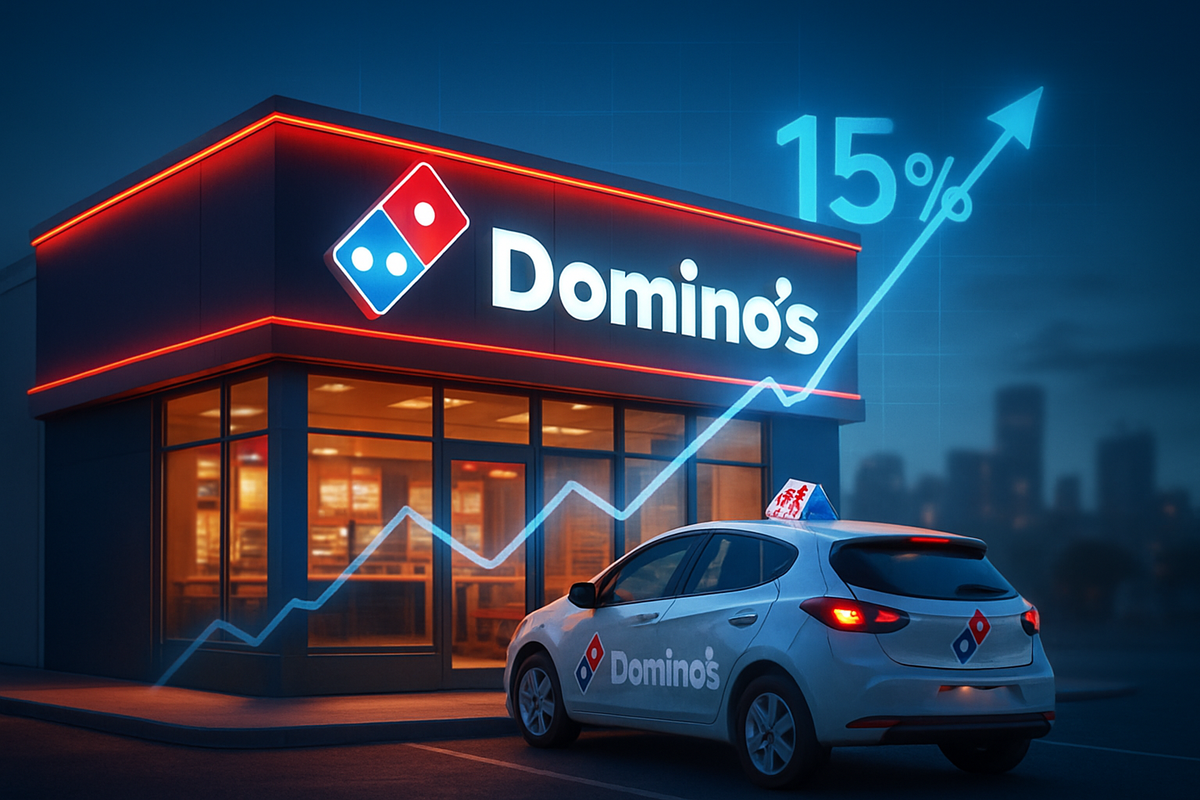
ANN ARBOR, MI – In a powerful display of consumer resilience and operational efficiency, Domino’s Pizza, Inc. (NYSE: DPZ) reported fourth-quarter 2025 financial results this morning that comfortably cleared Wall Street’s expectations for revenue and domestic growth. The pizza giant’s performance was bolstered by a resurgent U.S. delivery business and the continued success of its "Hungry for MORE" strategic initiative, leading the Board of Directors to approve a substantial 15% increase in the company’s quarterly dividend.
The market’s reaction was swift and decisive. Shares of Domino’s Pizza surged nearly 6% in early trading on February 23, 2026, as investors looked past a fractional miss on earnings per share to focus on the company’s accelerating top-line momentum. With a global footprint that has now expanded to 22,142 locations, Domino's has solidified its position as the world’s largest pizza company, signaling that its aggressive expansion and digital-first approach are continuing to take a larger slice of the global Quick Service Restaurant (QSR) market.
Financial Strength and the Dividend Bonanza
For the fourth quarter ending December 2025, Domino’s reported total revenue of $1.54 billion, marking a 6.4% increase over the previous year and surpassing the consensus analyst estimate of $1.52 billion. The company’s U.S. same-store sales grew by 3.7%, an impressive feat that outpaced the 3.47% growth projected by industry experts. This growth was largely attributed to a refined loyalty program and deeper integrations with third-party delivery aggregators, which have expanded the brand’s reach to "non-core" customers.
The headline-grabbing announcement, however, was the 15% hike in the quarterly dividend. The payout will rise to $1.99 per share, up from $1.74, payable on March 30, 2026. This move, supported by a 31.2% year-over-year increase in free cash flow to $671.5 million, underscores management's confidence in the company's long-term "profit power." Despite a slight earnings per share (EPS) miss—$5.35 actual versus the $5.39 expected—the underlying health of the business remains robust, with the company also executing $80 million in share repurchases during the final quarter of the year.
Winners and Losers in the Pizza Wars
The primary winner in this earnings cycle is undoubtedly Domino’s Pizza (NYSE: DPZ). By successfully navigating the inflationary environment of 2025 and maintaining a value-oriented menu, the company has managed to increase franchisee profitability, which in turn has fueled a massive surge in new store openings. In 2025 alone, the company added 776 net global stores, including 392 in the fourth quarter, bringing its total presence to over 22,100 locations. This scale provides a massive logistical advantage in purchasing power and advertising reach that smaller chains struggle to match.
Conversely, competitors like Papa John’s International, Inc. (NASDAQ: PZZA) and Yum! Brands, Inc. (NYSE: YUM), the parent company of Pizza Hut, may face increased pressure. As Domino’s aggressively targets market share through its new brand campaigns and refreshed e-commerce platform, smaller rivals find themselves squeezed between Domino's value pricing and the rising costs of labor and ingredients. Furthermore, Domino's pivot to embrace third-party delivery platforms like Uber Technologies, Inc. (NYSE: UBER) has neutralized a previous advantage held by competitors who were earlier adopters of the "marketplace" model.
Broader Industry Trends and Strategic Shifts
Domino’s success is a bellwether for the broader fast-food industry’s shift toward "omnichannel" ordering. The company’s "Hungry for MORE" strategy is not just a marketing slogan; it represents a fundamental pivot toward maximizing "Most Delicious Food," "Operational Excellence," "Renowned Value," and "Enhanced Digital Experience." By prioritizing these four pillars, Domino’s has managed to sustain 32 consecutive years of international same-store sales growth, a record nearly unparalleled in the restaurant industry.
This event also highlights a growing trend of "value-based" loyalty. In an era where consumers are increasingly sensitive to price hikes, Domino's has utilized data from its rewards program to offer personalized deals that maintain customer frequency without eroding margins. This data-driven approach is likely to trigger similar technological investments across the sector as companies race to understand shifting consumer behavior in the post-inflationary landscape.
The Road Ahead for 2026
Looking forward, Domino’s has set ambitious targets for 2026. CEO Russell Weiner announced that the company aims for approximately 1,000 net global unit additions in the coming year, a significant step up from its 2025 pace. Management expects global retail sales growth of roughly 6% and U.S. same-store sales growth of 3%. To achieve these goals, the company is planning a "meaningful increase" in its marketing spend and a complete overhaul of its mobile app to streamline the user experience even further.
However, challenges remain. The international segment, while growing, saw a more modest 0.7% same-store sales increase in Q4 on a currency-neutral basis. Stabilizing international growth in a fragmented global economy will be a key priority for the executive team. Additionally, as the company reaches a saturation point in certain domestic markets, the focus will likely shift from pure unit growth to "fortressing"—opening more stores within existing territories to reduce delivery times and increase carryout convenience.
Investor Takeaways and Market Outlook
The Q4 2025 earnings report serves as a definitive validation of the Domino’s growth engine. With a 15% dividend hike and a revenue beat, the company has demonstrated that it can still find gears for growth even in a mature market. The expansion to over 22,100 locations marks a historic milestone, but the company's aggressive 2026 guidance suggests that the leadership team believes there is still plenty of "runway" left.
Investors should keep a close eye on the performance of the U.S. carryout business, which typically carries higher margins than delivery, and the continued integration with third-party apps. As long as Domino's can maintain its "value" perception while simultaneously rewarding shareholders with double-digit dividend growth, it remains a formidable leader in the consumer discretionary sector. The next few months will reveal if the 1,000-store expansion target for 2026 is attainable, or if global headwinds will finally begin to slow the pizza titan’s momentum.
This content is intended for informational purposes only and is not financial advice.