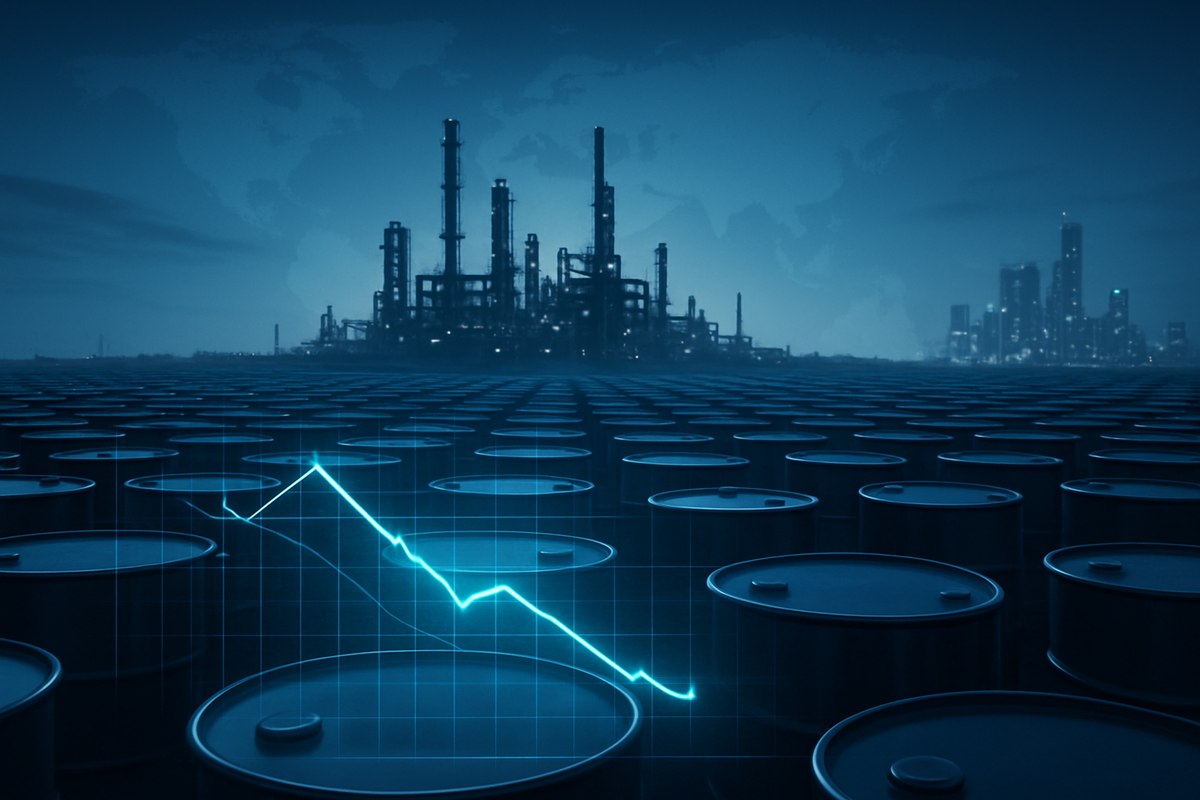
The World Bank’s latest Commodity Markets Outlook, updated as of February 2026, forecasts that global commodity prices will plunge to their lowest levels in six years. Driven by a massive projected oil surplus and cooling industrial demand from China, the aggregate index of commodity prices is expected to fall by 7% this year, marking the fourth consecutive year of decline. This shift represents a significant structural change in global trade, as the post-pandemic inflationary era gives way to an era of oversupply.
The primary catalyst for this downturn is a staggering global oil glut, which the World Bank estimates will average 1.2 million barrels per day (mb/d) throughout 2026. This level of oversupply is historic, matched only twice before: during the 1998 oil price collapse and the 2020 COVID-19 lockdowns. Crucially, economists note that this surplus is now large enough to act as a definitive buffer against geopolitical shocks, potentially neutralizing the price spikes typically associated with escalating tensions in the Middle East.
The Great Oil Glut of 2026
The convergence of record-high production and stagnating demand has created a "perfect storm" for energy markets. For the past two years, non-OPEC+ nations—most notably the United States, Brazil, Canada, and Guyana—have aggressively ramped up production, consistently outpacing the demand growth seen in emerging markets. This surge has left the OPEC+ alliance with significant spare capacity, limiting their ability to support prices through production cuts without surrendering even more market share to Western competitors.
The demand side of the equation is equally transformative. China, long the engine of global commodity growth, has seen its appetite for oil and industrial metals wane as its economy shifts away from infrastructure-heavy investment toward services and high-tech manufacturing. Furthermore, the rapid electrification of the global transport sector has reached a tipping point. In China alone, electric vehicles and hybrids now account for over 40% of new car sales, drastically curbing the long-term outlook for gasoline demand. As a result, Brent crude is projected to average just $60 per barrel in 2026, down from nearly $80 only two years ago.
Corporate Winners and Losers in a Deflationary Market
The projected price collapse is creating a sharp divide between "energy-heavy" and "energy-light" corporations. Traditional oil majors, such as ExxonMobil (NYSE: XOM) and Chevron (NYSE: CVX), are facing significant margin compression. These companies have already begun pivoting their strategies toward higher-efficiency extraction and increased investment in carbon capture to offset lower per-barrel revenue. Conversely, state-owned giants like Saudi Aramco (TADAWUL:2222) are grappling with the difficult choice of maintaining high production to protect market share or cutting output to support price floors that may no longer exist.
On the winning side of the ledger, the transportation and logistics sectors are poised for a windfall. Major carriers like Delta Air Lines (NYSE: DAL) and United Airlines (NASDAQ: UAL) are expected to see a dramatic reduction in fuel expenses, their single largest variable cost, which could lead to record-breaking profit margins even if passenger demand remains flat. Similarly, logistics powerhouses such as FedEx (NYSE: FDX) and United Parcel Service (NYSE: UPS) stand to benefit from lower operational costs, providing them with the capital to accelerate the automation of their sorting facilities and the electrification of their last-mile fleets.
Geopolitical Shifts and the New Buffer
The broader significance of the 2026 outlook lies in how the oil surplus alters the calculus of global diplomacy. For decades, the threat of a "supply shock" from the Middle East has kept global markets on edge. However, the World Bank suggests that the 1.2 mb/d surplus provides a sufficient "safety net." Even if regional conflicts were to disrupt major production facilities, the combined spare capacity of OPEC+ and the high output from the Americas would likely prevent a sustained price spike above $90 per barrel, protecting the global economy from the stagflationary pressures seen in 2022.
This trend also provides much-needed relief to central banks, including the Federal Reserve. Falling energy and food prices—with food costs expected to remain stable or decline slightly through 2026—are serving as a powerful deflationary force. This allows for more accommodative monetary policies, potentially lowering interest rates and stimulating growth in non-commodity-linked sectors like technology and consumer discretionary. It marks a definitive end to the "scarcity mindset" that dominated the early 2020s.
Navigating the Road Ahead
Looking forward, the market must prepare for a period of "lower for longer" commodity pricing. In the short term, investors should watch for a potential price war within the energy sector, as producers compete for a shrinking slice of the demand pie. If OPEC+ chooses to abandon production quotas in an attempt to drive high-cost US shale producers out of the market—a tactic seen in 2014—volatility could spike even as the general price trend remains downward.
In the long term, the focus will shift toward "energy transition minerals." While oil and gas prices are falling, the demand for copper, lithium, and nickel remains resilient, though currently tempered by the global industrial slowdown. Companies like Freeport-McMoRan (NYSE: FCX) and Rio Tinto (NYSE: RIO) are increasingly seen as the new "essential" commodity plays, as the world continues to move away from fossil fuels regardless of their current abundance.
Summary and Investor Takeaways
The World Bank’s 2026 outlook serves as a stark reminder that the fundamental laws of supply and demand remain the ultimate arbiters of the market. The emergence of a historic oil surplus, driven by technological advances and shifting consumption patterns in China, has effectively capped the potential for energy-driven inflation. For investors, the takeaway is clear: the era of high-margin oil is fading, giving way to a period where the beneficiaries are those who consume energy rather than those who produce it.
Moving through 2026, the key metrics to watch will be China’s EV adoption rates and the production levels of non-OPEC+ nations. While geopolitical "black swan" events, such as a full-scale disruption of the Strait of Hormuz, remain a risk, the global economy is arguably better positioned to handle such shocks today than at any point in the last thirty years. The "commodity supercycle" that many predicted at the start of the decade appears to have been cut short by the very innovations meant to replace it.
This content is intended for informational purposes only and is not financial advice.