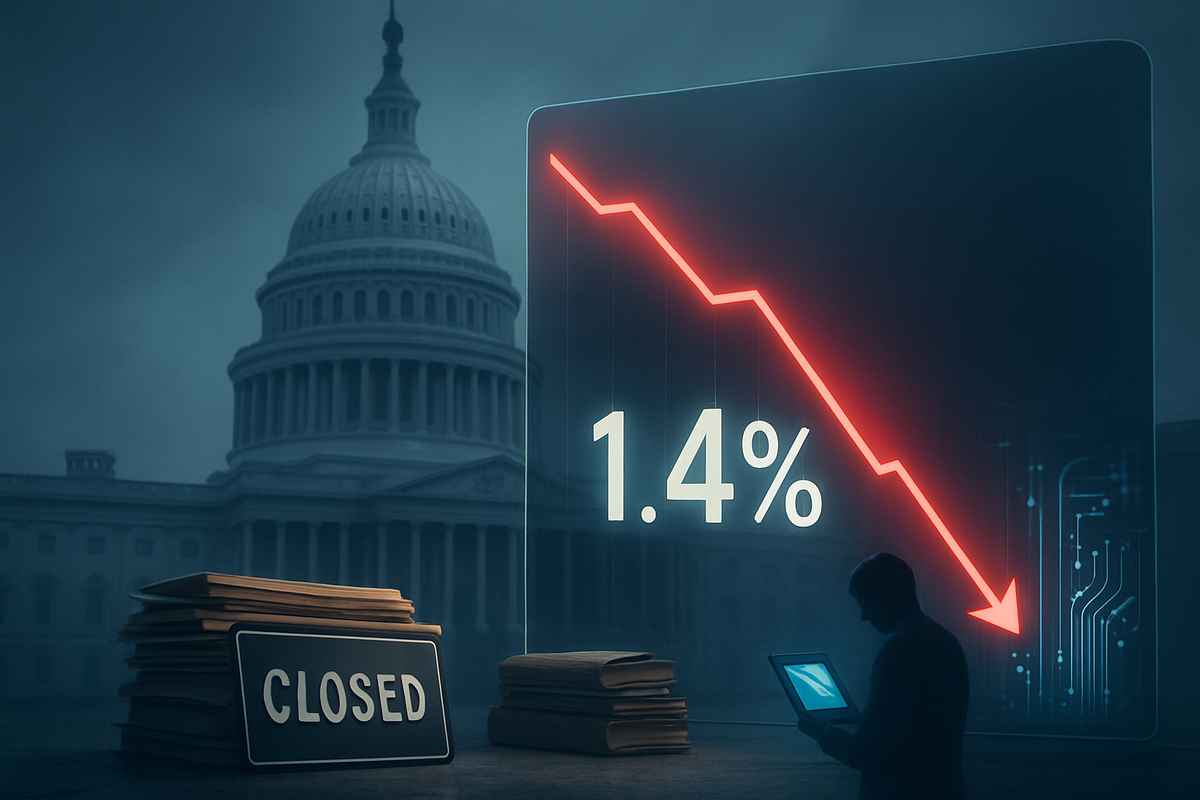
The United States economy hit a significant speed bump in the final stretch of 2025, with Fourth Quarter Gross Domestic Product (GDP) growing at a lackluster 1.4% annualized rate. The figure, released earlier this morning, fell sharply short of the 2.5% to 3.0% growth range projected by Wall Street economists and non-partisan budget offices. This disappointing performance marks the slowest quarterly expansion in over two years, casting a shadow over what many hoped would be a resilient transition into 2026.
The primary culprit for this deceleration was a historic 43-day federal government shutdown that paralyzed Washington from October 1 to mid-November 2025. While the private sector, particularly the technology and artificial intelligence industries, attempted to carry the weight of the economy, the total suspension of non-essential federal services and the furloughing of over 650,000 workers created a drag too heavy to ignore. As of February 20, 2026, the data confirms that the political impasse in D.C. has had tangible, multi-billion-dollar consequences for the nation’s bottom line.
Anatomy of a Slump: The 43-Day Impasse
The Q4 slowdown was not a result of organic market cooling but rather a self-inflicted wound stemming from the legislative "October Freeze." The shutdown, which began on the first day of the fiscal year and lasted until November 13, 2025, led to a staggering 16.6% contraction in federal government economic activity. For six weeks, government contracts were frozen, national parks were closed, and regulatory approvals across the FDA and SEC slowed to a crawl. The Congressional Budget Office (CBO) estimates that the shutdown shaved approximately 1.5 percentage points off the headline GDP figure, suggesting that without the political deadlock, the U.S. economy might have actually exceeded expectations.
The timeline of the crisis saw a series of failed stopgap funding measures as lawmakers clashed over border security and debt ceiling limits. By late October, the impact moved beyond federal office buildings and into the broader economy. Small businesses reliant on federal loans through the SBA found themselves in a liquidity crunch, while travel and tourism sectors in regions heavily populated by federal workers saw a sharp drop in consumer discretionary spending. Even after the government reopened in mid-November, the "restart" phase was sluggish, as agencies grappled with a massive backlog of administrative tasks and procurement cycles.
Initial market reactions to the 1.4% print have been mixed but cautious. Treasury yields saw immediate volatility as traders debated whether the weak growth would force the Federal Reserve to reconsider its "higher-for-longer" interest rate policy. Meanwhile, the S&P 500 remained relatively flat, bolstered by the fact that the weakness was concentrated in the public sector rather than the high-flying tech sector. However, for the average American, the numbers validated a growing sense of economic unease that has persisted throughout the winter.
Corporate Fallout: Winners, Losers, and the Resilient
The defense sector bore the most direct brunt of the Q4 stagnation. Heavyweights like Lockheed Martin (NYSE: LMT) and Northrop Grumman (NYSE: NOC) faced significant disruptions as the Department of Defense was unable to finalize new contract awards or issue payments on existing non-essential programs during the shutdown. Boeing (NYSE: BA) also saw a secondary impact, as regulatory delays at the FAA hampered the certification process for new aircraft deliveries, further straining a company already navigating a complex recovery. These firms are now playing catch-up, with management teams signaling that while the revenue isn't "lost," the timing shift has created a "lumpy" earnings profile for the start of 2026.
In the retail space, the impact was felt most acutely by companies with high exposure to the D.C. metro area and military hubs. Walmart (NYSE: WMT) and Target (NYSE: TGT) reported a noticeable softening in "big-ticket" discretionary sales during the October-November window, as hundreds of thousands of federal employees and contractors tightened their belts in anticipation of a prolonged lack of paychecks. While Walmart’s essential grocery business provided a defensive cushion, the overall sentiment check on the consumer has led to more conservative guidance for the first half of 2026.
Conversely, the banking sector presented a more nuanced picture. JPMorgan Chase (NYSE: JPM) and Goldman Sachs (NYSE: GS) reported that while M&A activity was briefly delayed due to the SEC’s limited operations, the underlying demand for credit remained stable. However, these institutions are now bracing for potential credit quality issues among small business borrowers who were forced to take on high-interest private debt to survive the 43-day funding gap.
The clear "winners"—or at least the insulated—remain the masters of the AI revolution. Nvidia (NASDAQ: NVDA) and other semiconductor giants have continued their upward trajectory, largely unbothered by the domestic political climate. Because their revenue is increasingly global and driven by private capital expenditures into data centers and machine learning infrastructure, they have effectively decoupled from the domestic federal budget cycle, acting as the primary engine keeping the U.S. economy from entering a technical recession.
Broader Implications and Historical Context
The 1.4% growth rate in Q4 2025 is being viewed by many as a "distorted" data point, drawing comparisons to the 2018-2019 shutdown. However, the 2025 event was nearly ten days longer and occurred during a period of much higher interest rates. Historically, shutdowns are followed by a "rebound" quarter, but the 2026 context is different. Inflation remains "sticky" at 3.0%, well above the Federal Reserve's 2.0% target. This creates a policy "straitjacket" for the central bank: they cannot easily cut rates to stimulate the flagging growth because doing so might reignite price increases.
This event highlights a growing trend of "geopolitical risk" originating from within U.S. borders. Investors are increasingly pricing in a "Washington Premium," acknowledging that political dysfunction is no longer a fringe risk but a recurring structural impediment to growth. The ripple effect on international partners is also significant; as the U.S. government shuttered, trade negotiations and regulatory harmonizations with the EU and G7 partners were put on ice, allowing competitors in other regions to gain a temporary foothold in emerging markets.
From a policy standpoint, the Q4 miss is likely to reignite debates over the effectiveness of the current budget process. There is growing bipartisan pressure to reform the "Antideficiency Act" to prevent future shutdowns from triggering such a massive economic contraction. However, with 2026 being a mid-term election year, any meaningful legislative reform is expected to be buried under partisan posturing.
What Comes Next: A Q1 Rebound or Structural Rot?
Looking ahead, the consensus for Q1 2026 is an optimistic rebound. Most economists expect a "snap-back" growth rate of 3.2% to 3.6% as back pay is distributed to federal workers and the $14 billion in delayed government spending finally hits the books. This "reopening effect" should provide a temporary boost to consumer spending and industrial production. However, the long-term concern is whether the Q4 slump has permanently damaged business confidence, leading to a "wait-and-see" approach for capital investments in the latter half of the year.
The Federal Reserve remains the wild card. In its most recent meeting in January 2026, the Fed held rates steady at 3.5% to 3.75%. Chair Jerome Powell has signaled a "hawkish pause," indicating that the committee views the 1.4% GDP figure as an anomaly. If inflation does not trend downward toward the 2.1% projection by June, the Fed may keep rates high even if growth remains tepid, raising the specter of a "stagflation" environment where prices rise while the economy stands still.
The primary strategic pivot for 2026 will be found in corporate balance sheets. Expect to see companies increasing their cash reserves and diversifying their revenue streams away from government-dependent contracts. The market may also see a shift in investment toward "recession-proof" sectors if the Q1 rebound fails to materialize with the expected vigor.
Conclusion: Watching the "K-Shaped" Recovery
In summary, the Q4 2025 GDP miss is a stark reminder of the cost of political volatility. While a 1.4% growth rate is not a recession, it represents a significant loss of momentum at a time when the global economy is already on edge. The key takeaways for investors are the resilience of the AI-driven tech sector and the ongoing fragility of the American consumer, who continues to be squeezed by high prices and political uncertainty.
Moving forward, the market will likely focus on two metrics: the March 2026 inflation report and the Q1 2026 GDP advance estimate. These will determine whether the U.S. has truly moved past the "October Freeze" or if the shutdown was the first domino in a larger economic cooling. The "K-shaped" nature of this recovery—where the wealthy and tech-heavy sectors thrive while the federal-dependent and lower-income sectors struggle—is likely to intensify.
For the months ahead, investors should keep a close watch on consumer credit defaults and the Federal Reserve's rhetoric. If the "rebound" in Q1 is anything less than stellar, the narrative may shift from "temporary glitch" to "structural slowdown," requiring a much more defensive posture for the remainder of 2026.
This content is intended for informational purposes only and is not financial advice.