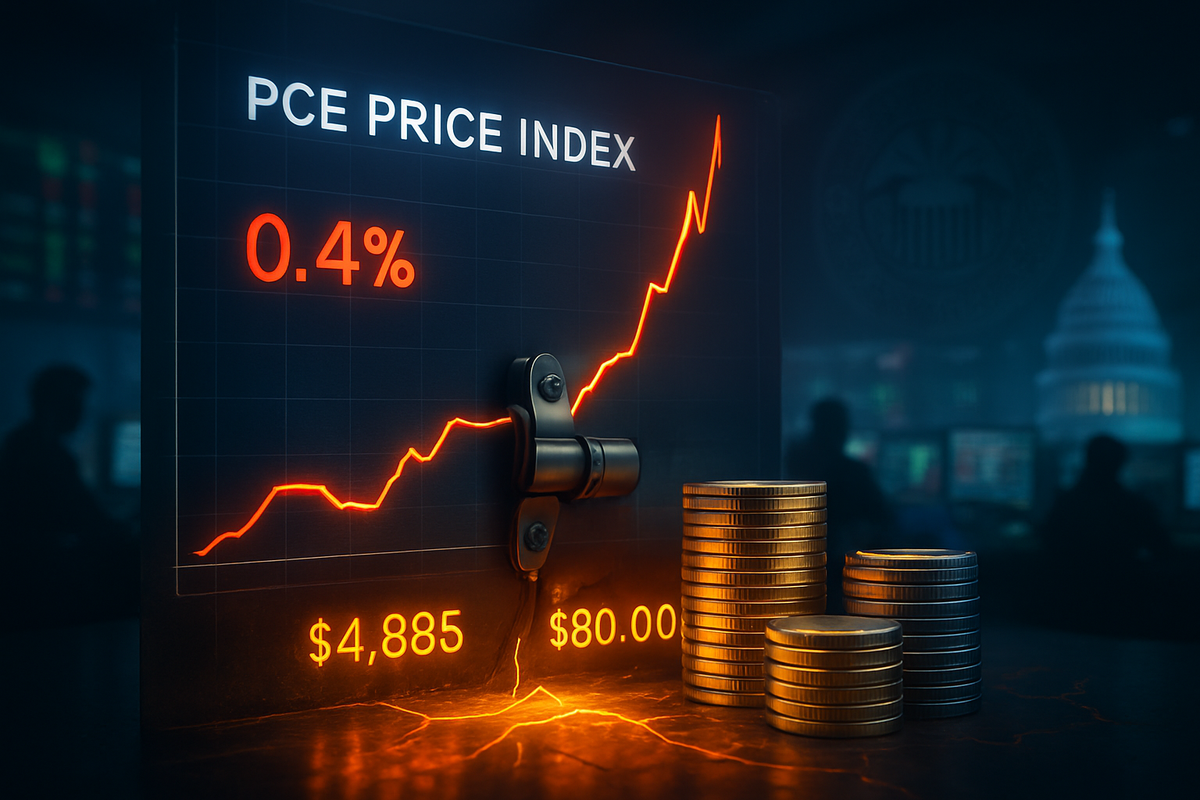
The global financial markets reached a definitive "hinge" moment this morning, February 20, 2026, as the Bureau of Economic Analysis (BEA) released the long-awaited Personal Income and Outlays report. With the Core Personal Consumption Expenditures (PCE) Price Index—the Federal Reserve’s preferred inflation metric—coming in at a "hot" 0.4% month-over-month, the narrative of a cooling economy has been abruptly challenged. This surprise upside, exceeding the 0.3% consensus estimate, has sent shockwaves through the commodities complex, specifically targeting leveraged positions in precious metals that have been betting on a more dovish central bank.
For investors in gold and silver, today’s data is more than just a macroeconomic data point; it is a catalyst for a potential structural shift in the 2026 bull run. As the 10-year Treasury yield spiked in the minutes following the release, the "safe haven" trade is facing a paradoxical test: persistent inflation is supporting the intrinsic value of hard assets, but the resulting "higher-for-longer" interest rate outlook from the Federal Reserve is threatening the massive leverage built into the system. Markets are now bracing for a volatile session that could either solidify a floor or trigger a cascade of liquidations.
A Rescheduled Reckoning: Inside the February PCE Print
The release of today’s report was uniquely fraught with tension, as it provided the final definitive look at December 2025 data, delayed by several weeks due to the federal government shutdown late last year. The headline PCE Price Index rose 3.0% on a year-over-year basis, while the Core PCE (excluding volatile food and energy) similarly registered a stubborn 3.0% annually. This marks a sharp stagnation in the "disinflation" trend that many analysts had predicted would carry the Fed toward its 2.0% target by mid-2026. Instead, the data suggests that inflation has become entrenched in the services sector, even as goods prices fluctuated.
The timeline leading to this morning’s volatility began with the January FOMC meeting, where Fed Chair Jerome Powell signaled a "data-dependent" pause, keeping the federal funds rate in the 3.5%–3.75% range. Since then, a chorus of hawkish commentary from regional Fed presidents suggested that if today’s PCE reading surprised to the upside, a rate hike—rather than the forecasted cuts—could be back on the table for the March meeting. Initial market reactions were swift: the U.S. Dollar Index (DXY) surged, putting immediate pressure on dollar-denominated assets.
Key stakeholders, including institutional hedge funds that have rotated heavily into "hard money" trades over the last twelve months, are now scrutinizing the internal components of the BEA report. Personal consumption expenditures increased by $91.0 billion (0.4%), suggesting that despite higher borrowing costs, the American consumer remains resilient—or perhaps increasingly reliant on credit—adding further fuel to the inflationary fire that the Fed is struggling to extinguish.
Winners and Losers: Miners and Metals Under the Microscope
The "hot" reading has placed a direct target on the back of major precious metals producers and the leveraged instruments that track them. Newmont Corporation (NYSE: NEM), the world’s largest gold miner, saw its shares trade with high volatility in the pre-market as investors weighed the benefit of $4,800+ gold against the rising operational costs associated with persistent inflation. Similarly, Agnico Eagle Mines Limited (NYSE: AEM) and Wheaton Precious Metals Corp. (NYSE: WPM) are being watched as "quality duration" assets that may weather a short-term liquidation better than their smaller, more debt-heavy peers.
In the silver space, the stakes are arguably higher. Pan American Silver Corp. (NYSE: PAAS) and the iShares Silver Trust (NYSEARCA:SLV) are currently testing the mettle of "weak-hand" longs. Silver has historically exhibited higher beta than gold, and with the metal currently hovering near the critical $80 level, any break below this psychological support could trigger automated stop-loss orders in leveraged futures contracts. Conversely, if the $80 floor holds through today’s close, it could signal that the market has already "priced in" the Fed’s hawkish pivot, potentially setting the stage for a massive short-squeeze rally.
The divergence between physical demand and paper-market positioning is stark. While the SPDR Gold Shares (NYSEARCA:GLD) continues to see inflows from central bank buying and sovereign wealth funds seeking protection against geopolitical instability (notably the ongoing tensions regarding European territorial disputes), the leveraged ProShares Ultra Gold (NYSEARCA:UGL) is at risk of significant drawdowns if the "high $4,800s" support zone for spot gold fails to hold.
The Geopolitical and Policy Ripple Effects
The significance of today's PCE print extends far beyond the trading floor of the COMEX. It represents a potential crisis of independence for the Federal Reserve. Throughout early 2026, the Fed has faced unprecedented political pressure to lower rates, yet today's 0.4% monthly inflation jump makes such a move nearly impossible without abandoning the 2% target. This "inflation persistence" is reminiscent of the 1970s "double-hump" inflation, where a premature easing of policy led to a second, more aggressive wave of price increases.
Furthermore, the broader industry trend of "de-dollarization" has been the primary wind in the sails of the gold market, which hit record highs of $5,055 earlier this year. The market is now at a crossroads: if the Fed stays hawkish to fight this 3% PCE plateau, they risk a systemic credit event in the highly leveraged commercial real estate or sovereign debt sectors. If they blink and cut rates despite the hot data, gold could reasonably clear the $5,500 mark by summer, while silver could make a run toward its $95 all-time highs.
Historical comparisons are being drawn to the "Volcker era" adjustments, though the 2026 backdrop includes a much higher debt-to-GDP ratio, making "higher-for-longer" a far more dangerous game for the Treasury. Competitors in the digital asset space are also feeling the heat; as inflation remains sticky, the debate over whether Bitcoin or Gold is the ultimate inflation hedge is being settled in real-time by the price action following this BEA report.
The Road Ahead: Scenarios for the March FOMC
What comes next depends entirely on the resilience of the support zones identified by technical analysts. For gold, the "high $4,800s" (specifically the $4,875–$4,890 range) represents the 50-day moving average and a critical Fibonacci retracement level. A daily close below this level could open the trapdoor for a move toward $4,500. For silver, the $80 level is the line in the sand. A "cool" reaction later in the session—perhaps driven by a realization that real rates are still deeply negative—could lead to a "buy the news" event.
In the short term, expect a strategic pivot from institutional desks toward "defensive growth" within the mining sector. We may see a flight from speculative junior explorers toward cash-flow-positive seniors like Newmont. Strategically, the Fed must now navigate the March 18 meeting with extreme precision; any hint of a "hawkish hold" could be the final blow to the leveraged silver bulls, while a surprising "dovish tilt" in the face of this hot data would likely ignite the largest precious metals rally of the decade.
The potential for "massive liquidations" remains the primary risk for the next 48 hours. If margin calls are triggered in the silver pits, the contagion could briefly pull gold down with it, regardless of the long-term bullish fundamental backdrop. Investors are advised to watch the "gold-to-silver ratio," which has been compressing, for signs of which metal is leading the next leg of the cycle.
Final Assessment: A Market at the Precipice
In summary, today's BEA Personal Income and Outlays report has delivered a "hot" PCE reading that effectively ends the "easy" phase of the 2026 market recovery. The 0.4% MoM Core PCE surprise has re-anchored inflation expectations and placed the Federal Reserve in a precarious position between its price stability mandate and the needs of a debt-heavy economy. For the precious metals market, the "hinge" has swung toward a test of buyer conviction.
As we move forward, the key takeaways are the resilience of the $4,800 gold support and the $80 silver floor. These are not merely technical levels; they are the benchmarks for the "inflation hedge" thesis in a post-shutdown economy. If these levels hold, the bull market remains intact, fueled by the reality that inflation is not going away quietly. If they fail, a painful deleveraging event is likely.
Investors should maintain a close watch on the March dot plot and any further BEA revisions. The coming months will determine if 2026 is remembered as the year inflation was finally tamed, or the year the "hard money" transition became an unstoppable force.
This content is intended for informational purposes only and is not financial advice