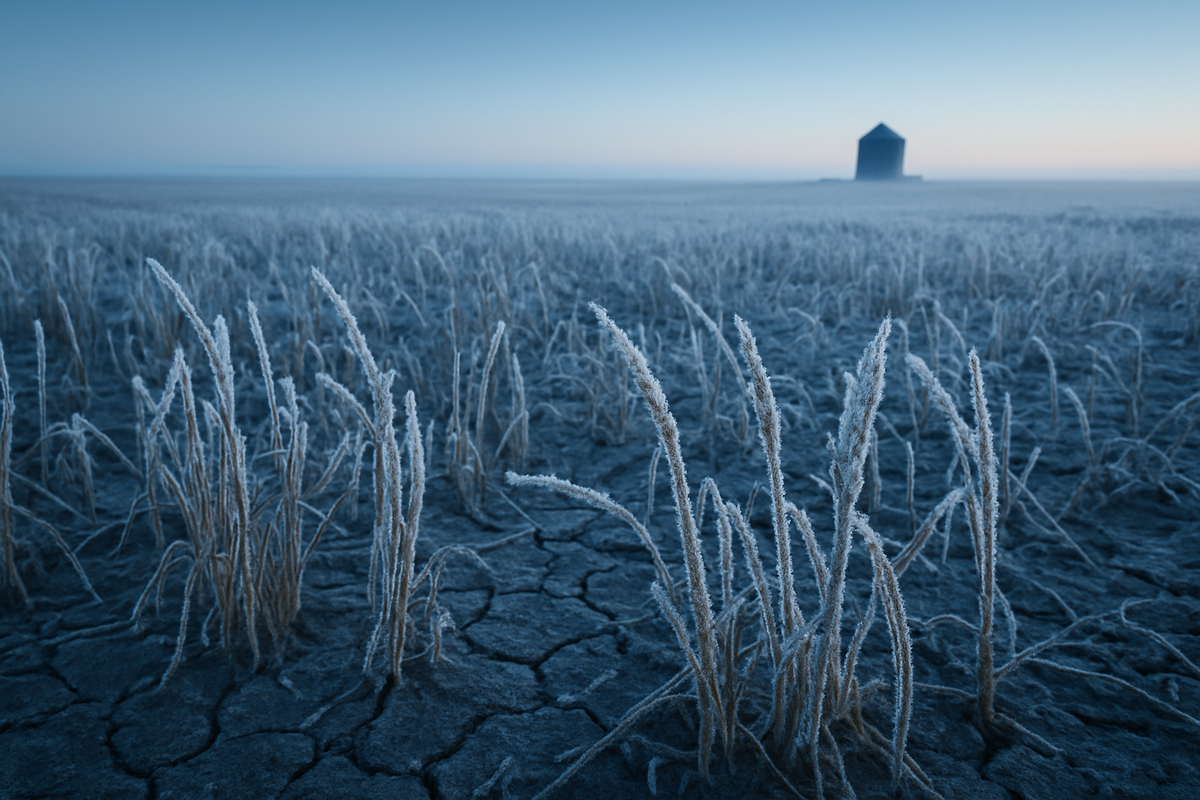
The global commodities market received a chilling wake-up call this week as wheat futures surged 6.1% per bushel, driven by a series of severe arctic blasts across the North American grain belt. "Winter Storm Fern," which swept through the U.S. Great Plains in early February 2026, has raised immediate alarms over "winterkill"—a phenomenon where dormant winter wheat is destroyed by extreme cold in the absence of a protective snow blanket. With temperatures in key producing states like Kansas and Nebraska plunging as low as -20°C, the sudden supply-side risk has shattered the relative calm that characterized the agricultural markets throughout much of late 2025.
The immediate implications are far-reaching, threatening to reignite food inflation just as global consumers were beginning to find relief from the "grain glut" of the previous harvest season. On the Chicago Board of Trade (CBOT), Soft Red Winter (SRW) wheat futures jumped to a three-month high of approximately $5.53 per bushel by mid-February. For the public, this spike signals a potential reversal in the downward trend of grocery prices, as food processors and millers grapple with a sudden 6% increase in raw material costs that could soon be passed down the supply chain.
The Deep Freeze: How "Winter Storm Fern" Rattled the CBOT
The current crisis began in late January 2026 when a displaced polar vortex sent sub-zero temperatures cascading into the Central Plains. Unlike previous winters, this arctic front arrived during a period of uncharacteristically dry soil and minimal snow cover, leaving the emerging wheat crop exposed. In Kansas, the top wheat-producing state in the U.S., agricultural specialists estimated that while 61% of the crop was initially rated good-to-excellent, at least 25% of the acreage was highly vulnerable due to thin root development from a late autumn planting. In Nebraska, the situation was even more dire; state reports released on February 19, 2026, showed "good-to-excellent" ratings plummeting to just 24%, down from 40% only a month prior.
The market reaction was swift and volatile. As the first reports of the freezing temperatures reached trading floors, speculative funds—which had held record-short positions betting on lower prices since 2022—were forced into a massive "short-covering" rally. This technical buying added fuel to the fire, causing wheat futures to jump 14 to 15 cents in a single session on the CBOT. By the second week of February, the risk premium embedded in wheat prices had reached its highest level in over a year, as traders scrambled to account for the possibility of a significantly diminished 2026 harvest.
The timeline of this event is particularly striking because it follows a period of perceived abundance. Throughout late 2025, record harvests in Argentina and high export volumes from Russia (estimated at over 85 million tons) had kept prices suppressed. However, the intensity of "Winter Storm Fern" served as a stark reminder of the agriculture market's inherent vulnerability to weather-related risks. Key stakeholders, including the U.S. Department of Agriculture (USDA) and international grain buyers, are now shifting their focus from the "supply cushion" of 2025 to the "production deficit" potential of 2026.
Agricultural Giants and Food Titans: Navigating the Margin Squeeze
The 6.1% surge in wheat prices has created a stark divide between the "winners" and "losers" in the public markets. Leading the charge among the beneficiaries is Bunge Global SA (NYSE: BG). The grain trading giant recently reached a 52-week high after successfully integrating its acquisition of Viterra, allowing it to leverage its expanded global footprint to capture high "origination" fees and volatility-driven margins. Similarly, Archer-Daniels-Midland (NYSE: ADM) has found a silver lining in the market turbulence; while ADM had previously forecast a low-margin environment for early 2026, the return of price volatility and a "contango" market structure—where future prices are higher than spot prices—allows the company to profit from its vast grain storage and elevator networks.
Conversely, the "losers" are concentrated in the consumer packaged goods (CPG) sector. General Mills (NYSE: GIS) saw its stock under pressure this week after the company slashed its 2026 earnings guidance on February 17. Management cited "stressed consumers" who are increasingly trading down to private labels, making it nearly impossible for the company to pass on the 6% wheat hike without losing volume. Mondelez International (NASDAQ: MDLZ) has also voiced caution, noting that while they are partially hedged, the sudden spike in wheat and other commodities like cocoa is forcing a shift in their "price-pack architecture," which may include smaller portion sizes or "shrinkflation" to maintain margins.
The agricultural equipment sector is seeing a more nuanced reaction. Deere & Company (NYSE: DE) surprised analysts on February 19, 2026, by raising its full-year net income guidance to $5.0 billion. Despite the crop damage, higher wheat prices often improve the "wealth effect" for farmers with uncommitted grain in storage, potentially boosting demand for high-tech planting and harvesting machinery. Fertilizer and seed providers like Nutrien (NYSE: NTR), Corteva (NYSE: CTVA), and The Mosaic Company (NYSE: MOS) are also being watched closely, as widespread winterkill may lead to a surge in "replanting" demand come spring, requiring additional seeds and soil nutrients.
Beyond the Plains: Global Ripple Effects and the End of the "Grain Glut"
This localized weather event in North America fits into a broader shift in the global agricultural landscape. For the past two years, the narrative has been dominated by oversupply and falling prices. However, the February 2026 spike suggests that the "bottom of the cycle" may have been reached. The ripple effects of a 6.1% rise in U.S. wheat are felt globally because North American exports act as a critical price-setter for the world. With U.S. export commitments already running 16% ahead of last year, any reduction in the 2026 harvest could lead to a tighter global balance sheet, especially if competing exporters like Russia or Ukraine face their own weather or geopolitical challenges later in the season.
Historically, events like the "Great Grain Robbery" of the 1970s or the 2012 drought showed how quickly a supply shock can transform into a policy crisis. While the current 6% rise is not yet at those historic magnitudes, it has already triggered discussions regarding food security in import-dependent regions like North Africa and the Middle East. If the North American crop is truly compromised, we may see a resurgence of "food protectionism," where exporting nations limit shipments to prioritize domestic price stability—a trend that would exacerbate global price spikes.
The regulatory environment is also evolving. Policymakers are increasingly scrutinizing the role of speculative funds in commodity price swings. The rapid short-covering that accelerated this week's 6.1% gain has reignited calls for tighter position limits on "managed money" to prevent weather events from being amplified by financial speculation. For competitors and partners in the global food chain, the lesson of February 2026 is clear: the era of "cheap and easy" grain may be coming to a close as climate volatility becomes a permanent fixture of the market.
The Spring Thaw: What’s Next for the 2026 Harvest?
The short-term focus for investors and analysts will be the "spring thaw," which will reveal the true extent of the winterkill damage. Historically, winter wheat damage is difficult to quantify until the crop "breaks dormancy" in March or April. If the damage is as widespread as the 24% "good-to-excellent" rating in Nebraska suggests, we could see another leg up in prices as the market transitions from speculative fear to fundamental shortage. Conversely, a wet and mild spring could help the resilient wheat plants recover, potentially erasing this week’s 6.1% premium.
In the long term, agricultural companies will likely pivot toward "climate-resilient" technologies. Expect increased investment from firms like Corteva (NYSE: CTVA) into drought-tolerant and cold-hardy wheat varieties that can withstand the erratic temperature swings seen in early 2026. Furthermore, grain traders will likely double down on geographic diversification to mitigate the risk of a single-region weather event disrupting their entire supply chain.
Scenario planning for the rest of 2026 now includes the "bull case" for wheat, where prices could test $6.50 per bushel if the European or Black Sea crops also stumble. For investors, this creates a market of opportunities in the "picks and shovels" of agriculture—storage, logistics, and inputs—while demanding a cautious approach toward food processors who are caught in the middle of rising costs and a price-sensitive consumer base.
A New Era of Volatility for the Breadbasket
The 6.1% surge in wheat prices this February serves as a potent reminder that the "commodity supercycle" is far from dead. What began as an arctic blast in the Great Plains has quickly evolved into a complex financial and geopolitical event, reshuffling the fortunes of global giants like Bunge (NYSE: BG) and General Mills (NYSE: GIS). The key takeaway for the market is that the supply cushion of 2025 has been eroded, leaving the global food system vulnerable to even minor production setbacks.
Moving forward, the market will likely remain in a state of "heightened alert." Investors should keep a close eye on the USDA’s upcoming "Prospective Plantings" reports and the weekly "Crop Progress" updates starting in April. These will provide the first hard data on whether "Winter Storm Fern" was a temporary market tremor or the beginning of a sustained upward trend in global food costs.
Ultimately, the significance of this event lies in its timing. It marks a transition point where the global economy must once again factor in the high cost of climate uncertainty. As we look toward the remainder of 2026, the "breadbasket" of the world is no longer a guaranteed source of cheap calories, and the market is adjusting to that reality, one bushel at a time.
This content is intended for informational purposes only and is not financial advice.