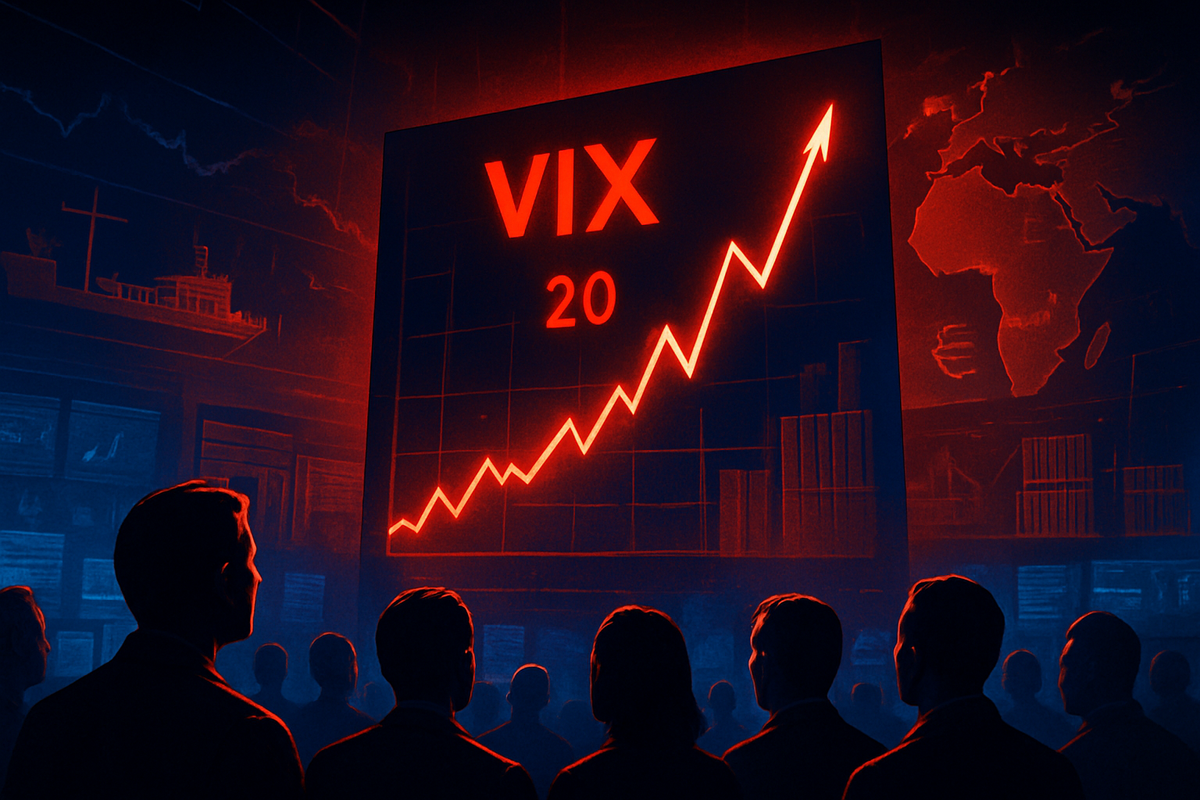
The CBOE Volatility Index (VIX), often hailed as the stock market’s “fear gauge,” surged past the critical 20.00 threshold on January 20, 2026, marking a significant shift in investor sentiment as the new year’s optimism collided with a wall of geopolitical and fundamental headwinds. Closing at 20.69—a nearly 28% jump in a single session—the index signaled a definitive end to the low-volatility environment that characterized the final quarter of 2025. This sudden spike was catalyzed by a stunning ultimatum from the White House regarding European trade and a wave of defensive earnings revisions that forced analysts to reconsider the "soft landing" narrative.
The immediate implications of this volatility are profound, as the cost of portfolio protection has skyrocketed and the traditional "risk-on" appetite for tech and growth stocks has abruptly soured. With the VIX trading above its historical average, market participants are bracing for a period of heightened turbulence. The intersection of a major transatlantic trade dispute and a lack of reliable economic data following the recent record-breaking government shutdown has left institutional investors flying blind, leading to a "sell first, ask questions later" mentality that wiped nearly 2% off the Nasdaq in hours.
A Perfect Storm: Greenland, The Fed, and The Data Void
The primary catalyst for the mid-January market fracture was the announcement of the "Greenland Tariff" on January 17, 2026. President Trump issued a shock threat to impose an immediate 10% tariff on eight European NATO allies—including Germany, France, and the United Kingdom—unless a deal was reached for the United States to acquire Greenland from Denmark. The administration further escalated tensions by setting a deadline of June 1, 2026, at which point the levies would jump to 25%. This move sent shockwaves through the global trade community, with European leaders immediately threatening $108 billion in retaliatory tariffs against American goods, reigniting fears of a trade war larger in scale than the 2018-2019 dispute with China.
Compounding the trade uncertainty is a brewing institutional crisis at the Federal Reserve. As Jerome Powell’s term as Chair nears its May 2026 expiration, public friction between the White House and the central bank has reached a fever pitch. A Department of Justice investigation into Powell regarding administrative building renovations was interpreted by many on Wall Street as a political maneuver to compromise the Fed’s independence and force lower interest rates. This uncertainty regarding Fed leadership has caused the 10-year Treasury yield to climb to 4.30%, as investors price in a "political risk premium" for U.S. sovereign debt.
The market’s ability to digest these shocks has been severely hampered by what analysts are calling the "Data Void." Following a record 43-day government shutdown that paralyzed federal agencies in late 2025, essential economic indicators—such as GDP growth, labor statistics, and PCE inflation data—have been delayed or presented with significant caveats. This lack of visibility into the true health of the U.S. economy has left the market overly sensitive to headlines. Without the steadying hand of official data, the vacuum has been filled by speculation, driving the VIX to its highest level in months.
Winners and Losers in the New Volatility Regime
The spike in volatility and the looming tariff threat have created a stark divide between the market’s winners and losers. Multinational industrials with heavy exposure to European supply chains were the first to feel the sting. 3M Company (NYSE: MMM) saw its shares tumble by 7.4% after CEO William Brown warned that the proposed tariffs could slice between $60 million and $70 million from the company's 2026 earnings. Similarly, J.B. Hunt Transport Services (NASDAQ: JBHT) reported softening demand in its transport sector, signaling that the ripple effects of trade friction are already impacting the logistics and shipping industry.
The high-flying technology sector, led by the "Magnificent Seven," also faced a harsh reality check. Nvidia (NASDAQ: NVDA) dropped 3% as investors liquidated "risk-on" assets to move into safer harbors. While the tech giants are not the direct targets of the Greenland-linked tariffs, their global supply chains and reliance on international revenue make them highly sensitive to a broader slowdown in global trade. Luxury retailers were particularly hard-hit, with LVMH (OTC: LVMUY) falling 4% on fears that a transatlantic trade war would decimate consumer appetite for high-end European imports.
Conversely, a few sectors have emerged as beneficiaries of the chaos. Gold reached a historic peak of $4,733 per ounce, boosting the prospects of precious metal miners. Defense contractors have also seen a surge in interest as Arctic tensions rise; Lockheed Martin (NYSE: LMT) received a notable upgrade to "Buy" as analysts projected increased military spending for northern border security. In a rare positive for the European sector, Bayer (OTC: BAYRY) gained 7.1% following a favorable U.S. Supreme Court ruling regarding its legacy Roundup litigation, proving that idiosyncratic legal wins can still provide a buffer against macro-economic storms.
Historical Echoes and the Legal Battle Ahead
The current market environment bears a striking resemblance to the 2018 trade war period, but with higher stakes and a more fragile global economy. The use of the International Emergency Economic Powers Act (IEEPA) to leverage land acquisitions via trade policy is a novel application of executive power that has landed the administration in a high-stakes legal battle. The Supreme Court is currently reviewing the legality of these sweeping tariffs; a ruling is expected by the end of the first quarter. Market participants are watching this closely, as a ruling against the administration would likely collapse the "volatility premium" almost overnight, while a favorable ruling would codify a new era of protectionist trade policy.
Furthermore, the "earnings redlining" seen this January is a significant departure from the optimism of 2025. Firms like LPL Research have already slashed their 2026 S&P 500 earnings forecasts from a consensus of $310 down to $290. This downward revision reflects the rising cost of inputs due to tariffs and the increased cost of capital driven by the Fed's leadership uncertainty. Historically, when the VIX sustains a level above 20 while earnings forecasts are being revised downward, it often precedes a broader market correction of 10% or more, as the "equity risk premium" is repriced to account for lower growth and higher uncertainty.
The Road to June: Strategic Pivots and Scenarios
Looking ahead, the market is laser-focused on the June 1, 2026, deadline. This "tariff cliff" will dictate corporate strategy for the first half of the year. Companies are already beginning to announce strategic pivots, with some shifting manufacturing out of the eight targeted European nations and back into the domestic U.S. or into "friendly" third-party nations in South America. However, these supply chain relocations are expensive and time-consuming, meaning the short-term impact will likely be a contraction in profit margins across the retail and industrial sectors.
In the coming months, two primary scenarios are likely to emerge. In the "Resolution Scenario," a legal victory in the Supreme Court for the administration, followed by a negotiated settlement with the EU and Denmark, could lead to a sharp "relief rally" and a collapse in the VIX. Conversely, the "Escalation Scenario" involves the implementation of the 25% tariff in June and a full-scale retaliatory strike from the EU. This would likely push the VIX into the 30s and could potentially trigger a global recession as the cost of goods surges and global trade volumes crater.
Navigating the 2026 Volatility Spike
The return of the VIX to the 20 level is more than just a statistical milestone; it is a clear signal that the market's "honeymoon period" with the current administration’s economic policies has ended. The convergence of the Greenland Tariff threat, Fed leadership friction, and the lingering effects of the government shutdown has created a "visibility gap" that is making every headline a potential market-mover. Investors should expect continued turbulence as the legal and political battles of early 2026 play out in the courts and on the global stage.
Moving forward, the key indicators to watch will be the Supreme Court’s decision on IEEPA authority and the announcement of Jerome Powell’s successor at the Federal Reserve. For investors, the takeaway is clear: the era of "easy growth" fueled by low volatility and predictable trade policy is on hiatus. Defensive positioning, an increased allocation to safe havens like gold, and a focus on domestic-focused energy and utilities may provide the necessary shelter as the market grapples with a year that is quickly becoming defined by its unpredictability.
This content is intended for informational purposes only and is not financial advice.