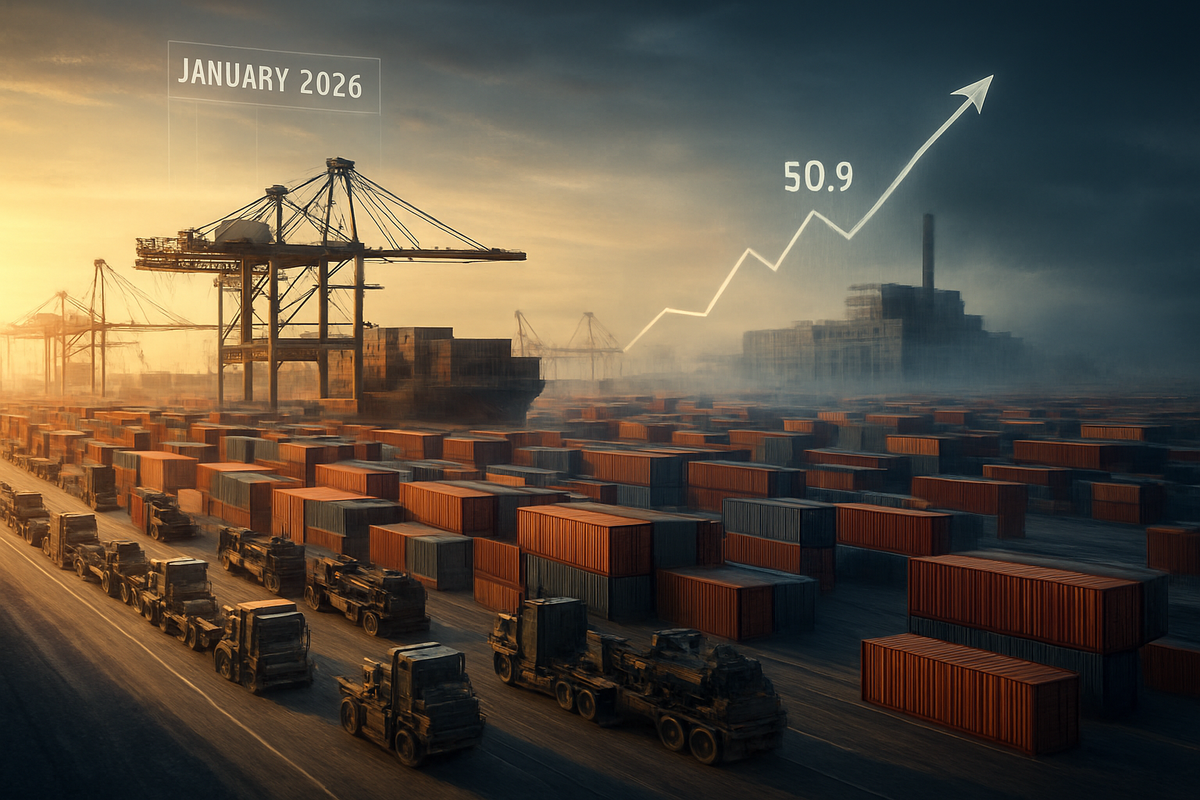
The American manufacturing sector has finally crossed the threshold into expansion territory, with the latest Institute for Supply Management (ISM) Manufacturing PMI rising to 50.9. This mark represents the strongest performance for the sector in nearly a year, sparking a flurry of optimism on Wall Street and suggesting that the "industrial winter" of 2025 may finally be thawing. However, beneath the surface of this 50.9 headline figure lies a contentious debate among economists and market analysts: is this a genuine resurgence of domestic demand, or a frantic, short-term "sugar high" fueled by companies stockpiling goods ahead of a looming trade war?
The rise to 50.9—up from the sub-50 contraction levels seen throughout much of late 2025—comes at a pivotal moment. With new, aggressive tariffs on European imports recently announced and set to take effect in stages starting February 1, 2026, many experts argue that the manufacturing "growth" we are seeing is actually a desperate rush to "pre-buy" components and raw materials. This front-loading of inventory creates the illusion of a healthy, expanding market, but it may lead to a significant "demand cliff" later this year once the new trade barriers are fully implemented.
Breaking Down the 50.9 Print: A Timeline of Volatility
The journey to 50.9 has been anything but linear. Following a volatile 2025 characterized by shifting trade policies and "tariff creep," the manufacturing sector entered January 2026 with a sense of urgency. The timeline of the current "recovery" shifted dramatically on January 17, 2026, when the administration announced the "European Tariff Wave." This policy introduced a tiered tariff structure targeting eight key European allies—including Germany, France, and the U.K.—with an initial 10% duty effective February 1, escalating to 25% by June 1, 2026.
This announcement triggered an immediate and massive "pre-buying" surge. Logistics data from early January shows a spike in shipments of high-value goods, particularly specialized machinery and automotive components, as U.S. manufacturers raced to get their orders across the border before the February deadline. The ISM’s "New Orders" and "Production" sub-indices, which weigh heavily into the 50.9 headline number, were the primary drivers of the rise, as firms placed "just-in-case" orders to build a buffer against the mid-year 25% rate. Initial market reactions were mixed; while the 50.9 figure provided a temporary boost to industrial stocks, the "Prices Paid" sub-index also climbed sharply to 58.5, signaling that the cost of this expansion is already being felt in the supply chain.
Winners and Losers in the Race to Stockpile
The current environment has created a sharp divide between companies that can afford to front-load their inventories and those that are being squeezed by rising component costs. Major automakers like Ford Motor Company (NYSE: F) and General Motors (NYSE: GM) find themselves in a precarious position. Both companies have reported significant "pre-buying" activity to secure European-made engines and electronics before the June deadline. While this keeps their production lines running for now, General Motors (NYSE: GM) recently signaled a pivot to pragmatism, taking a $6 billion charge to scale back some of its more capital-intensive programs in anticipation of a more expensive 2026.
Conversely, domestic materials producers and "re-shoring" consultants are emerging as potential winners. Companies like United States Steel Corporation (NYSE: X) stand to benefit from the shift away from European imports, as manufacturers look to localize their supply chains to avoid the 25% tariff wall. In the healthcare sector, Amgen Inc. (NASDAQ: AMGN) and Pfizer Inc. (NYSE: PFE) have been proactive, with Amgen Inc. (NASDAQ: AMGN) reportedly accelerating its $900 million facility expansion in Ohio to reduce its reliance on imported pharmaceutical ingredients that could be caught in the trade crossfire. Meanwhile, retail giants like Walmart Inc. (NYSE: WMT) are sounding the alarm; CEO Doug McMillon recently warned that while they have front-loaded inventory to create a 3-to-4-month cushion, price hikes for consumers are likely inevitable once those "pre-bought" stocks are depleted.
The Significance of "Just-in-Case" Manufacturing
The rise to 50.9 represents more than just a data point; it signals a fundamental shift in global supply chain philosophy. For decades, the industry operated on a "Just-in-Time" model, prioritizing efficiency and low inventory levels. However, the events of early 2026 have solidified the transition to "Just-in-Case" manufacturing. This event fits into a broader trend of "permanent volatility" where trade policy, rather than consumer demand, becomes the primary driver of industrial activity.
Historically, this resembles the "pre-tariff" surges seen in 2018 and early 2019, which were invariably followed by periods of stagnation as companies worked through their excess inventory. The difference in 2026 is the scale and the speed of the escalation. The "Greenland-related" tariffs on European allies represent a significant departure from previous trade focus, creating a ripple effect that forces partners like the U.K. and Germany to consider retaliatory measures. This regulatory uncertainty makes the 50.9 PMI reading a "noisy" indicator—one that reflects defensive positioning rather than an organic economic boom.
Looking Ahead: The June 1st Cliff
The short-term outlook for the manufacturing sector remains tied to the shipping calendar. Through the end of May 2026, we can expect PMI numbers to remain elevated or at least stable as companies finish their final "pre-25%" runs. However, the true test of the American manufacturer will come after the June 1st deadline. Once the 25% duties are active and the "pre-bought" stockpiles begin to dwindle, the market will face a significant challenge: can domestic demand sustain a 50+ PMI when the cost of production has structurally increased by double digits?
Potential scenarios for the latter half of 2026 include a "hard landing" for the industrial sector if consumer spending cools in response to tariff-driven price hikes. Investors should look for strategic pivots during the upcoming Q1 earnings season, particularly among firms that are successfully "re-shoring" or finding alternative suppliers in non-tariffed regions. The ability to adapt to a high-tariff environment will be the defining characteristic of the year's corporate winners.
Wrap-Up: A Skeptical Eye on Expansion
The rise of the ISM Manufacturing PMI to 50.9 is a welcome headline for a sector that has been under pressure, but it should be viewed with a healthy dose of skepticism. The primary takeaway is that the "expansion" is currently being driven by a race against the clock. While the data shows growth, the qualitative evidence from company leaders at Ford Motor Company (NYSE: F), Walmart Inc. (NYSE: WMT), and General Motors (NYSE: GM) suggests that this is a defensive posture rather than an offensive expansion.
Moving forward, the market will be hyper-focused on the June 1 deadline and the subsequent depletion of inventories. For investors, the "prices paid" component of the PMI will be just as important as the headline number, as it will indicate how much of the tariff cost is being absorbed by companies versus being passed on to the public. The 50.9 print may look like a recovery, but in the volatile landscape of 2026, it may simply be the calm—and the rush—before the storm.
This content is intended for informational purposes only and is not financial advice.