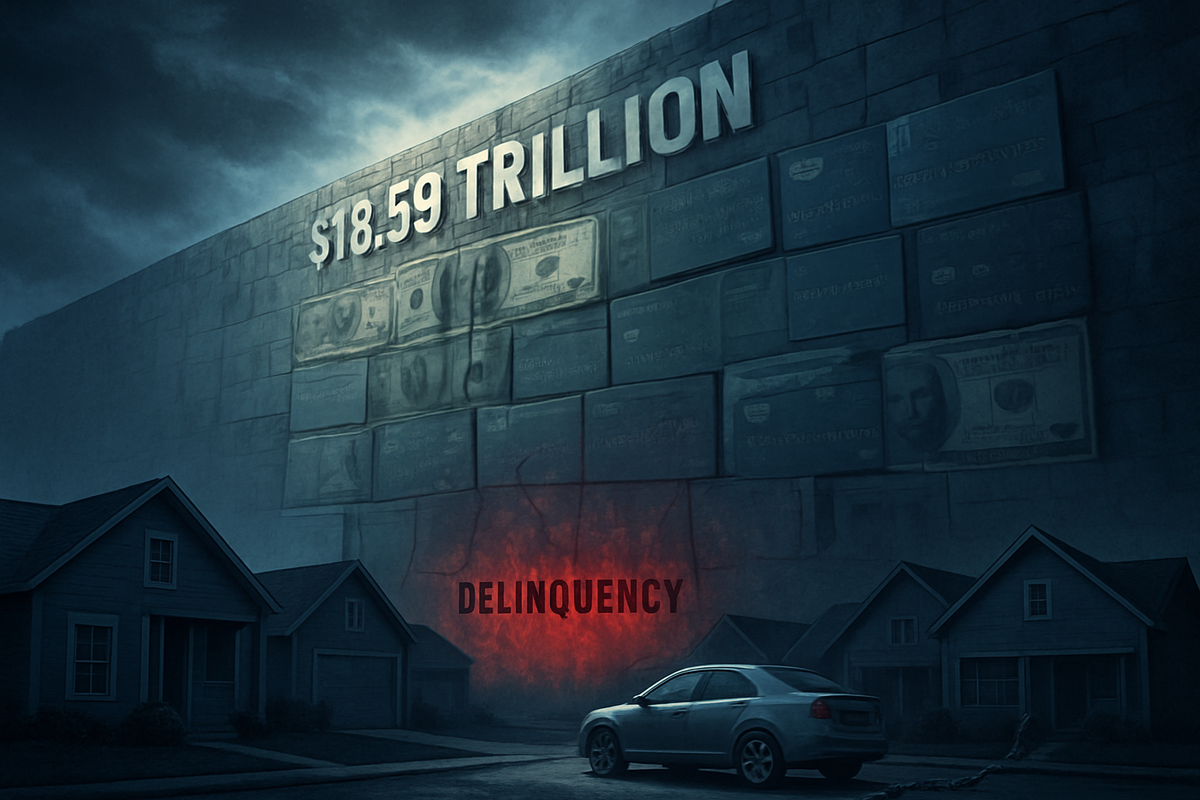
As of January 20, 2026, the American consumer is navigating a financial landscape defined by a staggering milestone: total household debt has officially surged past the $18 trillion mark, settling at a record $18.59 trillion. While the headline figure represents a massive expansion of credit, the underlying data reveals a fracturing economy. With aggregate delinquency rates hitting a critical 3.6%—and serious delinquencies for credit cards and auto loans climbing even higher—the "spending-led" growth that defined the post-pandemic recovery is now being replaced by a cautious, debt-servicing "chill" that threatens to dampen broader economic stability.
The immediate implications are profound for both Wall Street and Main Street. The Federal Reserve Bank of New York (FRBNY) report highlights a "K-shaped" debt crisis where high-income households continue to benefit from record-high asset valuations, while younger and lower-income borrowers are increasingly "maxed out." This divergence is creating a significant drag on consumer spending, with analysts projecting a slowdown in real consumption growth from 2.6% in 2025 to less than 2.0% in 2026 as households divert over $560 billion annually toward interest payments alone.
The journey to $18 trillion was not a sudden spike but a compounding pressure cooker. Following the rapid inflation of 2023 and 2024, American households increasingly relied on credit cards to bridge the gap between stagnant real wages and rising costs for essentials. By late 2024, the $18 trillion threshold was first breached, but the momentum carried into 2025 as the full resumption of student loan payments and the exhaustion of pandemic-era excess savings took their toll.
Throughout 2025, the "interest trap" became the primary driver of debt growth. As the Federal Reserve maintained higher rates to combat lingering price pressures, the cost of carrying balances on credit cards—which reached a record $1.23 trillion by early 2026—spiraled. The 3.6% aggregate delinquency rate, a figure not seen since the recovery periods of the mid-2010s, serves as a benchmark for a broader distress signal. In the auto sector, serious delinquencies (90+ days late) have reached levels reminiscent of 2009, indicating that the foundational mobility of the American workforce is under fiscal duress.
The key stakeholders in this drama extend beyond the borrowers. Major financial institutions, retail giants, and federal regulators are now locked in a struggle to manage the fallout. While the banking sector remains capitalized, the "flow" into delinquency has accelerated faster than many risk models predicted. By the end of Q4 2025, the transition rate into serious delinquency for credit card debt hit 3.03% on an aggregate basis, though for borrowers under the age of 39, that figure is nearly double, highlighting a generational wealth gap that is widening into a chasm.
The impact of this debt ceiling is unevenly distributed across the corporate landscape, creating a clear divide between those who can capitalize on distressed consumers and those whose business models are tied to low-income discretionary spending.
The Winners:
- Walmart Inc. (NYSE: WMT): As middle-income households (earning $75,000 to $125,000) feel the pinch of debt service, they are increasingly "trading down" to Walmart for groceries and essentials. Walmart’s stock hit all-time highs in January 2026, as it effectively captures market share from higher-end competitors while maintaining a resilient supply chain.
- Encore Capital Group (NASDAQ: ECPG): As one of the world's largest debt purchasers, Encore is seeing a windfall. The surge in credit card charge-off rates has provided a massive supply of non-performing loans that the company can purchase at a discount. In early 2026, ECPG reported a nearly 27% return over the previous 90 days, fueled by a record volume of "charged-off" paper from the banking sector.
- JPMorgan Chase & Co. (NYSE: JPM): Despite rising loan-loss provisions, JPMorgan remains a "structural winner." Its "Fortress Balance Sheet" has allowed it to absorb high-value portfolios, such as the Apple Card, while its diversified revenue streams from investment banking shield it from the worst of the retail loan defaults.
The Losers:
- Capital One Financial Corp. (NYSE: COF): With a business model heavily weighted toward credit card lending (76% of its revenue), Capital One is acutely exposed to the 12.4% serious delinquency rates currently seen among subprime borrowers. The stock has faced downward pressure as regulatory threats to cap interest rates at 10% loom, potentially gutting its net interest margins.
- Ally Financial Inc. (NYSE: ALLY): Ally is the "canary in the coal mine" for the auto market. With serious auto delinquencies at a 15-year high, Ally’s shares fell nearly 19% between late 2025 and early 2026 as management warned of "intensifying credit challenges" and a rising tide of repossessions.
- Dollar General Corp. (NYSE: DG): While it should theoretically benefit from trade-downs, Dollar General’s core customer base—households earning under $40,000—has been financially "exhausted." Unlike Walmart, DG has seen a decline in traffic as its primary shoppers simply run out of money before the end of the month, leading to a forecast of negative earnings growth for the 2026 fiscal year.
This $18 trillion milestone is more than just a large number; it represents a fundamental shift in the US economic engine. For decades, US GDP growth has been fueled by robust consumer consumption. However, the current "K-shaped" debt profile suggests that this engine is misfiring. When households spend $560 billion a year on interest, that is money not being spent on new homes, technology, or services. This "interest drag" is expected to be a permanent feature of the mid-2020s economy unless a significant deleveraging event occurs.
Historically, such levels of debt relative to income have preceded regulatory crackdowns. We are already seeing the early stages of this, with renewed political calls for national interest rate caps on credit cards and more stringent oversight of the "Buy Now, Pay Later" (BNPL) sector, which has operated in a regulatory gray area for years. These policy shifts could fundamentally alter the profitability of the consumer finance industry, forcing a pivot toward more conservative lending standards that could, ironically, further slow economic growth by restricting access to credit.
Furthermore, the ripple effects are being felt in the housing market. With student loan delinquencies reaching nearly 9.4%, a massive segment of the millennial and Gen Z workforce is seeing their credit scores decimated. This is creating a "renter-class trap" where the inability to secure a mortgage at reasonable rates, combined with high debt-to-income ratios, is preventing the typical wealth-building transition from renting to owning, potentially stagnating the housing market for years to come.
Looking ahead, the next 12 to 18 months will be a period of forced adaptation for the financial sector. If the job market remains resilient, banks may be able to "earn their way" out of these losses through higher interest income. However, any uptick in unemployment could turn the current delinquency "leak" into a "flood," forcing the Federal Reserve to pivot aggressively toward rate cuts by mid-2026 to prevent a systemic credit crunch.
Short-term, we should expect a wave of consolidation in the retail sector. Weakened players like Dollar General may become acquisition targets or be forced to close underperforming stores to preserve cash. Conversely, technology-driven lenders who can better utilize AI to predict delinquency before it happens will likely gain an edge over traditional regional banks that lack the data infrastructure to manage a rapidly shifting credit landscape.
The $18 trillion debt report from the New York Fed is a sobering reminder of the fragility of the post-pandemic recovery. While the total volume of debt is a testament to the scale of the US economy, the 3.6% delinquency rate is a flashing yellow light for investors. The key takeaway is the stark bifurcation of the consumer: the affluent are still spending, but the bedrock of the American middle and lower-class consumer base is under significant strain.
Moving forward, the market will likely reward companies with "fortress" balance sheets and those that cater to the essential needs of a cost-conscious public. Investors should keep a close watch on monthly credit card charge-off reports from the major issuers and the Federal Reserve’s "Beige Book" for any signs that the consumer "chill" is turning into a "freeze." As we move deeper into 2026, the ability of the American household to balance its checkbook may be the most important economic indicator of all.
This content is intended for informational purposes only and is not financial advice.