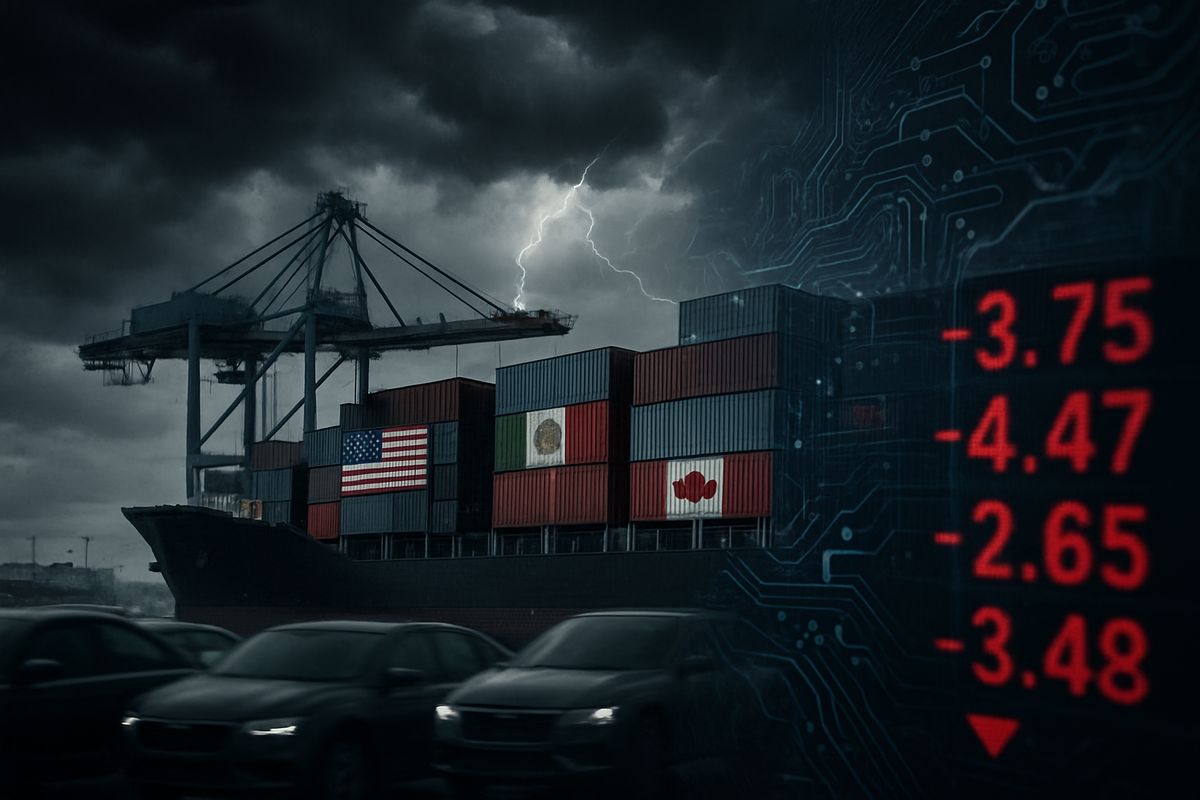
As the clock struck noon on January 20, 2026, marking exactly one year since the second inauguration of President Donald J. Trump, the financial markets were greeted not with a celebratory rally, but with a sharp spike in volatility. The "Trump Trade," which once fueled optimism through deregulation and tax cuts, has evolved into a complex "Protectionist Premium" as the administration reinforces its aggressive tariff regime. The market reacted sharply this morning to reports that the 25% duties on Mexican and Canadian imports—initially framed as a temporary border-security measure—would be cemented for the duration of the current administration, alongside a further expansion of the "Additional 10%" levy on Chinese goods.
The immediate implications have been felt across the S&P 500, with the index sliding 1.8% in early trading, while the CBOE Volatility Index (VIX) surged past the 22.00 mark. Investors are grappling with the reality of a "Sell America" sentiment as international partners move beyond diplomatic protests toward concrete retaliatory measures. The focus remains squarely on the automotive and semiconductor sectors, where supply chain disruptions have transitioned from hypothetical risks to recurring line-item costs on quarterly earnings reports.
A Timeline of Disruption: From Social Media to Executive Action
The current market anxiety traces its roots back to the evening of November 25, 2024, when then-President-elect Trump used Truth Social to announce a tectonic shift in U.S. trade policy. He pledged to sign an Executive Order on his first day in office—January 20, 2025—imposing a 25% tariff on all products coming from Mexico and Canada until illegal migration and the flow of fentanyl were halted. Simultaneously, he announced an additional 10% tariff on all Chinese imports, layered on top of existing duties, citing Beijing's failure to curb the export of precursor chemicals.
Throughout 2025, these measures moved from campaign rhetoric to industrial reality. The administration utilized the International Emergency Economic Powers Act (IEEPA) to bypass lengthy Congressional debates, leading to an immediate 20% drop in cross-border commerce by mid-2025. By early 2026, the administration's focus has expanded to a "Universal Baseline Tariff," and recent threats of "Greenland Tariffs" against European allies have further spooked the 10-year Treasury yield, which recently surged to 4.28%. This timeline reflects a transition from "trade as a negotiating tool" to "trade as a permanent pillar of domestic economic policy."
Sector Impact: The Automotive Crisis and Tech Whiplash
The automotive sector has become the primary casualty of the North American trade friction. General Motors (NYSE: GM) and Ford Motor Company (NYSE: F) have seen their stock prices battered as they grapple with the 25% levy on parts and completed vehicles crossing from Mexico. General Motors (NYSE: GM), which sources approximately 22% of its U.S. sales from Mexico, is estimated to be facing an annual tariff burden of nearly $5 billion. Similarly, Stellantis (NYSE: STLA) has been forced into a radical restructuring, relocating Jeep Compass production from Canada to Illinois to avoid the cross-border duties—a move that secured political favor but incurred massive capital expenditure hits in the short term.
In the semiconductor and tech space, the 10% additional tariff on China has created a "policy whiplash" for companies like NVIDIA (NASDAQ: NVDA) and Advanced Micro Devices (NASDAQ: AMD). The situation worsened in early 2026 when the administration mandated a "testing detour," requiring advanced AI chips manufactured in Taiwan to pass through U.S. soil for national security verification, triggering the 25% duty even on units bound for international markets. Apple (NASDAQ: AAPL) has also faced severe margin compression, with analysts at Goldman Sachs noting that the tech giant’s inability to fully pass on these costs could see its gross margins drop from 43% to 38% by the end of the 2026 fiscal year. While domestic steel producers like Nucor (NYSE: NUE) and Steel Dynamics (NASDAQ: STLD) have benefited from reduced competition, the broader manufacturing sector is reeling from the increased cost of raw materials.
The Global Paradigm Shift and the Death of "Friendshoring"
This event signifies a broader departure from the post-Cold War era of globalization. The United States-Mexico-Canada Agreement (USMCA), once hailed as a triumph of North American cooperation, has entered a "zombie state." While the treaty remains technically active, the unilateral imposition of tariffs has effectively rendered its free-trade provisions moot, leading to a "chronic uncertainty" that has halted long-term capital investments across the continent. This shift fits into a wider industry trend where "just-in-time" supply chains are being forcibly replaced by "just-in-case" domestic manufacturing, regardless of the inflationary cost.
The ripple effects are global. Apple’s (NASDAQ: AAPL) attempts at "friendshoring" production to India and Vietnam have been met with "reciprocal tariffs" ranging from 26% to 46%, as the U.S. seeks to penalize any shift of production that does not return directly to American soil. This has created a historical precedent where even non-adversarial nations are being pulled into the trade fray, echoing the protectionist cycles of the 1930s. The regulatory landscape is also shifting, as the Supreme Court is currently deliberating on the legality of the President’s unilateral trade authority under IEEPA, a ruling that could either validate this new economic order or spark a constitutional crisis.
Looking Ahead: Retaliation and Strategic Pivots
In the short term, markets will be watching for the formal retaliatory packages from Mexico City, Ottawa, and Beijing. There are growing fears that Mexico may retaliate by targeting U.S. agricultural exports or slowing cooperation on energy transit. For corporations, the next 12 months will require a "strategic pivot" away from global efficiency and toward domestic resilience. Companies that have already invested heavily in U.S.-based manufacturing will likely see a "compliance premium" in their stock valuations, while those tied to complex Asian or Mexican supply chains will remain under heavy selling pressure.
The potential for a "de-escalation deal" remains the primary upside scenario for the market. If the Trump administration achieves its stated goals regarding border security and drug interdiction, there is a possibility that the 25% tariffs could be scaled back to "monitoring duties." However, the long-term outlook suggests a semi-permanent state of trade friction. Investors should prepare for a landscape where corporate guidance is frequently revised based on the latest executive orders, and where the "Art of the Deal" becomes a mandatory study for any portfolio manager.
Wrap-Up: Navigating the New Economic Border
The market volatility witnessed on the one-year anniversary of the Trump inauguration is a stark reminder that the protectionist shift of 2025 was not a fleeting moment, but a fundamental restructuring of the American economy. The key takeaways for investors are clear: the era of cheap, frictionless global supply chains is over, and the "geopolitical risk" premium is now a permanent fixture in equity valuations. The automotive and semiconductor sectors will continue to be the "canaries in the coal mine," signaling how much pain the broader economy can absorb before the inflationary pressure becomes untenable.
Moving forward, the market will likely remain in a state of "wait-and-see" as it monitors the upcoming Supreme Court ruling on tariff authority and the potential for a "Greenland-style" expansion of trade barriers. For the coming months, investors should watch for clues in the 10-year Treasury yield and the VIX, while closely following quarterly earnings calls for signs of how companies like Ford (NYSE: F) and NVIDIA (NASDAQ: NVDA) are adapting their balance sheets to this high-cost environment. The lasting impact of this period may well be the "reshoring" of American industry, but the price of that transition will be paid in market volatility and consumer inflation for the foreseeable future.
This content is intended for informational purposes only and is not financial advice.