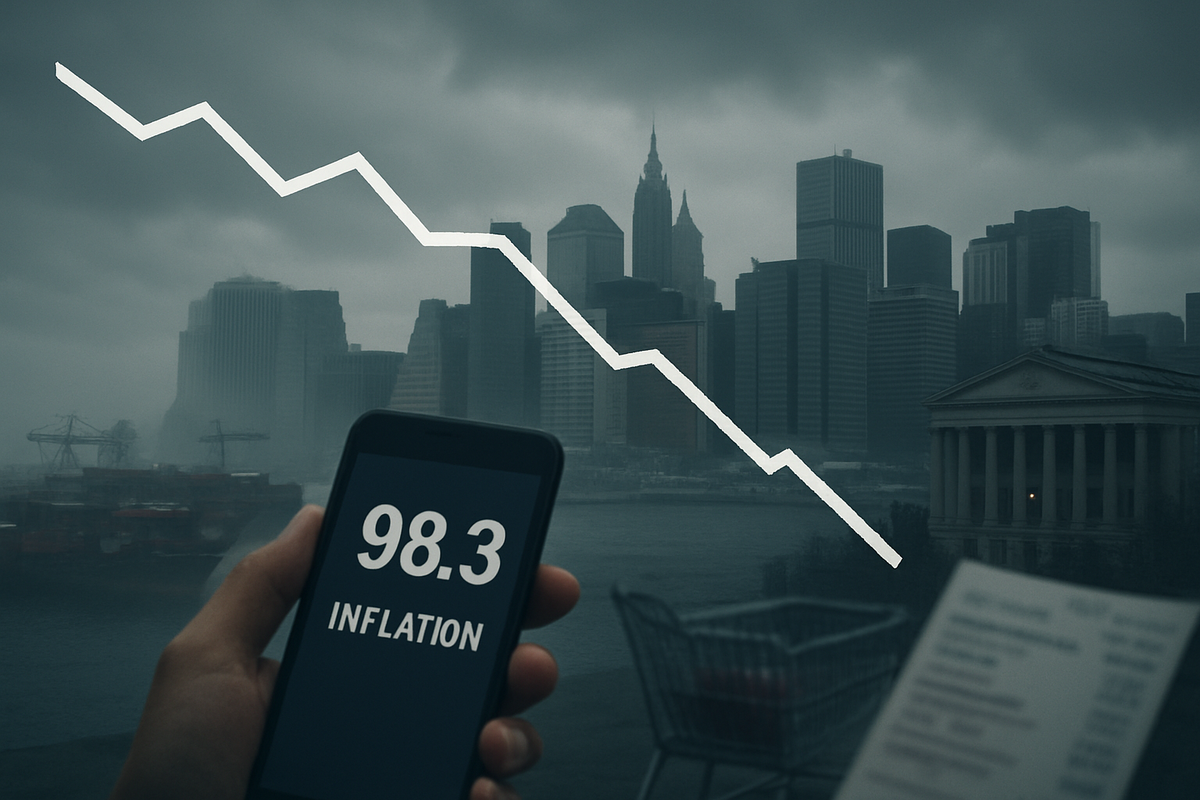
The American consumer is retreating into a defensive posture as the new year begins. The Conference Board announced today, January 20, 2026, that its Consumer Confidence Index fell to 98.3, an eight-month low that significantly missed economist expectations of 102.7. This decline reflects a deepening sense of unease across the nation, driven by a volatile mix of aggressive new trade tariffs and an unprecedented restructuring of the federal government that has left thousands of workers in professional limbo.
The drop from December’s reading of 104.1 marks the sharpest month-over-month decline since the brief panic of early 2025. While the "Present Situation Index" remained relatively stable at 136.5, the "Expectations Index"—a measure of consumers' six-month outlook for income, business, and labor market conditions—plunged to 72.9. Historically, any reading below the 80-point threshold in the Expectations Index is a reliable harbinger of a recession within the next twelve months. For the first time in nearly a decade, the "belt-tightening" rhetoric seen in corporate boardrooms is officially manifesting in the kitchen-table economics of average households.
A Perfect Storm of Policy Shifts
The erosion of consumer trust did not happen in a vacuum. The primary catalyst cited by analysts is the cumulative weight of the "Liberation Day" trade policies enacted throughout 2025. These measures established a 10% baseline tariff on nearly all imports, with escalated reciprocal rates reaching as high as 54% for certain goods from China and 20% for European imports. While the administration argues these measures protect domestic industry, the immediate effect has been "tariff anxiety." Consumer inflation expectations for the year ahead have jumped to 6.0%, as retailers begin passing the $4,850 average annual cost-of-living increase directly to shoppers.
Simultaneously, the domestic landscape has been rocked by the activities of the Department of Government Efficiency (DOGE). Over the course of 2025, approximately 300,000 federal employees were separated from their roles through a combination of forced layoffs, agency relocations, and incentivized buyouts. The instability reached a fever pitch with the re-implementation of "Schedule Career" (formerly known as Schedule F) earlier this month, which stripped civil service protections from tens of thousands of policy-related roles. This move has turned historically stable federal careers into "at-will" positions, chilling consumer spending particularly in the Mid-Atlantic region and among the millions of private contractors tied to federal spending.
The market reaction has been swift and unforgiving. Following the release of the report, treasury yields dipped as investors bet on a potential pivot from the Federal Reserve, while the S&P 500 saw broad-based selling in the discretionary and financial sectors. "We are seeing a 'wait-and-see' economy," noted one senior strategist. "When people aren't sure if their neighbor will have a job in three months, or if their next car will cost 20% more because of a trade spat, they stop spending on anything that isn't a necessity."
Sector Impact: Navigating the New Economic Reality
The decline in confidence has created a stark divide between "defensive" winners and "discretionary" losers. Luxury and high-ticket items are bearing the brunt of the downturn. Saks Fifth Avenue (Private) filed for a "slow-burn" restructuring earlier this month, a move that many see as the death knell for legacy luxury retail in an era of high tariffs and low confidence. In the automotive sector, Tesla, Inc. (NASDAQ: TSLA) has seen a cooling of the frantic demand that defined its early years; reports indicate Cybertruck sales effectively halved in 2025 as the $100,000+ price tag became unpalatable for even wealthy buyers. Similarly, General Motors Company (NYSE: GM) and other legacy automakers are bracing for what is projected to be the first annual decline in total US vehicle sales since 2022.
The financial sector is facing a double-edged sword. While low confidence often leads to higher savings rates, which can benefit banks, JPMorgan Chase & Co. (NYSE: JPM) and Bank of America Corporation (NYSE: BAC) saw their shares tumble this week. The sell-off followed a legislative proposal to cap credit card interest rates at 10%, a populist move designed to alleviate the cost-of-living crisis but one that executives warn will force them to restrict credit to the very low-income consumers who are currently struggling most.
Conversely, "budget-resilient" companies are seeing a surge in interest. Costco Wholesale Corporation (NASDAQ: COST) continues to report robust membership growth as households look to bulk-buying to hedge against rising prices. Discount beauty and consumer staple brands are also holding firm. Even in tech, Apple Inc. (NASDAQ: AAPL) is being forced to pivot its marketing focus toward its more affordable SE models and service subscriptions as the "iPhone Pro" cycles lengthen due to the perceived impact of import costs on hardware prices.
Broadening the Lens: Historical Precedents and Ripple Effects
The current effective US tariff rate has climbed to levels not seen since the 1940s, a historical pivot that is fundamentally reshaping global supply chains. This shift toward protectionism has created a ripple effect among trade partners. While "truce" deals were reached late last year with Japan and the UK, the ongoing tension with the European Union and China has led to retaliatory measures that are now hurting American exporters. For example, Treatt plc (LSE: TET), a major player in the global flavoring and fragrance market, recently reported a nearly 8% decline in US-linked revenue, citing "soft consumer demand and the unpredictability of the trade regime."
This event fits into a broader trend of "economic nationalism" that has characterized the mid-2020s. The restructuring of the federal workforce under DOGE is an unprecedented experiment in administrative downsizing. Historically, federal employment served as a stabilizer for the US economy during downturns; by removing that floor, the current administration has introduced a new variable into recession modeling. If the "Schedule Career" reclassifications continue, the loss of institutional knowledge and the resulting administrative bottlenecks—such as the feared delays in IRS tax refunds this coming spring—could further depress the "Present Situation Index" which, until now, has been the only bright spot in the data.
The Road Ahead: Strategic Pivots or Stagnation?
In the short term, the market is looking toward the Federal Reserve for a lifeline. If consumer confidence continues to languish below the 100-point mark, pressure will mount for a significant interest rate cut to stimulate borrowing. However, with inflation expectations pinned at 6.0% due to tariffs, the Fed finds itself in a "stagflationary" trap where cutting rates could further devalue the dollar and exacerbate the cost of imports.
For corporations, the remainder of 2026 will be a year of radical adaptation. Companies that can successfully "near-shore" their manufacturing to avoid the highest tariff brackets will likely outperform. We should expect to see a surge in domestic manufacturing investment, though these projects often take years to come online, providing little immediate relief to the consumer. Furthermore, the "gig-ification" of the federal workforce could lead to a rise in private-sector consulting opportunities, but it remains to be seen if these will offset the loss of stable, middle-class government salaries.
Summary and Investor Outlook
The fall of the Consumer Confidence Index to 98.3 is more than a statistical blip; it is a signal that the cumulative shocks of 2025—the 43-day federal shutdown, mass workforce reductions, and the most aggressive trade policy in 80 years—have finally reached the American psyche.
Key Takeaways for Investors:
- Watch the Expectations Index: At 72.9, it is screaming "recession." Until this moves back toward 80, defensive positioning is warranted.
- Monitor Credit Availability: If the 10% credit card interest rate cap gains traction, the tightening of consumer credit could lead to a sharper drop in retail sales than currently modeled.
- The Federal Factor: Keep a close eye on the rollout of "Schedule Career." Any signs of massive dysfunction in tax processing or agency operations will weigh heavily on sentiment this spring.
Moving forward, the resilience of the US economy will be tested. While the stock market has shown flashes of optimism in the past, the underlying consumer engine is clearly sputtering. Investors should remain cautious, favoring companies with domestic supply chains and strong pricing power in the "needs" rather than "wants" category.
This content is intended for informational purposes only and is not financial advice.