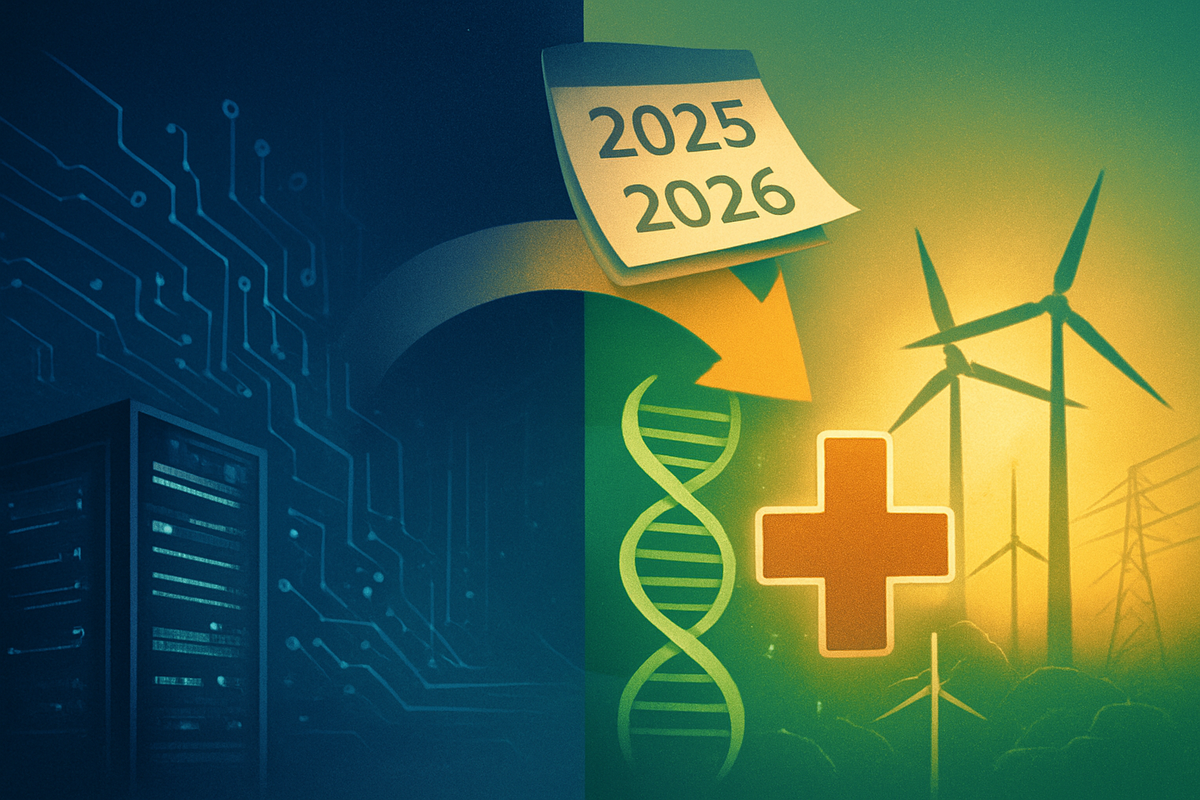
As the final trading days of 2025 wind down, a massive tactical shift is sweeping through Wall Street. Institutional fund managers and retail investors alike are aggressively rebalancing portfolios, pulling capital from the high-flying technology sector that dominated the post-April recovery and rotating it into "value-oriented" and defensive sectors like healthcare and energy. This "Great Rebalancing" of December 2025 reflects a growing consensus that while artificial intelligence remains a long-term driver, the valuations of the market’s primary engines have become overextended, leaving them vulnerable to the macroeconomic shifts expected in 2026.
The implications of this rotation are immediate and visible in the daily tape. As of December 29, 2025, the tech-heavy indices are seeing their first sustained period of underperformance since the summer, while the Dow Jones Industrial Average and sector-specific ETFs for healthcare and utilities are hitting fresh multi-month highs. This movement is not merely a year-end "window dressing" exercise; it is a strategic repositioning designed to hedge against potential supply chain disruptions and the "execution reality" of the tariff policies that defined much of the 2025 fiscal debate.
A Year of Extremes: The Path to the December Rotation
The road to this year-end rotation began with a historic "tariff shock" in April 2025, often referred to by traders as the "Liberation Day" crash. Following an executive order that imposed reciprocal tariffs on all major trading partners, the S&P 500 suffered a staggering 10.53% drop in just 48 hours, erasing over $6.6 trillion in market value. However, the market proved resilient, led by a mid-year surge in "Agentic AI"—autonomous software systems that promised a second wave of productivity gains. This recovery saw companies like Nvidia (NASDAQ: NVDA) and Oracle (NYSE: ORCL) reach record valuations, carrying the broader market through a volatile autumn.
By the fourth quarter of 2025, however, the narrative began to shift. While the Federal Reserve successfully navigated a "soft landing" by delivering three rate cuts—bringing the federal funds rate to a range of 3.50%–3.75%—the "AI 2.0" trade began to show signs of exhaustion. Investors started questioning the "circular financing" models where tech giants were essentially buying hardware from one another to build infrastructure that had yet to show a clear path to consumer-level profitability. This "valuation fatigue" reached a boiling point in mid-December, as the "Magnificent Seven" cohort reached a forward price-to-earnings ratio of 31x, nearly 50% higher than the rest of the S&P 500.
Key stakeholders, including major pension funds and sovereign wealth funds, have been the primary drivers of this late-December exodus. Data from the final weeks of the year shows a net outflow of nearly $42 billion from technology-focused mutual funds, the largest such exit since 2022. Simultaneously, healthcare and energy sectors have seen their highest weekly inflows of the year. This transition is being viewed as a "controlled flush," where the market is not necessarily crashing, but rather broadening its leadership to include the "S&P 493"—the stocks that were largely left behind during the AI-fueled rallies of 2024 and 2025.
Winners and Losers: The Shifting Tide of Capital
The most prominent "losers" in this year-end rotation are the tech titans that have carried the indices for the last 24 months. Microsoft (NASDAQ: MSFT) and Apple (NASDAQ: AAPL), while still fundamentally strong, have seen their share prices stagnate in late December as investors lock in gains to satisfy 2025 tax obligations and diversify into cheaper sectors. The hardware providers, most notably Nvidia (NASDAQ: NVDA), are facing the brunt of the "infrastructure pause," as analysts warn that the massive server-buying spree of 2025 may lead to a digestion period in early 2026.
Conversely, the healthcare sector has emerged as the primary beneficiary of this capital flight. Eli Lilly and Company (NYSE: LLY) and UnitedHealth Group (NYSE: UNH) have seen significant buying pressure as investors seek "quality" earnings that are less sensitive to trade policy. Healthcare is also benefiting from its own AI revolution; the integration of agentic AI into drug discovery has reportedly doubled the number of compounds entering clinical trials this year, turning the sector into a "defensive growth" play. With over $1 trillion in cash reserves sitting on healthcare balance sheets, the industry is also braced for a massive M&A wave in 2026.
The energy and utilities sectors are also seeing a surprising resurgence. Once considered "boring" value plays, companies like Exxon Mobil (NYSE: XOM) and NextEra Energy (NYSE: NEE) are being re-rated as essential components of the AI ecosystem. The massive data centers required to run 2026’s autonomous AI models have driven a projected 22% spike in power demand. Consequently, utilities are no longer being traded as bond proxies but as "AI-adjacent" infrastructure plays, attracting investors who are wary of the high multiples found in pure-play software companies.
Macro Significance and the "AI Utility" Era
This rotation marks a significant evolution in how the market perceives the artificial intelligence "supercycle." We are moving from the "Infrastructure Era"—characterized by the frantic purchase of chips and servers—to the "Utility Era," where the focus shifts to the companies that use AI to generate real-world efficiencies or provide the physical power to run it. This mirrors the historical precedent of the late 1990s fiber-optic build-out, where the initial winners were the equipment makers, but the long-term value was captured by the service providers and industrial adopters who utilized the new infrastructure.
Furthermore, the rotation is a direct response to the "Tariff Wall" expected in 2026. With global trade relations remaining frosty following the 2025 executive orders, investors are prioritizing domestic-heavy sectors like healthcare and utilities that are less exposed to international supply chain shocks. This "inward-looking" investment strategy is a departure from the globalized tech-dominance of the last decade and suggests a structural change in how portfolios will be constructed for the remainder of the 2020s.
The regulatory environment is also playing a role. As the U.S. government ramps up antitrust scrutiny on "Big Tech" platforms, sectors like energy and healthcare—which have already navigated decades of heavy regulation—appear more stable to institutional "long-only" managers. This shift reflects a broader industry trend toward "resilience over growth," as the market prepares for a 2026 that may be defined by geopolitical friction and higher-for-longer input costs.
Looking Ahead: The 2026 Strategic Pivot
In the short term, the market is likely to experience a "January Effect" that could be more muted for tech but explosive for mid-cap healthcare and energy firms. If the rotation continues at its current pace, we may see the S&P 500 achieve a more balanced distribution of returns, reducing the "concentration risk" that has plagued the index for years. Strategic pivots are already underway at major hedge funds, which are increasingly using AI-driven sentiment analysis to identify "undervalued" industrial and healthcare stocks that are beginning to show momentum.
However, the transition is not without its challenges. The primary risk for 2026 is that if the tech sector's "infrastructure pause" turns into a full-scale spending freeze, it could drag down the broader economy before the "utility" sectors have enough time to pick up the slack. Investors should watch for the Q4 earnings calls in late January, as the guidance provided by the "Magnificent Seven" will either validate the current rotation or trigger a "buy the dip" frenzy that could reverse these year-end trends.
Summary of the 2025 Year-End Rebalancing
The final week of 2025 has confirmed a major shift in investor sentiment. The key takeaway is that the "AI trade" is not dying; it is simply maturing. Capital is flowing away from the high-multiple "picks and shovels" of the tech sector and toward the "end-users" and "power-providers" in healthcare and energy. This rotation is a rational response to the valuation extremes of 2025 and a defensive posture against the potential trade and regulatory headwinds of 2026.
Moving forward, investors should keep a close eye on the "S&P 493" and the performance of defensive ETFs. The market is no longer a one-trick pony driven solely by semiconductor demand. As we enter 2026, the watchwords will be "quality," "valuation," and "resilience." The era of "growth at any price" appears to be taking a backseat to a more nuanced, diversified approach to the next phase of the technological and economic cycle.
This content is intended for informational purposes only and is not financial advice.