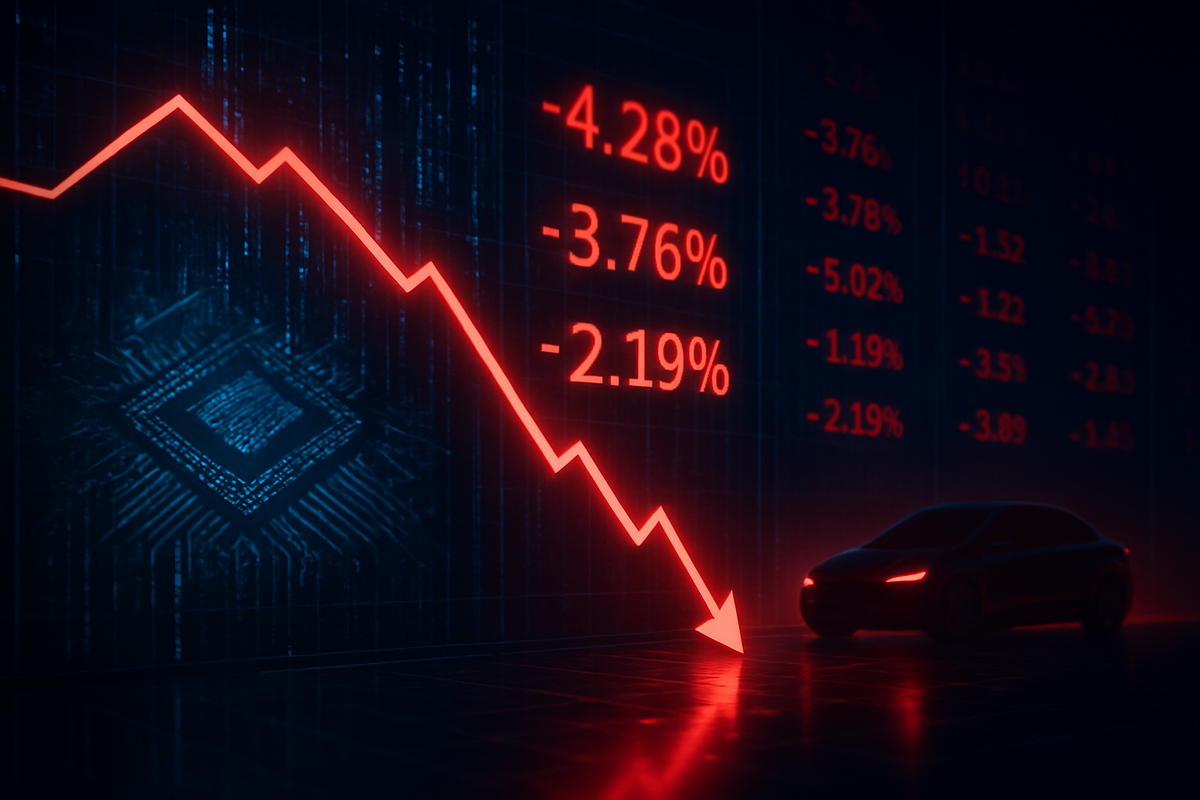
The technology sector faced a harsh reality check on Monday, December 29, 2025, as Nasdaq futures led the broader market lower in a bout of aggressive year-end selling. The tech-heavy index, which had enjoyed a stellar run throughout much of the year, saw its futures decline by as much as 0.7% in early trading, while the Nasdaq Composite slipped approximately 1.2% by mid-day. This retreat comes as institutional investors move to "de-risk" portfolios and lock in profits following a year of record-breaking highs, signaling a cautious end to 2025.
The downward pressure was primarily concentrated in the market's most influential players, with Nvidia and Tesla bearing the brunt of the selling. While the broader S&P 500 saw a more modest decline of 0.4%, the concentrated pain in the technology sector highlights a growing sensitivity to valuation and geopolitical instability. As thin holiday trading volumes amplified price swings, the market’s focus shifted from the optimism of the AI boom toward the starker realities of delivery misses and shifting battery strategies.
The sell-off on December 29 was not a sudden shock but rather the culmination of several brewing headwinds that converged during the final trading week of the year. Tesla, Inc. (NASDAQ: TSLA) saw its shares plummet nearly 4.5%, falling into the $470 range—a sharp reversal from its all-time high of $498.83 reached just a week prior on December 22. The catalyst for Tesla’s decline was a "perfect storm" of fundamental concerns, including leaked internal targets suggesting a 7.7% annual delivery contraction for 2025. This would mark the first significant year-over-year volume decline in the company’s history, fueled by the expiration of federal EV tax credits in September which had pulled demand forward into earlier quarters.
Simultaneously, Nvidia Corp. (NASDAQ: NVDA) experienced a pullback of roughly 2.5%. While the AI powerhouse remained more resilient than its peers due to the unyielding demand for high-performance computing, it was weighed down by its own strategic maneuvers. Investors reacted coolly to Nvidia’s $5 billion private stock purchase of Intel Corp. (NASDAQ: INTC), a move designed to stabilize its struggling competitor and secure supply chain interests. While strategically sound for the long term, the massive cash outlay during a period of market volatility prompted many funds to trim their positions.
The timeline of the day's events showed a steady deterioration in sentiment as news broke regarding a collapsed $2.9 billion supply deal between Tesla and the South Korean battery maker L&F Co Ltd (KRX:066970). The revision of this deal to nearly zero signaled a drastic shift in Tesla’s battery procurement strategy, further unnerving stakeholders who were already concerned about the company's Q4 delivery numbers. By noon, the selling had spread across the semiconductor and EV sectors, leaving few tech stocks in the green.
The primary losers in today's session are undoubtedly the high-growth tech firms that have led the market for the past eighteen months. Tesla (NASDAQ: TSLA) is facing a period of intense scrutiny as its growth narrative is challenged by a shrinking delivery footprint and a more competitive global EV landscape. The loss of tax incentives has proven to be a greater hurdle than many analysts anticipated, potentially leading to a downward revision of 2026 earnings estimates.
Nvidia (NASDAQ: NVDA), while still a market leader, is entering a phase of "strategic preservation" among institutional holders. Having gained over 40% in 2025, the stock is being used as a source of liquidity for investors looking to rebalance their portfolios for the new year. Conversely, Intel (NASDAQ: INTC) may eventually emerge as a winner from Nvidia’s $5 billion lifeline, though its stock remained volatile today as the market questioned the company’s ability to execute on its turnaround plan despite the fresh capital.
On the winning side of today's volatility were energy companies and defense contractors. Geopolitical tensions in Eastern Europe and South America sparked a 2.5% jump in WTI crude oil prices, which climbed toward $58 per barrel. This benefited major oil producers like Exxon Mobil Corp. (NYSE: XOM) and Chevron Corp. (NYSE: CVX), as investors sought refuge in traditional value plays. Additionally, the failure of weekend peace talks regarding the Ukraine conflict has renewed interest in the aerospace and defense sector, as the prospect of a prolonged conflict remains a reality for 2026.
Today’s market action fits into a broader trend of sector rotation and geopolitical risk management that has defined the latter half of 2025. The shift away from the "Magnificent Seven" reflects a growing consensus that the easy gains from the AI revolution have been realized, and the market is now demanding more tangible evidence of sustained profitability and volume growth. The struggle of the Nasdaq today is a classic example of year-end "window dressing," where fund managers sell their winners to lock in annual performance metrics.
The event also carries significant regulatory and policy implications. The expiration of the EV tax credit has highlighted the fragility of the green energy transition when stripped of government subsidies. This may prompt renewed lobbying efforts in Washington as the industry grapples with a potential "EV winter." Furthermore, the geopolitical friction involving Ukraine and Venezuela serves as a reminder that global supply chains remain vulnerable to political instability, a factor that continues to exert upward pressure on energy costs and inflation.
Historically, this sell-off mirrors the late-December corrections seen in previous high-growth cycles, such as the dot-com era or the post-2021 tech peak. In those instances, a period of extreme valuation expansion was followed by a "flight to quality" as investors prioritized cash flow and fundamental stability over speculative growth. The current market appears to be following a similar trajectory, as the exuberance of 2025 gives way to a more sober assessment of the economic landscape.
Looking ahead, the market’s trajectory for the start of 2026 will likely be determined by the Federal Reserve's tone in its upcoming December meeting minutes. Investors are searching for clues on whether the central bank will maintain its current interest rate path or if the recent cooling in the housing market and stagnant pending home sales will prompt a more dovish shift. Any indication of a pause in rate hikes could provide the necessary fuel for a tech recovery in early January.
For companies like Tesla and Nvidia, strategic pivots will be required. Tesla must find a way to reignite demand without the crutch of federal incentives, possibly through aggressive price cuts or the acceleration of its next-generation low-cost vehicle platform. Nvidia, meanwhile, will need to demonstrate that its investment in Intel and other ecosystem partners will yield tangible returns beyond mere market stabilization. The emergence of new AI applications in the enterprise sector remains a potential catalyst that could offset the current cooling in hardware demand.
Short-term volatility is expected to persist through the first week of January as tax-loss harvesting concludes and new capital allocations are made. Investors should watch for a potential "January Effect," where beaten-down stocks see a resurgence in buying interest. However, the overarching challenge will be navigating a higher-for-longer interest rate environment and a more complex geopolitical map.
The sell-off on December 29 serves as a potent reminder that even the most dominant market leaders are not immune to the gravity of valuation and macroeconomic shifts. The decline in Nasdaq futures, led by Nvidia and Tesla, underscores the fragility of the tech sector's recent rally and the increasing importance of fundamental performance over hype. As the year draws to a close, the key takeaway for investors is the necessity of diversification and a keen eye on geopolitical developments that can disrupt even the most robust growth stories.
Moving forward, the market will be characterized by a greater emphasis on "earnings quality" and the ability of companies to navigate a post-subsidy world. While the AI narrative remains a powerful long-term driver, the immediate focus has shifted toward delivery targets, supply chain resilience, and the cost of capital. Investors should remain vigilant, watching for the Federal Reserve’s next moves and the resolution of ongoing international tensions.
As we transition into 2026, the tech-heavy Nasdaq will remain the primary barometer for risk appetite. Whether today's decline is a temporary blip or the start of a more significant correction will depend on how the market absorbs the reality of a slowing growth environment. For now, the "de-risking" trend suggests that the era of unbridled tech optimism may be giving way to a more disciplined and cautious investment landscape.
This content is intended for informational purposes only and is not financial advice.